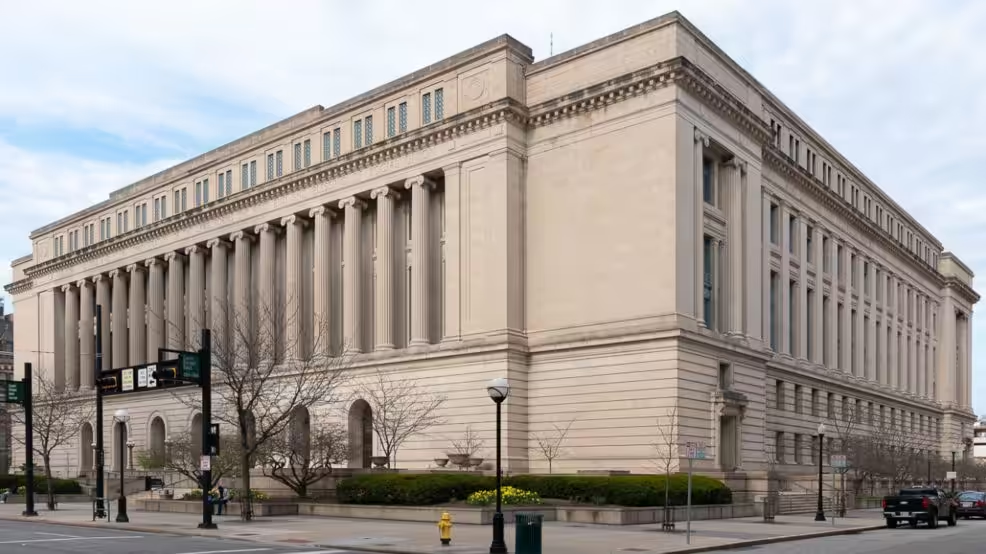
The COVID-19 pandemic crisis has spurred a second suspension of jury trials in Hamilton County, this one “until further notice.”
This applies to to both civil and criminal jury trials. As far as other proceedings (from conferences with the Judge to non-jury trials), it is “hit or miss” and each case and each Judge may have a different schedule. However, our experience is that things are proceeding, if slower than normal.
The State of Ohio has added two programs to further assist small businesses with the unprecedented business interruption associated with the COVID-19 pandemic crisis, (a) $125 million in Small Business Relief Grants and (b) $1.5 billion in refunds to small businesses from the Workers Compensation program. Details on both programs are below
Small Business Relief Grant.
The Small Business Relief Grant (“SBRG”) is designed to provide necessary relief to Ohio businesses that have been negatively impacted by the effects of COVID-19. The State has designated up to one hundred twenty-five million dollars ($125,000,000) of funding received by the State of Ohio from the Federal CARES Act to provide $10,000 grants to small businesses to assist in ensuring the survival and stability of these crucial businesses.
Some of the terms are:
The applicant business is a for-profit entity (corporation, LLC, partnership, joint venture, sole proprietor).
The applicant business is an employer firm with at least 1 and no more than 25 Ohio employees paid via W2 wages as of 1/1/2020, determined either by a headcount or full-time equivalent employee calculation.
NOTE: A headcount calculation should include both part-time and full-time employees. A full-time equivalent calculation equals the total hours compensated for all W2 employees in calendar year 2019 divided by 2,080.
The applicant business has a physical location in Ohio and earns at least 90% of annual revenue from activities based in Ohio.
The applicant business has been in continuous operation since January 1, 2020, except for interruptions required by COVID-19 public health orders, and has the ability to continue operations as a going concern, taking into account a potential program grant.
The applicant business has experienced revenue loss or incurred unplanned costs substantially caused by COVID-19 and a grant is necessary to help it recover from the impact of COVID-19.
The applicant business is in good standing with the Ohio Secretary of State, the Ohio Department of Taxation, and any other governmental entity charged with regulating the business.
If applicable, the applicant business has fully utilized any other government support received (including both grants and loans) by the applicant business for business expenses incurred due to COVID-19 or that can be utilized for business expenses incurred due to COVID-19.
The link for the Ohio Small Business Relief Grant program from the Ohio Development Services Agency is here.
There are also restrictions that may nullify your ability to obtain a grant. Contact Jane Schulte at Finney Law Firm for more information on how we can assist you in navigating the application process.
Workers Compensation refunds.
This is the second refund program this year, this time distributing $1.5 billion in excess funds held by the Ohio Worker’s Compensation program to Ohio employers. BWC started sending checks to up to 200,000 private and public employers in its system in late October after first applying the dividend to any unpaid balances. The dividend follows a similar dividend in April, where the average check size was $8,500.
The refunds are automatically calculated and the checks sent by the BWC. No action on the part of employers is necessary.
Kentucky citizens have the right to know how public agencies, officials, departments and other bodies conduct their affairs. Since passage of the Kentucky Open Records Act in 1976, all public records have been open for inspection by anyone who requests them, unless the record falls under an exemption.
The Open Records Act applies to all public records kept by state and local government entities, including:
State and local government officers, departments and legislative bodies
County and city governing bodies, school district boards, special district boards and municipal corporations
State or local government agencies created by statute or other legislative acts
Bodies that receive at least 25 percent of their funds from state or local authority
An entity where the majority of its governing body is appointed by a public agency
Boards, commissions, committees and other bodies that are established, created and controlled by public agencies
Interagency bodies of two or more public agencies
The full procedure for requesting public records, along with explanations of which records are exempt, is available here.
You must first send your request, in writing, to the official records custodian for the agency. You must describe the records you want to inspect, sign the request, and print your name.
Importantly, the request must seek records, not merely information. A request stating, “How much are the city’s employees paid?” is likely to be denied. The proper way to phrase the request is, “Please provide me with copies of the city’s payroll records for the most recent year.”
Your request may be hand-delivered, mailed or faxed to the agency. Sending your requests by email may be an option, but many agencies are not required to answer them. The state governor requires all executive branch agencies to accept email requests, but non-executive agencies do not have to do so.
The agency must respond to your request, in writing, within three business days. If you send your request to the wrong agency, or if the record you requested is unavailable, the agency is required to notify you. Similarly, if the agency refuses your request, the agency must explain why.
Records will be provided in whatever format they are kept. Agencies are not required to convert paper records to electronic formats.
About Finney Law Firm, LLC
Founded in 2014, FLF has grown to 15 attorneys located in offices in Eastgate and downtown Cincinnati with five major practice areas: Corporate Law, Real Estate Law, Employment Law, Commercial Litigation and Public Interest and Constitutional Litigation. FLF has the unique claim to three 9-0 victories at the United States Supreme Court for its public interest practice along with breakthrough class action work.
FLF also has an affiliated title insurance company, Ivy Pointe Title, LLC, that closes and insures nearly a thousand commercial and residential real estate transactions annually.
For more information about Finney Law Firm, visit finneylawfirm.com.
Media Contact: Mickey McClanahan; mickey@finneylawfirm.isoc.net; 513.797.2850.
The Centers for Disease Control and Prevention on Friday clarified the nationwide eviction moratorium that it had issued on September 4, 2020, lasting through the end of the year. That clarification (“Frequently Asked Questions”) is linked here.
Some important points from the FAQ:
The Order does not prevent owners from commencing eviction proceedings so long as the actual eviction (which we interpret to mean the set out) does not take place until January. As we see it, this means that evictions can proceed to writ, but the set out must wait until January.
As set forth in this blog entry, the protection to a tenant under the eviction moratorium is trigged when the tenant signs a CDC form that certifies all of the following (every adult residing in the unit must sign the form for the moratorium to take effect).
The individual has used best efforts to obtain government assistance for the payment of rent.
The individual falls below the above-income thresholds.
The individual can’t pay rent due to loss of income or medical expenses.
The individual is using best efforts to pay the rent or as much of it as he can.
Eviction would render the individual homeless.
An owner may cross examine (or perhaps conduct discovery as the Court would allow) as to the truthfulness of those certifications. Previously, the rule was ambiguous on this point, leading to inconsistent application throughout the thousands of jurisdictions handling executions in the nation.
Landlord are not required to inform tenants of their rights under the CDC Order.
The clarification reiterates that (a) tenants still owe their rent and (b) tenants have a duty to make partial rent payments as they are able.
The clarification reiterates the criminal penalties for tenants making material misrepresentations on the CDC form.
Friday’s FAQ pronouncement tilts the effect of the moratorium in favor of landlords. Given that the set out in Ohio typically is six-to-eight weeks after the start of the process (the 3-day notice), the real delay in recovering possession of a landlord’s property from a non-paying tenant is now under 30 days.
The scope of the moratorium is limited to situations where the default is solely the non-payment of rent. Our firm has successfully worked with landlords who need to recover possession of their property from hold over tenants, squatters, those causing physical damage to property, those involving illegal use and sale of drugs, too many occupants and other lease violations.
Please call our experienced landlord/tenant litigators if you have questions. Contact Julie Gugino (513.943.5669) for more information.
Many prospective clients of the firm are experiencing actual or threatened utility cutoffs due to income disruption caused by the COVID 19 crisis. Many calls to our office are exploring bankruptcy as an option to address their predicament. This article addresses alternate solutions and whether bankruptcy is a good option for utility disconnections.
Introduction
COVID 19 has had far reaching and unprecedented financial effects on our communities. Due to layoffs, furloughs, and shutdowns, we have seen a showing of togetherness and unity (community concern) as our leaders have come to the aid of those less fortunate and provided financial assistance. We have seen income assistance by way of unemployment payments, PPP, and COVID stimulus payments. In addition, we have seen moratoriums on foreclosures, evictions and utility disconnections. Fortunately, the two former have been extended until the new year. However, many areas are seeing the end of a moratorium on utility shutoffs and an increase in disconnection notices. The purpose of this blog is to make the consumer aware of what options may be available in and out of the bankruptcy arena.
Kentucky Utility Shutoffs
In Kentucky, the moratorium put in place on March 16, 2020 has been lifted as it applies to non-residential customers effective, October 20, 2020. However, the Kentucky Public Service Commission is requiring utility companies to provide payment plans of at least six months to residential consumers who are behind due to COVID-19. For those of you facing arrearages please contact your utility company to set up a payment plan. In addition, these links will connect you with Kentucky Community Action and Kentucky Cabinet for Health and Family Services where you will be directed to further resources.
Ohio Utility Shutoffs
Ohio, however, has lifted the moratorium as to utility disconnections and customers are beginning to receive shutoff notices. This has prompted a spike in phone calls to our office regarding what can be done prevent disruption of utility service. If utility arrearages are your main concern, it makes sense to attempt to remedy the situation outside of bankruptcy first and leave bankruptcy as your last resort. First, contact your utility provider to inquire as to whether they offer a payment plan and what those payments might entail. If the plan provided is not feasible for your budget, consider contacting a local social services agency to determine if you qualify for their assistance programs. These links will connect you to Ohio’s website for Home Energy Assistance Program as well as their list of social service agencies by county.
Conclusion
As we all know, there is a sense of urgency when you receive a disconnection notice for your utilities. If you find that you are not receiving the assistance you need, do not qualify for assistance or have insurmountable additional debt, bankruptcy may be an option. Utility arrearages may be included in bankruptcy as a dischargeable debt. One caveat is that once you file for bankruptcy, you will be required to place a deposit with the utility company to begin a new account. In many cases, this is a small amount to pay in comparison to the mounting utility bills some debtors face.
If you are experiencing financial hardship and would like further information about the bankruptcy process, please contact Susan Cress Browning (513.797.2857) at Finney Law Firm, LLC for a FREE CONSULTATION. I will discuss your financial situation with you to determine what options you have and what is the best direction to take to resolve your debt issues.
We are excited to announce the launch of Finney Law Firm’s new website. We have worked hard to create a modern website that is easy to navigate and fun to use. Our website is optimized to work on your laptop, desktop, tablet, and smartphone. Our new social features make it easy for you to connect with our professionals and share content on all your favorite platforms. Please take a look: www.finneylawfirm.com and let us know what you think.
Responsive Design
One of our primary goals in creating our new site was to make our content accessible to all our clients and visitors. Our new website employs what is called a “responsive design” that dynamically resizes to fit your browser. This means that no matter what device you are using right now, our website will change to give you a great viewing experience.
Clean, Modern Design
We are committed to keeping you up to date on the latest legal and business issues. To reinforce this commitment, our new website delivers rich content in a clean and organized way. We have changed the organizational structure of our Blog and have narrowed down our categories for easier searching. Our website infrastructure has been developed to make this content easily accessible and fast to load.
Partnership with Holland Adhaus
We are thrilled to have found an agency that shares our values and integrity. Their honest and open communication every step of the way has helped us to enhance Finney Law Firm’s presence in Greater Cincinnati and Northern Kentucky. Holland provides a comprehensive suite of marketing services for small businesses and large companies alike. Please visit www.hollandadhaus.com for more information.
When someone who controls a corporation, such as a CEO or director, engages in conduct that a shareholder believes has harmed the corporation in some way, what can the shareholder do about it? In some circumstances, a shareholder may file a derivative lawsuit.
Shareholders are investors in a corporation but they do not have control over business operations. They elect directors who in turn appoint officers and executives to handle management. However, shareholders have a variety of rights, and one of the most important is the right to sue an officer or director who allegedly has harmed the corporation. Such a lawsuit is called a derivative action because the shareholder is stepping into the shoes of the corporation, sticking up for its interests when its own leaders fail to do so.
Shareholder derivative lawsuits allege that a director or officer has engaged in such mismanagement, fraud or some other wrongful act or has failed in discharging their fiduciary duties. The shareholder suit against fast food giant Wendy’s, for example, alleges that directors breached their fiduciary duty by approving inadequate security practices that led to a massive data breach.
The plaintiff must be shareholder when the alleged wrong occurred.
The shareholder must first make a demand on the corporation, insisting that it take the desired action.
If the shareholder doesn’t make a demand, he or she must convince the court that such a demand would be futile.
Assuming a demand is made, the board of directors may, in its business judgement, refuse to act on the demand.
It is then the plaintiff’s burden to explain why the refusal to act on the demand is anything but a valid use of business judgment.
The business judgment element is a critical part of a derivative lawsuit. There is a legal presumption that directors, when making a business decision, do so in good faith, with enough information and with the honest belief that they are acting in the company’s best interest. Kentucky case law holds that “if the requirements of the traditional business judgement rule are met, the board’s decision [to refuse the demand] will be respected by a reviewing court.”
About Finney Law Firm, LLC
Founded in 2014, FLF has grown to 15 attorneys located in offices in Eastgate and downtown Cincinnati with five major practice areas: Corporate Law, Real Estate Law, Employment Law, Commercial Litigation and Public Interest and Constitutional Litigation. FLF has the unique claim to three 9-0 victories at the United States Supreme Court for its public interest practice along with breakthrough class action work.
FLF also has an affiliated title insurance company, Ivy Pointe Title, LLC, that closes and insures nearly a thousand commercial and residential real estate transactions annually.
For more information about Finney Law Firm, visit finneylawfirm.com.
Media Contact: Mickey McClanahan; mickey@finneylawfirm.isoc.net; 513.797.2850.
Tonight, the Centers for Disease Control issued this proposed Order that will prohibit most residential evictions nationwide. The Order is scheduled to take effect on September 4, 2020, this Friday, and last through the end of the year.
Previous rulings by the federal government limiting evictions were limited to projects financed with special HUD loans, which were few and very large projects. In contrast, this ruling applies to almost all residential tenants in all States and US Territories (except American Samoa) with the following exceptions:
Engaging in criminal activity while on the premises;
Threatening the health or safety of other residents;
Damaging or posing an immediate and significant risk of damage to property;
Violating any applicable building code, health ordinance, or similar regulation relating to health and safety; or
Violating any other contractual obligation, other than the timely payment of rent or similar housing-related payment (including non-payment or late payment of fees, penalties, or interest).
The Order also will not apply to residents who earn more than $99,000 individually or $198,000 if filing jointly.
In order to qualify for the protection, the resident must sign a CDC-prescribed form that says:
The individual has used best efforts to obtain government assistance for the payment of rent.
The individual falls below the above-income thresholds.
The individual can’t pay rent due to loss of income or medical expenses.
The individual is using best efforts to pay the rent or as much of it as he can.
Eviction would render the individual homeless.
The Finney Law Firm sees this as a significant shift in the balance between landlords and tenants in fulfilling leasehold obligations through year’s end. It will cause economic hardship for many landlords, and could force many projects into default.
Contact Chris Finney (513-943-6655) for more details and to learn how we can help.
In Part One of our Bankruptcy Basics series, we discussed Ohio Chapter 7 Bankruptcy, which can be read at this link. In Part Two of our series, we discussed Ohio Chapter 13 Bankruptcy which can be read at this link. In Part Three of our series, we discussed Ohio Chapter 11 Bankruptcy which can be read at this link.
In our final blog in the series, we explore a new Bankruptcy solution now available to small businesses called the Small Business Reorganization Act – or Subchapter V to a Chapter 11 Bankruptcy.
Finally, More Favorable Relief for Small Businesses
There have always been economic fluctuations in operating a small business that have necessitated relief under the Bankruptcy Code. However, this has historically proven to be a lengthy and expensive process. Legislators recognized these deterrents to small business debtors getting a fresh start and drafted a new Subchapter to the Bankruptcy Code to improve the process and allow more small business debtors to take advantage of its provisions.
The enactment of these provisions, which pre-date COVID-19, are timelier and more appropriate than the drafters could have ever thought possible. With shutdowns, social distancing, and mask orders, now more than ever, we are seeing small businesses struggle, especially in the restaurant and food service industry.
Small Business Reorganization Act- Subchapter V
The Small Business Reorganization Act became effective February 19, 2020. The purpose of the Act was to streamline the process making it less expensive, and easier and quicker for small businesses to file for Chapter 11 Bankruptcy.
To take advantage of Subchapter V, the debtor must qualify as a small business debtor and must be engaged in commercial or business activities. It is likely that this definition would include the winding up of a business as well as the continuation of business in Chapter 11. This requires that at least 50% of the debtor’s debts come from commercial or business activity.
In addition, there is a debt limit that a debtor must not exceed in Subchapter V which is set at $2,725,625 million. However, the Coronavirus, Aid, Relief, and Economic Security Act (“Cares Act”), effective March 27, 2020, changed this to $7.5 million for one year following the effective date. This amendment will allow even more debtors to take advantage of the new Subchapter V provisions.
Filing
The filing procedure of a Subchapter V case is different from a standard Chapter 11 case. The debtor must make an election upon bankruptcy filing to take advantage of the provisions. Parties in interest may object to the debtor’s election of Subchapter V status.
Once a debtor becomes a Debtor in Possession, controlling the assets and operations of the business, it has powers of a trustee. A Debtor in Possession must provide its most recent balance sheet, statement of operations, cash-flow statement, and federal tax return.
A Debtor in Possession, or senior management, must file a monthly operating report, procure insurance, attend meetings and hearings, and file statements of financial affairs including required schedules.
A disinterested Subchapter V Trustee is appointed to facilitate, provide oversight, and monitor the case. Some of the Trustee’s duties include: Facilitating in the development of a consensual plan; Appearance at status conferences, confirmation, modification hearings, hearings on valuation of secured property and sale of estate property; reviewing and objecting to Proofs of Claim; accounting for property received by the estate; opposing discharge in proper cases; and, filing final reports.
These duties are expanded in a case where the Debtor in Possession is removed due to fraud or misconduct.
Some procedural benefits to Subchapter V are that no creditor committees are formed and no disclosure statements and hearings on disclosure statements are required unless ordered by the court.
The United States Trustee is not paid by the debtor in Subchapter V; rather, the Subchapter V Trustee is paid for services by the debtor as an administrative expense.
Initial Status Conference
The court will hold an initial status conference within 60 days after filing. The debtor, debtor counsel and Subchapter V Trustee must attend, and creditors may elect to attend. The purpose of this conference is to further the expeditious and economical resolution of a case under Subchapter V.
A debtor is required to file a report 14 days ahead of the first status conference, detailing what efforts have been made to procure a consensual plan agreeable to the creditors.
Debtor and Trustee may hire a professional to assist in the case. However, Trustee, debtor attorney and any other professionals must be disinterested.
A distinct change for debtor attorney is that they may be owed up to $10,000 in pre-petition fees without being considered a conflict of interest. However, these fees may only be paid as a general unsecured creditor. If debtor paid the attorney an avoidable preference the attorney is disqualified from representation.
The court will set the confirmation hearing, deadlines for acceptance or rejection of the proposed plan, objections to confirmation and filing Proofs of Claim.
Bankruptcy Plan
A plan of reorganization must be filed by the debtor within 90 days of filing.
Only the debtor may propose a plan. This differs from Chapter 11 where creditors may propose a competing plan after the exclusivity period ends.
There is no disclosure statement or hearing required unless ordered by the court. However, a statement of the history of operations of the business is required in the plan when submitted. In addition, a liquidation analysis, and projections of disposable income available to pay the plan are required to determine its feasibility.
A proposed plan may be a consensual plan if all classes of creditors consent to the plan. This requires that more than 50% of the creditors in each class approve the plan and those creditors represent at least 2/3 of the total dollar amount in the class. A consensual plan must pay administrative and priority claims on the effective date of the plan. If a creditor fails to file a timely ballot it, is deemed to have accepted the plan.
If a consensual plan is not accepted, then the debtor may propose a cramdown plan without approval of any creditors.
The cramdown plan will propose to pay debts to be discharged over a three to five-year period. Long- term debts may be paid over a longer time but will not be discharged. Priority debts and administrative claims may be paid over the three to five-year plan period. Unsecured creditors may receive a percentage of their claim or they may receive nothing.
Secured creditors’ claims can be crammed down to the value of the collateral. The remainder of the claim will become an unsecured claim. However, secured creditors can elect treatment that requires that their claim be paid in full, but they receive no interest.
One of the biggest changes in bankruptcy law is the ability of a debtor to modify a mortgage on their principal residence if the loan was not used to purchase the property and was primarily used for business purposes. In this situation, the loan would be secured only to the extent that the value of the residence supports it. The balance will be deemed a general unsecured claim. This may be particularly relevant in SBA loans that require a lien on personal residence.
The debtor may modify the plan at any time prior to confirmation.
Confirmation
For the court to confirm a plan it must be fair and equitable and must not unfairly discriminate.
A consensual plan requires that all classes must vote in favor of the plan. For a class to accept the plan, more than 50% of creditors in the class and at least 2/3 of the monetary claims in that class must vote to accept.
If any or all classes fail to approve the plan, the debtor may propose a cramdown plan. This plan is funded with projected disposable income despite whether the debtor is an individual or business entity. Projected disposable income is the income a debtor has that is not reasonably necessary for the maintenance and support of debtor and dependents, including payment of domestic support obligations, and that which is necessary for the continued operation of the business. In the case of a business filing, projected disposable income is the income of the business beyond what is necessary for the continuation, preservation, or operation of the business. There is more room for discretion in this analysis based on individual circumstances and businesses than in other bankruptcy chapters.
The projected disposable income is paid for a three-year period or such longer time as the court may determine, not to exceed five years.
Feasibility is determined by the ability of the debtor to make the payments. The debtor must be reasonably certain to make the payments. In addition, there must be set remedies in the event debtor fails to make the required payments.
Creditors can object to confirmation of the plan.
Trustee Duties
In a consensual case, the Subchapter V Trustee is terminated when the plan is substantially consummated. This is generally when property has been transferred and distributions have begun. The debtor will make payments to the creditors.
In a nonconsensual plan, the Trustee will make payments to the creditors, unless the plan provides for the debtor to do so, and the trustee will continue as the trustee in the case.
Post-confirmation Modification
A consensual plan may be modified at any time prior to substantial consummation if creditors do not reject the modified plan and it meets all other confirmation requirements.
A cramdown plan may be modified at any time prior to the last payment made by the debtor if it meets all other confirmation requirements.
Only the debtor may modify the plan.
Discharge
Discharge in a Subchapter V case depends on whether the confirmed plan was consensual or a cramdown plan.
In a consensual plan, discharge will be issued upon confirmation of the plan for both an individual and a business entity. However, if the plan is a liquidation of most or all the debtor’s assets, the business would no longer operate, and the debtor would not be eligible for discharge in a Chapter 7, then a discharge will not be entered.
Discharge will be granted despite whether any creditor filed a Proof of Claim or accepted or rejected the plan. Debts owed to governmental units and certain taxes will not be discharged by an individual or business entity.
Discharge will not be granted to an individual when the debt is for certain taxes, fraud, larceny, breach of fiduciary duty, domestic support obligations, and/or unscheduled claim, just to name a few.
In a cramdown plan, the discharge will be entered as soon as practicable after the three to five-year period. Only the debts scheduled to be paid in the three to five-year commitment period will be discharged. Long term debts will not be discharged.
In a cramdown plan an individual may not discharge claims based on fraud, domestic support obligations, larceny, breach of fiduciary duty, unscheduled claims, certain taxes etc. Due to the language of the statute it is unclear whether a business entity may discharge debts of this type.
Default
Remedies for default will be spelled out in the confirmed plan. In a consensual plan, the creditors have agreed and possibly negotiated for default terms. In a cramdown plan, the court and Subchapter V Trustee determine whether the default language is acceptable.
Default provisions could include sale of non-exempt property, conversion to Chapter 7 if assets are available for liquidation, dismissal if conversion would add no value to the estate, and debtor may be removed as Debtor in Possession, and/or relief from stay may be granted for pursuit against secured property.
When plan is consensual, dismissal results in the confirmed plan replacing old obligations and creditors must pursue their rights under those new terms.
In a cramdown plan where dismissal occurs, creditors and debtors return to their pre-bankruptcy status including costs and fees accumulated during the pendency of the bankruptcy.
Conclusion
With these distinctions made between the new Small Business Reorganization Act Subchapter V and other bankruptcy options it is hopeful that this Act will be a new tool in the small business debtor’s arsenal to navigate the bankruptcy process and alleviate debt concerns.
In reading the above, you will note that this process can be quite complex. This article is written to outline those complexities and to give contrast to the other types of bankruptcy relief in the other three parts of the blog.
If you are struggling financially, please contact me so I can explain solutions available to you in a FREE Consultation. Susan Browning, Finney Law Firm, (513) 943-6650, or email at susan@dev.finneylawfirm.com
Recognition by Best Lawyers is based entirely on peer review. Our methodology is designed to capture, as accurately as possible, the consensus opinion of leading lawyers about the professional abilities of their colleagues within the same geographical area and legal practice area.
Best Lawyers employs a sophisticated, conscientious, rational, and transparent survey process designed to elicit meaningful and substantive evaluations of the quality of legal services. Our belief has always been that the quality of a peer review survey is directly related to the quality of the voters.
ABOUT FINNEY LAW FIRM
In 2014, led by Christopher P. Finney, seven bright, hard-working attorneys and a dedicated and talented staff, came together to form Finney Law Firm. Our team is committed to a unique practice of law that makes a positive difference for our clients by focusing on defining and then arriving at the best outcome for them. Finney Law Firm’s practice has extensive experience in the broad range of legal services that individuals and businesses may need:
Business formation and development
Residential and Commercial Real estate
Estate planning and administration
Commercial dispute resolution
Public interest law
Labor and employment law
Small Business Solutions Group
Bankruptcy
Personal Injury and Wrongful Death
Water Law
Affiliated Title Company – Ivy Pointe Title, LLC
We work relentlessly to add value for our clients by applying cutting edge legal strategies and utilizing highly productive technology. This approach allows us to keep pace with the changing demands of our clients’ own challenging personal and business environments. ~ Christopher P. Finney