


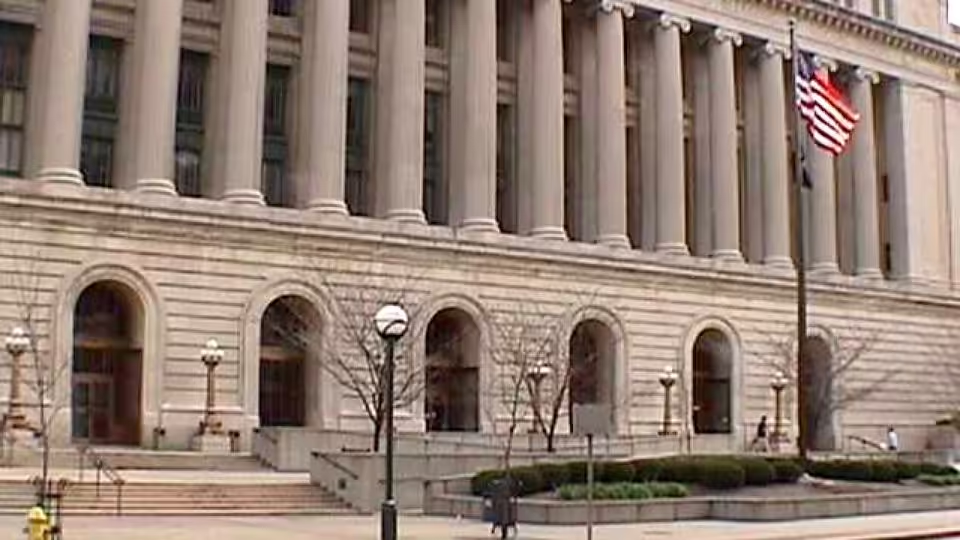
Hamilton County Court House

The COVID-19 crisis has created a series of delays in civil and criminal cases.  One of those casualties has been residential evictions in Hamilton County.

The problem

No evictions hearings have been held since March 15, and the earliest they are scheduling new hearings at present is July 28. This means not only that landlords can’t clear their properties of tenants who won’t pay rent, but also that tenants who deal drugs, damage property — or even worse criminal behavior — can stay in possession now for more than five months before the landlord can have a hearing to restore possession of the property to him.

Suing the Judges

Finney Law Firm has initiated a relatively unused action — for a Writ of Procedendo — to force the Hamilton County Municipal Court Judges to proceed with forcible entry and detainer actions. The Complaint, captioned State Ex rel. Salvador Properties v. Judge Heather Russell is here.

Other counties

Below is what our research has shown other counties currently are doing (note “per normal” noted below means you can timely get a decision in an eviction case; there may be modified procedures and hours to accommodate the crisis):

  • Butler County: Holding hearings per normal;
  • Warren County: Holding hearings per normal;
  • Clermont County: Holding hearings per normal;
  • Franklin County (Columbus): Holding hearings per normal;
  • Montgomery County (Dayton): Holding hearings per normal;
  • Summit County (Akron and all Municipal Courts): Holding hearings per normal;
  • Lucas County (Toledo): Holding hearings per normal;
  • Mahoning County (Youngstown): No hearings being scheduled; and
  • Cuyahoga County (Cleveland and all Municipal Courts): Cleveland and Cleveland Heights are holding hearings after 6/15/20 and 6/17/20, respectively, and other Municipal Courts (Shaker Heights and Berea) are holding hearings per normal.

So, of surrounding counties and Ohio’s major urban counties, only Mahoning (Youngstown) and two of four Municipal Courts in Cuyahoga County are further delaying eviction hearings for COVID-19 issues. Other than Youngstown with no hearings being scheduled at all, Hamilton County presently is the worst in the State for scheduling eviction hearings.

Conclusion

This suit is one in a series of actions initiated by Finney Law Firm to re-open Ohio business and Courts that have been closed under the COVID-19 crisis. For more information, contact Chris Finney (513.943.6655).




Jane Schulte, Small Business Solutions Group


We all know that body language sometimes speaks more clearly about what we are thinking than our actual words.  We know that crossing our arms while speaking (or listening) communicates that we may be closed off; rolling our eyes makes a statement that we don’t agree with what is being said; looking away may mean we are distracted or bored; and, avoiding eye contact when speaking may mean that we are not being forthright.

But there is also email body language which is the message you are conveying with the written word that may tell the recipient things about you or what you are thinking that you do not intend.

When dealing with people, remember you are not dealing with creatures of logic, but creatures of emotion. ~Dale Carnegie

Have you ever been the recipient of an email that leaves you scratching your head as to the intention behind the words? A lack of response which feels like you are being intentionally ignored? Or an email that was very short which felt as if the sender was being curt? We all have, and in defense of the sender, 99% of the time, they are well meaning and there are other reasons are behind the communication. Rushed for time, lack of proofreading or not responding because they do not have an answer (yet).

For Example

You receive an email from a client asking you a question to which you do not know the answer.  You forward the email to someone else in your office who does have the answer and assume they will get back to you within a reasonable time.  Meanwhile, the client waits for your response.  Your colleague gets busy and does not get back to you until a week later and you then answer your client.

What is the client left with?  The sense that you do not find them important or that you are too busy to handle their inquiry.  In other words, they picture you with your arms folded or visualize you as stressed out with no time to handle the details.  But that was not your intention at all!

How do we avoid this?  When someone emails you with a question you cannot answer, reply immediately that you will need some time to obtain the answer which tells them 1) you received their email; and 2) you are on it! Blind copy yourself and then drag and drop the email into your Outlook ™ tasks or calendar for the next day so you can follow up in a timely manner.

Diligent follow up and follow through will set you apart from the crowd and communicates excellence. ~John Maxwell

Draft like you are writing a letter

Draft as the author and proofread as the recipient. An email should be drafted like a letter in that it should have a greeting and closing (i.e. Good morning/afternoon with the person’s name and a thank you or have a good day at the end).  The body of your email should convey your message concisely so that no two minds can differ on what is being said or asked.  If you draft the email with the reader in mind, you can avoid multiple clarifying exchanges, saving time and of course, showing your attention to detail and professionalism.

The worst distance between two people is misunderstanding. ~Anonymous

Also, it is a good idea to:

  • Insert a meaningful subject line so the recipient knows the nature of your email
  • Proofread and do not rely on spell check
  • Attach the attachment before you draft the email, so you do not forget at the end
  • Insert the recipient’s email address at the end to avoid accidently sending the email before it is complete

At the end of the day, we are all human

Your email body language may leave someone wondering if you are a kind and caring person ready to assist them or an unfriendly and burdened individual that they are bothering.  Since we are all human beings dealing with other human beings, kindness always wins the day.  The more words you can use in your email that reflect kindness and clear information, will not only put you in a favorable light, but also make people feel welcome and that they made the right choice by doing business with you.

Take a few extra minutes to put warm touches on your email to brighten someone else’s day.  When you have clear, positive, and warm engagements in email, others will remember that and may even adopt some of your style so they can pass it on.

Use self-awareness, along with a critical inward lens, when drafting emails. Effective communication is at the heart of every good relationship both inside and outside of your business.

To learn more about effective communication and other Work Smart tools, contact Jane Schulte, 513.797.2855.


  • posted: May 26, 2020
  • Todd McMurtry
  • Taxation

The traditional tax day of April 15 has passed and millions of Americans are taking advantage of the three-month reprieve given by the federal government and many states in response to the COVID-19 pandemic. Depending on your individual circumstances, you might be looking to file as quickly as possible in order to collect your refund. On the other hand, problems accessing information or scheduling meetings with an accountant or tax preparer could push your submission closer to the revised deadline.

For filers and businesses alike, this is a necessary and welcome change, as many do not have access to their records and cannot get them while various parts of the country are in a lockdown. With the extension, you should have enough time to gather your records and pay — without penalty — at the later date. If you haven’t filed yet, you should know:

  • Federal filing and payment deadlines are extended — Initially, it appeared that the deadline for filing would not be extended, but the deadline for payment would be. However, subsequent events, the potential for confusion and the overwhelming effect of the pandemic led the federal government to push the deadline for both out to mid-July. Just as we cannot foresee how long the deadly COVID-19 threat will last, we cannot be sure if further extensions or adjustments will be made.
  • States are taking various approaches — Many states have also extended their tax filing and payment deadlines. Some have followed the IRS by moving the date to July 15. Others have closer deadlines, while some states aren’t offering relief. It is important for you to learn what the standard is in your state, so you should refer to an official website or reliable professional if you have questions.
  • Refunds are available — Some confusion might have been caused by the Coronavirus Aid, Relief, and Economic Security (CARES) Act. The process for sending stimulus checks authorized by that law used income and bank account information from tax filings to determine eligibility and transfer funds. If your income rises above a certain level, you are not eligible for those payments, but standard tax refunds are being paid promptly regardless of your income or the amount you expect to receive.

Even in the first two months since the coronavirus started causing widespread harm, numerous changes have affected personal and business taxation. For example, there is a recently announced paid sick leave tax credit which many businesses are likely to avail themselves of during this pandemic. Though no one can be sure what’s coming, a knowledgeable taxation attorney can keep you abreast of key developments.

About Finney Law Firm, LLC

Founded in 2014, FLF has grown to 15 attorneys located in offices in Eastgate and downtown Cincinnati with five major practice areas: Corporate Law, Real Estate Law, Employment Law, Commercial Litigation and Public Interest and Constitutional Litigation.  FLF has the unique claim to three 9-0 victories at the United States Supreme Court for its public interest practice along with breakthrough class action work.

FLF also has an affiliated title insurance company, Ivy Pointe Title, LLC, that closes and insures nearly a thousand commercial and residential real estate transactions annually.

For more information about Finney Law Firm, visit finneylawfirm.com.

Media Contact: Mickey McClanahan; mickey@finneylawfirm.isoc.net; 513.797.2850.


Attorney Susan Cress Browning

The Coronavirus Aid Relief and Economic Security Act (CARES Act) was enacted on March 27, 2020 in response to the dramatic impact COVID-19 has had on the economy.  In particular, there are several provisions that provide relief for current and future consumer and business bankruptcy debtors.

Stimulus payments are not “income”

The first of these provisions provides that economic impact payments provided to debtors from the government due to COVID-19 is not to be considered income for the purposes of calculating current monthly income or for calculating disposable monthly income for a chapter 13.  These funds will not cause you to be disqualified from Chapter 7 or increase your payback in a Chapter 13.  The practical reason for this is that these are funds that will not be received on a regular basis and therefore should not be considered as regular income for the debtor.

Chapter 13 plans may be modified to extended

Additionally, if you are in a Chapter 13 case that was confirmed prior to enactment of the CARES Act, you may file a motion to modify your bankruptcy plan to extend your plan up to seven years from the date of confirmation.  The debtor must be able to show a “material financial hardship” due to the COVID-19 crisis.  The concern with this provision is, what aid is available for the debtor who has filed but has yet to have their case confirmed?  They are certainly not immune from the financial crisis that has befallen our community.   It is possible that lawmakers will take up this issue, recognizing this limitation will impact many chapter 13 debtors.

New Small Business Reorganization Act

For those businesses who have struggled during this crisis, the CARES Act sought to boost the benefits afforded by the recently enacted Small Business Reorganization Act (SBRA).  The Act increases the debt limits created by the SBRA from $2.725 million to $7.5 million.  This will be a significant boon to those businesses that were previously unable to benefit from the SBRA provisions and have now been affected by the COVID-19 downturn in the economy.

The benefits of the CARES Act will only be available, per the Sunset provision of the Cares Act, for one year from enactment.  The concern is that this pandemic will have lasting effects that extend well beyond this timeframe and one year will not be long enough to provide a meaningful benefit to bankruptcy debtors.

Health and Economic Recovery Omnibus Emergency Solutions Act

In further efforts to restore our nation’s economic balance, the House passed legislation called the HEROES Act (Health and Economic Recovery Omnibus Emergency Solutions Act).  The goal of this law is to prevent discrimination against bankruptcy debtors who request hardship assistance from creditors, increase debt limits for Chapter 13, and allow debtors additional time to catch up mortgage arrearages in Chapter 13.  This legislation is expected to stall in the Senate.

Conclusion

We will update this once new information becomes available.

Call Finney Law Firm to set a convenient consultation with Susan Browning, 513-797.2857. We now also offer telephone and virtual FREE CONSULTATIONS.


Attorney Christopher P. Finney

Finney Law Firm is proud to announce that Christopher P. Finney has recently become AV Preeminent Rated by Martindale-Hubbell. Martindale-Hubbell’s AV rating is the highest level of professional excellence at which a lawyer can be ranked in ability and ethics, and we are thrilled that Chris has achieved this honor.

The Martindale-Hubbell Peer Review Ratings System is based on the confidential opinions of members of the Bar and the judiciary. Martindale-Hubbell representatives conduct personal interviews with other members of the Bar to discuss lawyers under review. A consensus from fifteen judges and practicing attorneys is necessary to produce a rating. In addition, confidential questionnaires are sent to lawyers and judges in the same geographic location and/or area of practice as the lawyer being rated. Members of the Bar are instructed to assess their colleague’s legal ability and general ethical standards. Lawyers’ ratings serve as an objective indicator of a firm’s ethical standards and professional ability.

I am pleased to have reached this gold standard by this distinguished organization who has recognized lawyers for their high ethical standards and legal abilities for over a century. In an environmental where the market for legal services is highly competitive, the AV Preeminent Rating is a vital tool for prospective clients to evaluate a lawyer before engaging them for legal services.

~Chris Finney

The law firm itself received this rating back in March which provides the assurance that those needing legal services in the areas of Commercial and Residential Real Estate, Corporate Transactional, Business & Commercial Litigation, Labor & Employment Law, Small Business Solutions, Estate Planning & Administration, Public Interest Law, Bankruptcy, Personal Injury and Property Tax Valuation will receive a superior level of professional experience.

You can reach Chris Finney at 513.943.6655.

Finney Law Firm, attorney Curt C. Hartman and the 1851 Center for Constitutional Law won a great victory for Ohio citizens today when Judge Eugene Lucci of Lake County Common Pleas Court ruled unconstitutional the broad rule-making by Governor Mike DeWine and Dr. Amy Acton (Director of Ohio Department of Health) that has shut down Ohio businesses and locked people in their own homes.

The specific ruling today addressed re-opening Ohio gyms and fitness facilities, but the reasoning in the decision broadly finds all of Dr. Acton’s orders are unconstitutional. Read about that here.

Here is a wrap of today’s media coverage of this landmark decision:

I want to recognize the outstanding legal strategizing and implementation of Maurice Thompson of the 1851 Center for Constitutional Law, Curt Hartman, and Julie Gugino and Rebecca L. Simpson of this firm in this case. They did simply outstanding work on a series of cases holding Dr. Acton’s feet to the fire as to her authority (or lack thereof) to shut down businesses and incarcerate residents throughout Ohio during the COVID-19 crisis.

These attorneys have caught the vision of the Finney Law Firm to use our law licenses to “Make a Difference” for our clients and community with our legal work.

Attorney Matthew S. Okiishi

Today, Finney Law Firm attorney Matt Okiishi participated in a panel discussion for the public sponsored by the Cincinnati Bar Association on employment law issues presented by the COVID-19 crisis.

That discussion is now on line. You may watch it here.

Matt Okiishi devotes his practice to the employment law arena, representing both employers and employees in disputes, which include wage and hour issues, Family and Medical Leave Act issues, and illegal discrimination based upon age, race, gender, handicap, national origin, and other protected classifications. He has written extensively on COVID-19-related employment legislation on this blog.

Please contact Matt (513.943-6659) for help with your employment law issues.


Attorney Rebecca L. Simpson

If you are one of the many small businesses that received a Paycheck Protection Program (PPP) loan, you’ve likely been wrestling with questions about how to make sure your loan is forgiven.  We blogged several days ago about the unanswered questions on forgiveness and the need for guidance from the SBA.

The SBA has now provided additional guidance on PPP forgiveness in its Loan Forgiveness Application, which you can find by clicking here.  You will submit this Application (or an online version of it) to your bank, or the holder of  your loan, to apply for PPP forgiveness.

The Application and its instructions provide significant clarification on what is required for forgiveness and what documents and certifications you will need to provide to your bank.  Here are some of the highlights:

In general, how is forgiveness calculated?

In general, forgiveness is calculated by adding your qualifying payroll costs to your qualifying non-payroll costs, and reducing that amount by “FTE” and “Salary/Hourly Wage Reductions” (if you did not maintain or restore levels of compensation and employment as required).  Once you do that calculation, if you spent at least 75% of your PPP loan on qualifying payroll costs, the total you spent on qualifying payroll costs and qualifying non-payroll costs (up to the total amount of your loan) can be forgiven. (Then, obviously, if you spent more than 75% of the loan amount on qualifying payroll costs, the loan will also be 100% forgiven.)

What are the major changes to PPP loan forgiveness guidance? 

The Application and its instructions provide significant new guidance on PPP loan forgiveness which changes and expands previous guidance. Here are some of the major changes:

  • Period you look at for forgiveness: Previously the SBA had issued guidance that PPP funds were to be spent and forgiveness was to be measured during the 8 weeks following the distribution of the funds to the borrower.  This is defined as the “Covered Period.”  The Application allows for a “Alternative Covered Period” for some purposes for borrowers with a biweekly, or more frequent, payroll schedule.  The Alternative Covered Period begins on the first day of the borrower’s first pay period following their PPP loan disbursement date.   If you are eligible for and choose to use the Alternative Covered Period, make sure you read the instructions closely as you fill out the Application, required PPP Schedule A to the Application, and the Schedule A worksheet.  Even if you choose the Alternative period, some calculations still require you to use the Covered Period.
  • When payroll is measured: The Application clarifies that qualifying payroll costs include those paid as well as those incurred during the 8-week Covered Period or the Alternative Covered Period.  So, for example, if you incur payroll costs prior to the end of the 8-week period, but those incurred amounts are not paid until your normal payroll date after the 8-week period, they still count in the forgiveness calculation.  The Application makes clear, however, that payroll costs incurred and paid in the 8 weeks can only be counted once.
  • Expansion of qualifying non-payroll costs: The Application confirms that only 25% of PPP funds can be used for qualifying non-payroll costs, and that those qualifying costs include mortgage interest, rent, and utilities.  The Application, however, expands the definitions of mortgage interest and rent to include not only interest and rent on real estate mortgages and leases, but also to “mortgage” interest and rent or lease payments on personal property.  Covered non-payroll costs count in the calculation of forgiveness if they are paid or incurred during the Covered Period (the Alternative Covered Period is not applicable to the calculation of qualifying non-payroll costs), and are on obligations that were in place prior to February 15, 2020.
  • Calculation of reduction of loan forgiveness if employee and/or compensation levels are not maintained as required: The Application provides tables to complete and detailed instructions on how to calculate the reduction in your loan forgiveness if, in general, you do not maintain your full time employee level or you decrease salaries and wages by more than 25% for any employee that made less than $100,000 annualized in 2019.  These calculations require you to analyze levels on an employee by employee basis during certain defined time periods and then compare those periods. The Application also confirms safe harbors for those who restore their employees and salary levels by June 30, 2020.

Conclusion

Although the Application and its instructions provide a great deal of guidance on PPP loan forgiveness, more guidance is still needed.  We anticipate that the SBA will, over the next several days and possibly weeks, issue further guidance. Finney Law Firm will stay on top of the latest and will update you though this blog.  And, if you have questions or need guidance on the Application or on the PPP in general, please contact Rebecca L. Simpson at 513.797.2856.