

So, you’ve bought the building. You have the vision. It is all becoming a reality.

Maybe it’s an old barn you want to turn into a wedding venue. Maybe it’s an abandoned industrial building you plan to convert into high end apartments. Maybe it’s a warehouse you envision as a gym, or a brewery, or a creative space. You see endless potential where other people see problems, and you are ready to bring new life to a property that’s been sitting idle.

The purchase is complete. The keys are in your hand.

Now what?

This is the point where many (if not most) redevelopment projects begin to stall. This stall is not because the idea is bad, but because the process that follows is far more complex than most people expect.

It Starts with Your Idea

Your vision for what your project could be is only the beginning. Redeveloping or revitalizing a building involves layers and layers of legal and regulatory requirements that happen behind the scenes, and the average person does not see. Zoning rules, permits, inspections, and occupancy approvals are not simple technicalities, they are what determine whether your project can legally move forward at all.

One of the biggest challenges is that these rules are not uniform. Every city, town, and municipality has its own zoning code, permitting process, and inspection requirements. What worked in one location (or what a prior owner may have done or told you worked for them) does not guarantee that your project will be approved.

Zoning Matters Most

Zoning should always be your first step. Zoning determines what uses are allowed in a given area. Commercial, residential, industrial, mixed-use. These are the general classifications that dictate whether your idea is ever permitted on paper. But zoning is not just about the neighborhood. It is also about the building itself.

A property may be in a mixed-use or commercial district, yet the building may only be approved for a specific use. Changing a building from storage units to an event space, from industrial use to gym, or from commercial to HUD apartments often requires formal approval. That process may involve variances, conditional use permits, or hearings before a zoning board. In many cases, that approval comes through a Board of Zoning Appeals, which is often called a BZA.

A BZA process typically involves a formal application, public notice and a hearing where the proposed use is reviewed by the Board of Zoning Appeals. Neighbors in the community may have the opportunity to comments, however, the board is the one that ultimately gets to decide it the variance or the conditional use will be granted. This process can be long and daunting and can affect the timeline of your project, the budget of your project, and even the feasibility of your project. It needs to be considered early, before construction begins.

Skipping a review of zoning or assuming that zoning approval exists can lead to significant delays and expensive corrections later on, particularly if a project moves forward with necessary zoning authorization.

Don’t Overlook Historic District Restrictions

Another issue that often surprises owners is historic zoning.

If a building is located in a historic district or subject to historic preservation rules, additional layers of approval may apply. Changes to the exterior of the building, the windows, doors, signage, building materials, and even paint colors can be regulated. In some cases, interior alterations may also be restricted.

Historic designation does not mean redevelopment is impossible, but it does mean the process requires careful planning and early coordination sometimes even requiring coordination with the historic conservation board of the city or community you are redeveloping in. Discovering these restrictions after plans are finalized (or after work has begun) can significantly increase costs and timelines.

You Need Permits for More Than You Think

Once zoning is confirmed and any required approvals are obtained, the next step is permitting. Permits are often where redevelopment projects quietly fall apart.

Many property owners assume permits are only required for major construction or structural changes; however, permits are required for far more than most people expect. Generally, permits are required for all new construction, major repairs, alterations to a building, additions to a building, major plumbing or electrical changes, HVAC systems, fire alarms, fire suppression systems, and structural modification. The permit process is put in place to allow inspectors to verify that work meets safety and building code standards.

Permitting also matters because it ties directly into a building’s approved use. When a building is being converted from one use to another permits help document that transition and ensure that building systems meet the standards require for the new system. When a building changes from commercial use to residential use the fire, electrical and safety requirements generally change.

Failure to obtain proper permits can lead to enforcement actions, fines, and delays. Importantly, it can prevent your building from receiving a Certificate of Occupancy. Without that certificate, your building cannot legally be occupied, even if the work is complete.

Permits are critical when cities conduct inspections or respond to complaints made about your building. If an inspector identifies work that was done without a permit it generally will make the issue much bigger than it could have been. What might have started as a limited inspection can turn into a comprehensive review of the building, increasing both your cost and risk.

Doing work without permits often feels faster at the outset, but it frequently creates larger problems down the road. Unpermitted work can delay inspections, trigger enforcement actions, or prevent a building from being legally occupied.

Inspections and Compliance

After permitted work is completed, inspections follow. Building, housing, and fire inspectors are responsible for ensuring compliance with applicable codes, safety standards and approved plans. Their role is not to manage a project, but to confirm that the building is safe and compliant.

When inspectors identify violations or noncompliant conditions, they typically expect the property owners or property managers to evaluate the building as a whole and correct similar issues wherever they exist. An inspector notes problems in one location, but that is often an indicator of a broader compliance concern, not a single, contained defect.

Treating inspections as a checklist of individual fixes can lead to repeated citations, additional inspections, and increased enforcement. Taking a comprehensive approach by understanding the code requirements and applying the consistently throughout the building, helps projects move forward more efficiently and reduces the risk of ongoing compliance issues.

The Certificate of Occupancy

All  of these steps lead to one essential requirement: the Certificate of Occupancy. A Certificate of Occupancy is the City’s confirmation that a building is legally approved for its intended use and safe for people to occupy. Even if the renovations are complete, the building looks exactly like it is supposed to, and everything it perfect, the building cannot be lived in, operated out of or opened to the public without a Certificate of Occupancy.

To obtain a Certificate of Occupancy, the City will typically require that zoning is correct for the intended use, all required permits have been properly obtained, and all necessary inspections have been passed. If any of those steps were skipped or handled out of order, the Certificate of Occupancy can be delayed or denied. If any of those steps were skipped or completed out of order, securing a Certificate of Occupancy becomes significantly more difficult.

Common Mistakes We See

We regularly see property owners run into trouble because they assume that if a building can be used a certain way, it must be allowed to be used that way. Relying on what similar buildings nearby are doing or what a prior owner did is a common, and costly, mistake.

Another frequent issue is failing to distinguish between the zoning of the area and the approved use of the building itself. Even in mixed-use districts, a building may not be approved for residential or event use without additional approval.

Unpermitted construction is another major problem. Electrical, plumbing, HVAC, and fire systems are often modified without permits, creating issues when inspections occur.

Historic district restrictions are also frequently overlooked, particularly when owners are eager to move quickly. Discovering those requirements late in the process can derail an otherwise well-planned project.

Perhaps the most challenging situations arise when tenants or businesses are already occupying a building before zoning, permitting, and occupancy approvals are in place. At that point, the process has to be done in reverse, often under the pressure of inspections or enforcement action.

Working Backwards Is Always Harder

Our firm regularly helps clients navigate zoning, permitting, inspections, and Certificates of Occupancy. We can assist in coordinating with local authorities, identifying compliance issues, and helping projects move forward.

However, it is important to be candid: it is far easier, and far less expensive, to do this correctly from the beginning. When zoning and approvals are addressed early, projects tend to move more efficiently and with far less risk. When issues must be fixed after the fact, especially when a building is already occupied, the process becomes more complicated, more time-consuming, and significantly more expensive.

Redeveloping a building can be an exciting and rewarding investment. However, it can also be a legal and regulatory disaster if the proper steps are skipped or misunderstood.

Before you renovate, lease, or open your doors, make sure you understand what approvals are required, what restrictions apply, and what order the process should follow. Doing it right from the start is almost always the most efficient path forward, and it can save you time, money, and stress in the long run.


 

We issued this press release today on this important development for Finney Law Firm: 

FOR IMMEDIATE RELEASE

Christopher P. Finney, Esq.

513-943-6655

Chris@FinneyLawFirm.com

Finney Law Firm, LLC and Hemmer Wessels McMurtry PLLC announce combination under the Finney Law Firm banner

 ~ Combined firm creates strong Cincinnati-area commercial law firm on both sides of the Ohio River ~

[Cincinnati, Ohio, December 2025] – The law firms of Hemmer Wessels McMurtry PLLC (HWM) and Finney Law Firm, LLC (FLF) have agreed to combine, with an effective date of January 1, 2026.

The new firm will retain the name Finney Law Firm, LLC and will expand on the success of both firms with a more powerful Cincinnati-area presence: 21 attorneys focusing on commercial transactions and litigation, with particular strengths in Real Estate, Employment Law, Defamation Law, and Constitutional Litigation.

The announcement follows agreement by both firms to meld their mature and accomplished practices with a now-broader geographic footprint. The firm is uniquely positioned to serve corporate and individual clients from innovative startups to established and successful businesses of all sizes.

Christopher Finney will serve as President of the firm, while Carlo Wessels and Todd McMurtry of HWM and Stephen Imm, Bradley Gibson, and Isaac Heintz of FLF will be named partners. The firm will also welcome Donald Hemmer as an Of Counsel Attorney and Scott Thomas as Senior Counsel.

“This combination is a momentous step for both firms, bringing together top-notch commercial and real estate transactional attorneys, with nationally recognized litigators in Employment Law, Defamation Law and Constitutional Law,” said Christopher Finney.  “HWM’s attorneys share our commitment to ‘making a difference’ for our clients and our communities, with a focus on delivering creative legal services with determination.  This, combined with our respectful culture, where each employee is empowered to reach their professional potential and personal goals, exemplifies the focus of our firm.”

Carlo Wessels added, “The combination of the two firms advances the historic mission of the members of Hemmer Wessels and McMurtry to deliver quality, reliable and breakthrough legal services for our clients on both sides of the river.  With the newly expanded firm, clients will gain access to a broader array of many of Cincinnati’s best attorneys bringing to the table enthusiasm for the law, each with deep experience and accomplishment.”

The combination will take effect on January 1, 2026, with client services and legal operations integrated immediately. A broader brand integration, including visual branding, website updates, and expanded public communications, will roll out in phases with a formal rebrand and full public launch planned for March 2026.

The combined firm will keep each of its three offices: Eastgate, Downtown Cincinnati, and Ft. Mitchell.

About Hemmer Wessels and McMurtry PLLC
Headquartered in Ft. Mitchell, KY, with a strong presence on both sides of the Ohio River, HWM has historically maintained a formidable transactional practice anchored by Donald Hemmer and Carlo Wessels.  Todd McMurtry has complemented that corporate practice with his superior litigation team that has become, among other accomplishments, nationally preeminent in Defamation Law.  Todd McMurtry also currently serves as president of the Kentucky Bar Association.  HWM will onboard eight attorneys to the combined firm.

About Finney Law Firm, LLC

Founded in 2014, FLF has grown to 15 attorneys located in offices in Eastgate and downtown Cincinnati with five major practice areas: Corporate Law, Real Estate Law, Employment Law, Commercial Litigation and Public Interest and Constitutional Litigation.  FLF has the unique claim to three 9-0 victories at the United States Supreme Court for its public interest practice along with breakthrough class action work.

FLF also has an affiliated title insurance company, Ivy Pointe Title, LLC, that closes and insures nearly a thousand commercial and residential real estate transactions annually.

For more information about Finney Law Firm, visit finneylawfirm.com.

Media Contact: Mickey McClanahan; mickey@dev.finneylawfirm.com; 513.797.2850.

Social media platforms and podcasts give individuals the chance to reach a broad audience without having to go through a traditional media outlet. This can be empowering for someone who cannot convince a newspaper, broadcast station or book publisher that their message is worthwhile. On the other hand, without a structure in place to filter out potentially defamatory content, speakers risk serious legal problems if they make a false statement about someone else.

Even municipal officials can face libel suits. The mayor of a small Laurel County town is now the defendant in two separate legal actions stemming from comments he made on a podcast. According to two former Kentucky state troopers, London Mayor Randall Weddle made false and damaging statements about them. Elijah Jarvis has also sued Weddle based on material from a True CrimeCast episode. 

Brothers James and John Phelps say that Weddle accused them of sexual misconduct and other serious crimes, including murder. Their legal action alleges that these false statements have harmed their career prospects and reputations within their community. 

Defamation claims in Kentucky generally require a plaintiff to demonstrate the following four things:

  • False, defamatory statement — Should the case go to court, the trier of fact will evaluate the truth of Weddle’s comments. In some cases, defamation plaintiffs must show how the statements at issue harmed them. However, baseless accusations of criminal activity and sexual misconduct are known as defamation per se, meaning that we can assume that they would damage plaintiffs’ reputations.
  • Publication to a third party — Speaking a damaging falsehood to a third party is slander, while wider publication, such as through a podcast, constitutes libel. According to news reports, the True CrimeCast has more than 1,000 YouTube subscribers. 
  • Fault, amounting to at least negligence — In cases involving public figures, actual malice on the defendant’s part is required. This means that the speaker knew what they said was a lie or acted in reckless disregard of the truth. When the plaintiff is not a public figure, liability only requires negligence on the defendant’s part.
  • Damages — There are several ways to show damages stemming from defamation, including harm to career opportunities and symptoms of emotional distress. Even unproven allegations of criminal and sexual misconduct could change someone’s life measurably. 

Whether it’s on a podcast or anywhere else, false statements about you should not go unchecked. Hemmer Wessels McMurtry PLLC in Fort Mitchell handles libel and slander actions so that those who defame others are held to account. To speak with an experienced Kentucky lawyer, please call 859-344-1188 or contact us online

About Finney Law Firm, LLC

Founded in 2014, FLF has grown to 15 attorneys located in offices in Eastgate and downtown Cincinnati with five major practice areas: Corporate Law, Real Estate Law, Employment Law, Commercial Litigation and Public Interest and Constitutional Litigation.  FLF has the unique claim to three 9-0 victories at the United States Supreme Court for its public interest practice along with breakthrough class action work.

FLF also has an affiliated title insurance company, Ivy Pointe Title, LLC, that closes and insures nearly a thousand commercial and residential real estate transactions annually.

For more information about Finney Law Firm, visit finneylawfirm.com.

Media Contact: Mickey McClanahan; mickey@finneylawfirm.isoc.net; 513.797.2850.


There is a great deal of discussion about the rights of employees with respect to their employers. Most of us are familiar with the laws that protect employees from things like discrimination, harassment, retaliation, not being paid overtime or minimum wage, unsafe working conditions, etc.

We hear a lot less about what employers have the right to expect from their employees. One important duty that employees do owe to their employers is what is called the “duty of loyalty,” or what in the old days was called the “faithless servant” doctrine.

This is not a duty that it is imposed by a statute passed by the legislature. It is rather what we call a “common law” duty. It is not necessary for the employer to state this in a contract or otherwise. It is an implied duty that exists in all employment relationships in the state of Ohio. If you are an employee, you owe this duty of loyalty to your employer.

What this means as a practical matter is that and employer may have a right to sue a former employee if the employee does something, during the course of his or her employment, that is directly contrary to the employer’s best interests, or that deliberately causes harm to the employer.

The duty of loyalty ends when the employment ends. The employee no longer owes such a duty after resigning or being terminated. But while the employment lasts, the employee must act honestly and in good faith in matters that directly affect the employer’s interests.

Examples of violating the duty of loyalty include competing with the employer while still employed with it, trying to solicit the employer’s customers before resigning, diverting business opportunities from the employer to a third party, misusing the employer’s property or money, or taking kickbacks or bribes from the employer’s customers.

So the duties between employers and employees do run both ways. Both sides of the employment relationship should keep that in mind.

What’s in a name?

In the legal context, a business name is much more than the words on a website or the logo on the company merchandise. It is distinct identifier that implicates a company’s potential liability, right to exclusivity, and reputation.

For example, corporations and limited liability companies are required to have certain specific words in their business name, such as “Inc.,” “Company,” “Co.,” “Corp.,” or “LLC.”  This tells the general public how the company is structured and that, absent certain limited exceptions, the owners of the company are not liable for the company’s debts.

However, many companies also have “DBAs” or names under which they “do business as.” These names are not the formal name of the company, can be used to “rebrand” or expand upon an existing corporation or LLC, and generally fall into two categories: trade names and fictitious names. While these two categories are colloquially used interchangeably, they are not the same.

A trade name is “a name used in business or trade to designate the business of the user and to which the user asserts a right to exclusive use.” Ohio Rev. Code 1329.01(A)(1) (emphasis added). A fictitious name is “a name used in business or trade that is fictitious and that the user has not registered or is not entitled to register as a trade name.” Ohio Rev. Code 1329.01(A)(2). A fictitious name cannot include the name of any entity registered under the Ohio Revised Code, such as a corporation, LLC, or registered trade name and does not carry a right of exclusivity.

The incentive for registering a trade name is, typically, the right to exclusive use. Because a fictitious name does not include the right of exclusive use, the primary reason to register a fictitious name, if at all, is to be able to file and maintain a cause of action under the fictitious name. See Ohio Rev. Code 1329.10(B).

To register a trade name, the proposed name cannot include certain words and abbreviations such as “company,” “corp.,” etc., and must be “distinguishable” from any other names within the Ohio Secretary of State’s records. Ohio Rev. Code 1701.05(A). Importantly, a name is not considered “distinguishable” merely because it includes differing punctuation, abbreviations, or a different tense or number of the same word. Ohio Rev. Code 1701.05(B).

If another person or business attempts or purports to use a name that is the same as, or not readily distinguishable from, a registered trade name, such person or business may be liable for trademark infringement.

“[A] party [is] entitled to protection against the use, by another, of its established trade name and trademark in such manner as to mislead the trade and the public to believe that when they are dealing with one, they are dealing with the other, or in such manner that such use results, or may result, in appropriation of the good will, a property right of the other.” Patio Enclosures, Inc. v. Borchert, 8th Dist. No. 40592, 1980 Ohio App. LEXIS 12190, 1980 WL 354611, *2 (May 15, 1980).

“The touchstone of liability [for trademark infringement] is whether the defendant’s use of the disputed mark is likely to cause confusion among consumers regarding the origin of the goods offered by the parties.” Daddy’s Junky Music Stores, Inc. v. Big Daddy’s Family Music Ctr., 109 F.3d 275, 280 (6th Cir. 1997). In determining whether a likelihood of confusion exists, a court will typically weigh the following eight factors: (1) strength of the senior mark, (2) relatedness of the goods or services, (3) similarity of the marks, (4) evidence of actual confusion, (5) marketing channels used, (6) likely degree of purchaser care, (7) the intent of defendant in selecting the mark, and (8) likelihood of expansion of the product lines. Id., citing Frisch’s Restaurants, Inc. v. Elby’s Big Boy, Inc., 670 F.2d 642, 648 (6th Cir. 1982); see also Interactive Prods. Corp. v. a2z Mobile Office Solutions, Inc., 326 F.3d 687, 694 (6th Cir.2003).

The right to trade name exclusivity can be particularly useful in protecting your brand—or, in other words, your company’s reputation. If another company is using a substantially similar name, which is likely to cause confusion among consumers and is, for example, acting illegally, not providing quality products or services, treating its customers poorly, etc., that is not conduct that you want to be confused or associated with your brand. Having the legally protected right to prevent such a bad actor from using your company name (or one that is not readily distinguishable) can be a powerful tool, especially considering the relative simplicity and low cost of registering a trade name.

For assistance forming, restructuring, and/or protecting your business, or to enforce your rights with regard to your company or trade name, please contact Attorney Casey A. Jones at (513) 943-5673 or Casey@FinneyLawFirm.com.

Americans are generally reluctant to discuss personal financial issues. In many ways, keeping this information private is often a good idea, but there are situations where close family members, and even spouses, are not completely aware of an individual’s assets and debts. Once someone has died, the administration of their estate or trust clearly identifies property that is to be passed on to the decedent’s beneficiaries. Unfortunately, it might be difficult to discern if they received less than they should have as a result of legal malpractice. 

A lawsuit alleges that a Lexington estate planning attorney misappropriated millions of dollars from his clients. The allegations have triggered one of the largest legal practice fraud investigations in Kentucky’s history. According to the accusations, Delmon Lyle McQuinn’s actions might have affected more than 3,000 people. McQuinn died by suicide on March 18, 2025, shortly after the accusations surfaced.

The complaint of 79-year-old Linda Helton claims that McQuinn wrongly diverted millions of dollars from assets owned by her deceased husband. When her attorney reviewed the facts, he says that the discovered a widespread pattern of deception that included fraudulent wills and trusts. Potential forms of misconduct in the McQuinn matter include breach of fiduciary duty, fraud, forgery, theft by deception, intentional infliction of emotional distress and elder abuse.

While not every instance of estate planning malpractice has the dramatic scope of the McQuinn case, a lawyer’s failure to meet professional standards can have a devastating effect on a victim’s family. Even if an attorney is merely careless, rather than dishonest, serious problems might arise. Failure to conform with legal requirements or address concerns about incapacity could lead to the invalidation of testamentary documents. Errors involving commingled accounts or lost papers can also result in squandered funds or unnecessary litigation. 

When lawyers seek to divert client funds for themselves, it can be difficult to identify the misconduct. From the moment you suspect that something might be amiss, you should reach out to a qualified attorney who can assess the situation and investigate whether any improper activity took place. In the meantime, you can request an accounting of trust assets and transactions, as well as any records involving funds under the lawyer’s control. 

About Finney Law Firm, LLC

Founded in 2014, FLF has grown to 15 attorneys located in offices in Eastgate and downtown Cincinnati with five major practice areas: Corporate Law, Real Estate Law, Employment Law, Commercial Litigation and Public Interest and Constitutional Litigation.  FLF has the unique claim to three 9-0 victories at the United States Supreme Court for its public interest practice along with breakthrough class action work.

FLF also has an affiliated title insurance company, Ivy Pointe Title, LLC, that closes and insures nearly a thousand commercial and residential real estate transactions annually.

For more information about Finney Law Firm, visit finneylawfirm.com.

Media Contact: Mickey McClanahan; mickey@finneylawfirm.isoc.net; 513.797.2850.


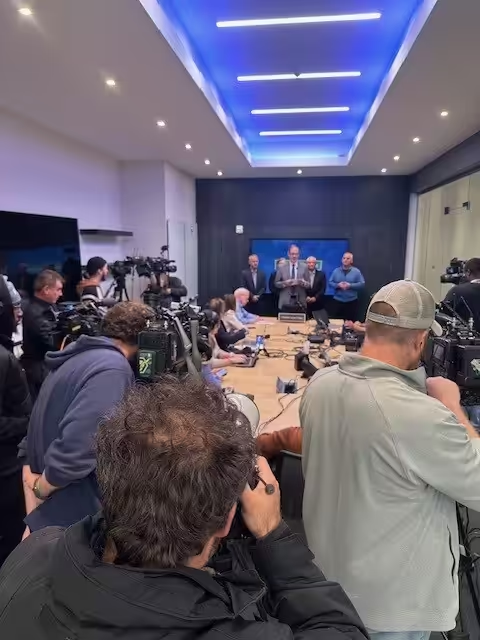
Finney Law Firm is honored to have been recently retained to represent Cincinnati Police Chief Teresa Theetge regarding her employment with the City. Chief Theetge is the first female Police Chief in the City’s history, and has an unblemished 35-year record of dedicated and distinguished public service, but was recently placed on paid leave by the City in the wake of several high-profile crimes in the downtown business district. The Chief, whose commonsense efforts to reduce crime in the City were unfortunately ignored by the politicians, is being unfairly used as a scapegoat to distract attention from those who are truly responsible for the problems the City is facing. FLF is committed to getting her back to work, and to hold the City responsible for its unlawful action against her.

Stephen Imm, head of our Labor and Employment Law practice group, is leading the team defending Chief Theetge’s rights. You can view Steve’s recent news conference here.

First, we have cautioned our readers previously about signing contracts with indemnity promises (see here, here, and here ).  They can be open-ended free and open access to your checkbook.  Avoid — like the plague — making promises relating to “indemnify” “defend” and “hold harmless.”

Second, contracts that require you to pay the other’s attorneys fees in the event of a dispute under a contract are a form of indemnity, and many times the drafter wants to make that fee-shifting provision one-sided: If the other party prevails, you have to pay their fees, but if you prevail they don’t have to pay yours. How is that fair?

But something more sinister that, after nearly 40 years of practice, that I am now seeing is this:

Customer shall indemnify, defend, and hold Seller harmless from and against any Losses that arise from or relate to any allegation of facts that, if true, would constitute a breach of Customer’s representations, warranties, or obligations under this Agreement.

and this:

Purchaser agrees to indemnify and defend, covenant not to sue, and hold harmless Seller for (a) performance of Purchaser(s)’s obligations under the Contract Documents or (b) breach of this Agreement by the Purchaser.

These are two separate provisions in two contracts I recently reviewed for clients.  They left me scratching my head.

For the first one, if the other party merely claims (and the claims could be untrue) that my client breached the contract (“facts that, if true, would constitute a breach of Customer’s representations, warranties, or obligations under this Agreement”), then we have to pay their attorneys fees and our own attorneys fees, win or lose for either of us.

In the second one, they were asking my client to pay their attorneys fees if my client failed to perform under the contract.  Essentially, it is one-sided fee shifting, my client has to pay the seller’s attorneys fees (presumably if he prevails), but it is not reciprocal.

Now as to the first example (true, real-life drafting), it is mind blowing.  If there is a suit over the contract, and my client is 100% right, my client still has to pay his own attorneys fees and the seller’s attorneys fees, win or lose.

Now, naturally, one would say that “certainly such a contract provision is not enforceable.”  But that’s not true (or may not be true).

Not that the single largest investment bank in the nation is entitled to any sympathy at all, but in a major fail on the due diligence side, J.P. Morgan Chase purchased a FinTech company called Frank.  Frank offered college students an on-line portal to help with financial aid.  Jamie Diamond, JP Morgan CEO,  was smitten with the company and decided to purchase it to provide access to young depositors and borrowers at the beginning of their banking relationships.  Frank founder and CEO, Charlie Javice, was able to pump up the purchase price by filling her supposed customer database with millions of fake customers (some twelve times their legitimate database size).  In its due diligence process — where JP Morgan Chase had access to the best of the best — the geniuses at JP Morgan Chase somehow failed to detect the fraud before it coughed up a whopping $175 million.

But — unbelievably — to compound its error, JP Morgan Chase’s lawyers, in the Asset Purchase Agreement, agreed to indemnify, defend and hold harmless Frank and Charlie Javice personally for all claims relating to the purchase.

A court found that that promise, first, extended to civil claims (including claims for fraud) brought by JP Morgan Chase against Charlie Javice — it had to pay her attorney fees for the civil suit in which Charlie Javice was found liable for $287 million to JP Morgan Chase.

But then to compound the insult to JP Morgan Chase and its truly terrible attorneys, JP Morgan Chase also had to pay the attorneys fees of Charlie Javice for the defense of criminal charges against her, even though she ultimately was found guilty of criminal fraud.

The final tally of the lawyer fees and expenses for both cases: $115 million!

From this Fortune magazine article: “To put the $115 million figure in perspective, a high-priced lawyer billing $2,000 an hour would have to bill eight hours every day, including weekends and holidays, for nearly 20 years to reach that total.”

So, yeah, be careful when signing an agreement calling for you to “indemnify, defend and hold harmless” the other party, including for their own breach of contract and fraud.  Be forewarned and be very careful.

Epic, ouch!

Disagreements over the nonpayment of construction contracts occur frequently. Contractors who have finished a job based on the expectation that they will receive full payment on completion often find themselves forced to chase property owners for the designated funds. In some cases, the hiring individual or entity will formulate some excuse as to why the agreed-upon amount is not being provided. Other times, no explanation is given for the nonpayment. 

Though some legal protections were in place for construction contractors, a new Kentucky law bolsters their ability to secure the compensation they’ve earned. Under Senate Bill 76, when a contract with a private party is valued at $2 million or more, any portion of the payment that the owner retains subject to project completion must be held in an escrow account. Once the job is done in a satisfactory manner, the owner must provide a release that triggers transfer of the escrow funds to the contractor. Parties to construction contracts are no longer permitted to negotiate away this escrow requirement. 

Likewise, the law bars contract provisions that purport to eliminate or undermine a contractor’s right to seek relief in court or waive other essential rights conferred under Kentucky law. By barring enforcement of these terms, the bill safeguards contractors from being coerced into unfavorable language that could put them at an unfair legal disadvantage. However, the bill does note that binding arbitration can be utilized as alternative dispute resolution method.

Among the law’s most important elements is its protection against clauses that unjustly prevent contractors from recovering costs or damages due to delays—especially when such delays stem from factors within the control of the contracting entity. Many construction law conflicts stem from situations where a project cannot be completed on time. There are numerous reasons why an unforeseen delay could occur, such as weather, regulatory hurdles or bureaucratic inefficiencies. By prohibiting clauses that put the entire economic burden of any delay on the contractor, this provision fosters a more equitable distribution of risk and responsibility.

About Finney Law Firm, LLC

Founded in 2014, FLF has grown to 15 attorneys located in offices in Eastgate and downtown Cincinnati with five major practice areas: Corporate Law, Real Estate Law, Employment Law, Commercial Litigation and Public Interest and Constitutional Litigation.  FLF has the unique claim to three 9-0 victories at the United States Supreme Court for its public interest practice along with breakthrough class action work.

FLF also has an affiliated title insurance company, Ivy Pointe Title, LLC, that closes and insures nearly a thousand commercial and residential real estate transactions annually.

For more information about Finney Law Firm, visit finneylawfirm.com.

Media Contact: Mickey McClanahan; mickey@finneylawfirm.isoc.net; 513.797.2850.