


I got a great question from a client this past week. He had a seller who was located in Mexico for his job. The facility at which he worked was nowhere near a US Embassy or Consulate, and the drive to the Embassy or Consulate was somewhat dangerous.  How could he get a valid and proper signed and notarized deed back to Ohio for the closing?

I thought: What a great chance for a blog entry on foreign execution and acknowledgement of recordable instruments (deeds, mortgages, etc.) in Ohio! (How exciting is my life!)

Domestic execution

First, when I started my career in real estate law, most (not all) instruments required two witnesses and a notary public to sign in order for the instrument to be recordable in Ohio.  Since then, the requirement for two witnesses has been dispensed with, so all that is needed for an execution of a recordable instrument in Ohio is a signature of the owner and an acknowledgement (notarization) (there are lots of other requirements as to the form).

Execution and acknowledgement in other states

Then, O.R.C.  § 5301.06 provides:

All deeds, mortgages, powers of attorney, and other instruments of writing for the conveyance or encumbrance of lands, tenements, or hereditaments situated within this state, executed and acknowledged, or proved, in any other state, territory, or country in conformity with the laws of such state, territory, or country, or in conformity with the laws of this state, are as valid as if executed within this state.

So, for other states and territories of the United States, meeting the execution requirements in that state (usually just a signature and an out-of-state acknowledgement) is just as valid as one from Ohio.

Execution and acknowledgement in foreign countries

Further, the above-statute provides that an acknowledgement from another country is valid if made in conformity with the laws of the other country.

That means that the Ohio title attorney signing off on the instrument would need to know the law the other country, which they will not (and since it is written in their language, would be difficult to research and discern with the degree of certainty required to assure quality transfer of title).

In this instance, the Mexican notary required an expensive (relatively) translation of the instrument into Spanish before acknowledging that instrument, and the Ohio title attorney would not accept the dual-translations in the document for recording.  For these reasons, it was a becoming a disaster before the matter came to our firm.

That takes us to the second option for execution outside of the United States: O.R.C. § 147.51:

Notarial acts may be performed outside this state for use in this state with the same effect as if performed by a notary public of this state by the following persons authorized pursuant to the laws and regulations of other governments, in addition to any other persons authorized by the laws and regulations of this state:

(A) A notary public authorized to perform notarial acts in the place in which the act is performed;

(B) A judge, clerk, or deputy clerk of any court of record in the place in which the notarial act is performed;

(C) An officer of the foreign service of the United States, a consular agent, or any other person authorized by regulation of the United States department of state to perform notarial acts in the place in which the act is performed;

(D) A commissioned officer in active service with the armed forces of the United States and any other person authorized by regulation of the armed forces to perform notarial acts if the notarial act is performed for one of the following or for a dependent of one of the following:

(1) A member of the merchant marines of the United States;

(2) A member of the armed forces of the United States;

(3) Any other person serving with or accompanying the armed forces of the United States.

(E) Any other person authorized to perform notarial acts in the place in which the act is performed.

As a practical matter, I just tell clients to get themselves to a US Embassy or Consular office.  It is best to call in advance and make an appointment (a) to assure they perform these services at the office you intend to visit, (b) to assure a notary is present at the time you show up, and (c) to assure the Embassy or Consulate is open at that time.  Further, embassies and consulates are used to performing these services for American citizens and residents.  This procedure is blessed by Section (C), above.

Then, members of the Armed Forces and their families have the additional option of going to a military base and having “a commissioned officer in active service with the armed forces of the United States and any other person authorized by regulation of the armed forces to perform notarial acts” performing the acknowledgement.

How about the new electronic notary process?

So, I thought when the problem was presented to me, wouldn’t this be a perfect use of the e-notary law (O.R.C. § 147.591, et seq.)?

Well, no, it would not, as I would learn.

Although the e-notary situated in Ohio can perform valid acknowledgements remotely, including with signers sitting in other states, he has no authority to acknowledge an instrument for a principal sitting outside of the “territory of the United States” O.R.C. § 147.64 (C).  Well, that threw cold water on that idea!

Corporate and LLC signatures

If the owner of the property in question is a corporation or a limited liability company, it may be possible to sign a corporate resolution (not requiring a notary) authorizing someone in the US to sign and have acknowledged the recordable instrument, thus saving the need to drive to an Embassy or Consulate.

Conclusion

So, in short, if you are outside of the United States or its territories, and want to execute and properly notarize a real estate instrument for recording in Ohio, (a) have the documents emailed to you where you are, (b) print them out, (c) get thee to an Embassy or Consulate and (d) Fed Ex them back to the closing agent in Ohio (subject to an escrow agreement or such other assurances as your attorney advises). If you are in a country without diplomatic relations with the United States, you may be out of luck.

For assistance with your Ohio and Kentucky real estate closing needs, please contact Rick Turner (513.943.5661), Isaac Heintz (513.943.6654) or Eli Krafte-Jacobs (513.797.2853).

Attorney Stephen E. Imm

Title VII of the federal Civil Rights Act of 1964, and all individual state laws, say that employment discrimination on the basis of “sex” is unlawful. But what if an employer fires (or refuses to hire) someone because of their sexual orientation? And what about discrimination on the basis of someone’s gender identity? Are these considered forms of “sex discrimination”? Are they covered by the laws that prohibit the making of employment decisions based on gender?

Federal decisions

Different courts and different states have reached different conclusions on these questions. The United States Supreme Court heard oral arguments last October of 2019 in three different cases that addressed these issues. It is expected that the Supreme Court’s decisions, expected before the end of their term in June of 2020,  will provide clarity regarding the scope of the federal law – Title VII of the Civil Rights Act. Many observers believe that the Court, as currently constituted, is likely to conclude that Title VII does not prohibit discrimination on the basis of sexual orientation or gender identity, but the Court has surprised people before in its rulings on employment matters.

State decisions and statutes

Whatever the Supreme Court rulings may turn out to be, however, they will only govern lawsuits that are brought under the federal employment discrimination law. Individual states are permitted to have their own statutes concerning employment law, and are permitted to offer protections that the federal law does not provide. Several states have, in fact, passed laws specifically stating that employment discrimination based on sexual orientation or gender identity is illegal in their states.

US Supreme Court weighs in on same-sex harassment

One interesting anomaly about this is that Title VII (the federal employment discrimination law) has already been determined by the US Supreme Court to prohibit same-sex harassment. In a harassment case, unlike a typical discrimination case, the employee is not complaining about being denied or deprived of employment opportunities, but rather about the treatment he or she is receiving while on the job. The Supreme Court has also held that “gender stereotyping” is an illegal form of sex discrimination. This ruling was issued in a case where a woman was denied partnership in a firm because she was not considered “feminine enough” by the (mostly male) partners.

Conclusion

So while the upcoming Supreme Court decisions may provide some clarity regarding the issues of sexual orientation and gender identity discrimination, many complicated issues will remain. Employers and employees facing these issues simply must have competent legal counsel to guide them.

Whether as an employee or an employer, for assistance with your employment law issues, please contact Stephen E. Imm at 513.943.5678 or Matthew S. Okiishi at 513.943.6659.

Cincinnati media has given extensive coverage to the Probate Court complaint filed by Attorneys Curt Hartman. Here is a quick round-up:

Television coverage of the filing of the complaint by WKRCWCPO; WLWT; and Fox19

Curt Hartman appeared on WLW with Scott Sloan on Thursday beginning at approximately 95:00, and again on Friday beginning a approximatley 40:00.

WCPO discussed the case against Tamaya Dennard on its podcast Hear Cincinnati

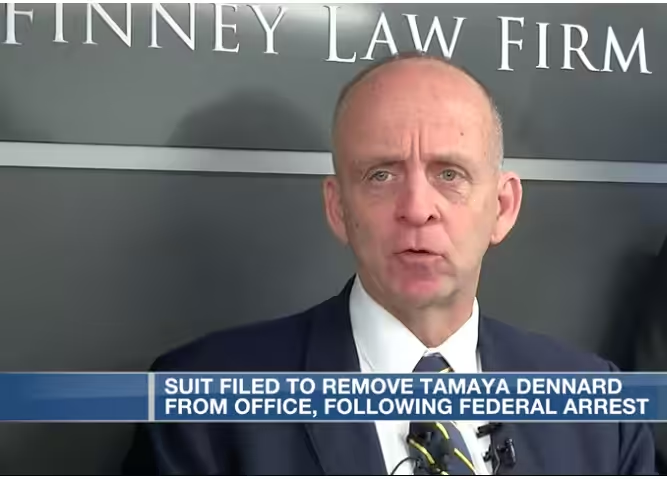
Attorney Curt C. Hartman, of counsel with Finney Law Firm, has filed a complaint in the Hamilton County Probate Court to remove Cincinnati Councilmember Tamaya Dennard from office pursuant to R.C. 733.72-76.

A copy of the Complaint is below or available here.

The Complaint was filed on behalf of Mark Miller and four other Cincinnati electors, including State Representative Tom Brinkman.

Under Ohio law when five electors file a complaint alleging that a city official has received payment for her services to the city in addition to her salary; has an interest in a public contract; or is otherwise guilty of malfeasance or misfeasance, the City Solicitor shall prosecute the case before the Probate Court Judge, and, if Dennard is found guilty, she shall be removed from office.

The statute provides that Tamaya Dennard should be ordered to appear before the Probate Court within ten days of the filing of the Complaint.

A press conference is scheduled for 10 a.m. at the Mt. Adams office of Finney Law Firm, 1077 Celestial Street.

[scribd id=449127398 key=key-ytT0JKTEv0nhWXmTwyek mode=scroll]

Trademarks and copyrights can be used to prevent your company’s original creations or identifying features from being misappropriated illegally.

A trademark can be registered with the U.S. Patent and Trademark Office (USPTO) for a brand name, slogan, logo or other mark used to distinguish the goods or services of its owner. If a company’s trademark in the form of an identifying word, name, symbol, phrase or design meets the USPTO’s registration criteria, it can be registered with the USPTO.

A copyright (which is different than a trademark) deposited with the U.S. Copyright Office (USCO) can establish one’s ownership of originally authored written works, musical compositions, software programs, architectural designs, films and other media.

However, there are right ways and wrong ways of acquiring and preserving protections for your valuable intellectual property. Here are some steps you can take to help avert legal woes.

  • Do the research — You may shield yourself from major headaches and infringement claims by doing thorough trademark or copyright research, either yourself or through a professional. An experienced researcher can inform you about any other businesses using slogans, logos or other brand materials similar to the one you hope to use. It is better to know that you need to change identifying brand details before creating marketing materials. If you don’t do the research and simply hope your brand is unique, an infringement claim could arise.
  • Put Others on Notice of Your Intellectual Property —Use of the “TM” symbol by a person or business is an informal way of putting others on notice that the user of the “TM” symbol is claiming the mark as their own (in other words – don’t infringe on this mark). Use of “TM” also shows that the mark is not registered with the USPTO.  Once a mark is registered with the USPTO, the “TM” can be switched to an “(R)” for “registered.”
    A person can claim a copyright for any piece of original, published work by using the symbol “(C)” without depositing the work with the USCO.  However, depositing an original work with the USCO is advisable for the benefits it provides, and it creates an official record of your original work.  Registration of a mark or depositing of an original work also makes your intellectual property discoverable to other people conducting trademark or copyright research.
  • Use the correct symbol — Making “TM,” “(R)” or “(C)” (for copyright) next to your mark or creative work lets others know that you are claiming ownership. This may make someone think twice before mimicking your work for their own benefit and may also be used as evidence in support of your case if you need to file or respond to an infringement claim.

About Finney Law Firm, LLC

Founded in 2014, FLF has grown to 15 attorneys located in offices in Eastgate and downtown Cincinnati with five major practice areas: Corporate Law, Real Estate Law, Employment Law, Commercial Litigation and Public Interest and Constitutional Litigation.  FLF has the unique claim to three 9-0 victories at the United States Supreme Court for its public interest practice along with breakthrough class action work.

FLF also has an affiliated title insurance company, Ivy Pointe Title, LLC, that closes and insures nearly a thousand commercial and residential real estate transactions annually.

For more information about Finney Law Firm, visit finneylawfirm.com.

Media Contact: Mickey McClanahan; mickey@finneylawfirm.isoc.net; 513.797.2850.


As we have written about previously, real estate transfers involving the sale of a limited liability company or other entity that owns the underlying real estate are under increasing scrutiny by Ohio’s county auditors and school boards. Now, Ohio’s Supreme Court has declared that these sales are “a contrivance for accomplishing the sale of commercial real estate.”

In a decision that will have broad implications on Ohio’s property tax law,  Columbus City Schools Board of Education v. Franklin County Board of Revision, Slip Opinion 2020-Ohio-353, an LLC that owned a 264-unit apartment building was sold but the contract documents indicated that the transaction was actually the sale of real estate, distinguishing this case from prior cases in which the Court had affirmed the Board of Tax Appeals’ treatment of such sales as the sale of a business rather than the sale of real estate. In those prior cases, the transfer of title to real estate did not appear to be the primary factor in the transaction.

“In stark contrast, the BTA in this case confronted a document labeled by the parties as “Sale of Palmer House on the Boulevard 4121 Palmer Park Circle East New Albany, Ohio” and “Purchase and Sale Agreement.”  That is, the contract identifies itself as a purchase agreement for the real estate at issue.  Beyond its cover page, the contract takes the classic form of a purchase agreement for commercial real estate by identifying as the subject matter of the transaction the specific real property along with categories of personal property appurtenant to the commercial operation of the real estate.  Finally, this particular contract includes an explicit provision setting forth an optional method for consummating the deal as a transfer of corporate ownership rather than a conveyance of real estate from the seller to the buyer.

We conclude that the documentation in this case made it reasonable for the BTA to find that this sale, unlike those in the earlier cases, reflected the parties’ intent to sell and purchase income-producing real estate and supported the BTA’s finding that the parties’ transfer of corporate ownership constituted a contrivance for accomplishing the sale of commercial real estate.”
Decision, at ¶¶ 38-39.

The prior cases involved an existing shareholder buying out other shareholders – indicating that such a sale was not “arm’s length” and that it was truly the business that was being purchased rather than simply the underlying real estate; and sales where the conveyances did not indicate that the real estate was truly the asset being acquired, rather than an actual going concern.

As a result finding that the transfer was a sale of real estate, the Board of Tax Appeals then treated the sale price as the “best evidence of value” of the real estate, thereby shifting the burden to the property owner to defeat the sale price value. Ultimately resulting in an increase of value from $16 million to over $34 million.

As school districts and county auditors become more aggressive in identifying membership interest transfers, and treating them as real estate sales, investors would be wise to review their contract documents with an appreciation for the fact that they may end up as evidence in a valuation dispute.

In the past few months, Cincinnati City Council has passed new laws regulating residential landlord/tenant relationships, including requiring all landlords to file extensive rental registration forms with the City and a first of its kind law requiring landlords to accept alternative security deposit payments. These new laws change the dynamic and financial viability of residential rental property within the City limits.

Presented below is a summary of new laws contained in six different enactments by  City Council.

Rental Registration

New Section 874-6 of the Municipal code requires all landlords to register with the city and supply the following information for each rental unit within the city limits:

  1. Name, address, and telephone number of the owners;
  2. If owned by an entity, the name, address, and telephone number of a member or corporate officer;
  3. The name, address, and telephone number for “any and all persons in control of the property” who can be reached 24 hours a day, 7 days a week, 365 days a year;
  4. Street address and permanent parcel ID of each rental property;
  5. Monthly rent charged; and
  6. The number and size of each rental unit, including the number of bedrooms, bathrooms, and approximate square footage of each unit.

Landlords must update any changes in information on the form, any change in ownership, or any change in use, including if the property is vacant for sixty days or more.

There is a registration fee of up to $1 per unit to be charged every time a unit is registered or updated.

Failure to register is a Class D Civil offense ($750 fine [$1,500 if delinquent]). After receipt of notice of violation, each subsequent day is a separate violation punishable by a fine of $150 per day ($300 per day if delinquent).

The rental registration law goes into effect on May 13, 2020.

Read Chapter 874 here.

Late Fee Regulation

Chapter 871 of the Municipal Code has been amended to regulate late fees charged to residential tenants. Like the registration requirement, this change applies to all residential rental properties within Cincinnati.

Section 871-8 caps late fees at $50 or 5% of the monthly rent, whichever is greater.

Section 871-9 prohibits:

  1. interest on late fees;
  2. late fees on late fees; and
  3. late fees assessed against a tenant where the late rent that is owed is owed by a third party payer (CMHA or other rental assistance organizations).

The late fee regulation went into effect on January 28, 2020.

Security Deposit Regulations

The most sweeping change is the newly enacted security deposit regulation.

Sections 871-9 of the Cincinnati Municipal Code have been amended to require that all landlords provide a receipt to the tenant when the security deposit is paid (unless such payment is by the tenant’s personal check).

871-9 also now requires that landlords “who own and control more than twenty-five rental units” who require security deposits must offer to accept at least one of the following options in lieu of the required security deposit:

  1. Rental security insurance;
  2. Payment of the security deposit over at least six monthly installment payments due on the same day as the rent;
  3. Payment of a reduced security deposit no greater than 50% of the monthly rent charged for that unit.

Additionally, prior to entering into a rental agreement, the landlord must provide the tenant with a written notice of the available security deposit alternatives. The law also prohibits landlords from requiring any additional security should a tenant select an alternative security deposit arrangement.

The security deposit regulations take effect starting on April 14, 2020.

Notably, the security deposit regulations apply only to those landlords who own twenty-five or more units. So long as a distinct LLC or other entity owns less than twenty-five units total, that owner would not have to accept the alternative security deposits.

The municipal code does not provide any specific penalty for landlords who do not comply with the new security deposit provisions, but does provide that a tenant may bring a lawsuit to obtain an injunction to force a landlord to comply with the Cincinnati landlord tenant laws. The city solicitor could also sue for such an injunction.

Read the security deposit ordinance here.

Conclusion

We expect legal challenges to these new laws. If you have questions about how these new laws may affect you, contact us using this link.

If you have specific questions, contact Christopher P. Finney at 513.943.6655.

As reported by Eye on Ohio,  State Representatives Doug Green (R. 66th House District), and Mike Skindell (D. 13th House District), have put forth Ohio House Bill 449 in late December, seeking to capture conveyance taxes when entities owning real estate, are sold. Read the bill and follow its status here.

What is a “Drop and swap?

Called a “membership interest transfer” or “drop and swap,” conveying the entity that owns real property rather than simply selling the real property directly, allows buyers to avoid reporting the transfer as a sale of real property, and the value placed on the property as part of the transaction. County auditors and school boards in particular have complained that these conveyances cost public entities tax revenues that would have been generated had the parties engaged in typical real estate transactions.

New legislation to capture drop and swap sales

The current proposal would require that whenever more than 50%  of the ownership interest of an entity owning real property (either directly or indirectly) is conveyed, that the conveyance be reported to the county auditor and the value of the real estate be determined and taxed as part of the sale.

Membership interest transfers have come under increasing scrutiny as property owners perceive that these transfers distort the tax rolls and shift tax burden onto less sophisticated owners. Many property tax levies are for a fixed dollar amount (e.g. a levy to raise $10 Million). So that, as the value of one property increases, other owners pay a slightly smaller amount toward that fixed dollar tax, while the higher value property owner pays a slightly higher amount toward that fixed dollar tax. When one property is kept at a lower value via a membership interest transfer, those other owners continue to pay a higher amount toward that fixed dollar tax.

As news outlets such as Eye on Ohio report on this issue, public opinion is swaying in favor of taxing  these transfers.

As always, would be property investors should consider not only the current tax bill, but the likely tax bill after purchasing a property, and factor that into their purchase price.

Status of legislation

H.B 449 has been referred to the House Ways and Means Committee, on which sponsor Doug Green sits. At this time no hearings have been scheduled on the bill.

As we predicted nearly two years ago to the day, whether this particular bill goes into law or not, the effort to identify, value, and tax these conveyances will continue.

Upcoming tax presentation to REIA

This bill, and membership interest transfers generally, will be a part of our presentation with Hamilton County Dusty Rhodes to the Greater Cincinnati Real Estate Investors on February 6. Learn more about that event and how to sign up for a free ticket here.

Conclusion

The attorneys of Finney Law Firm have achieved literally hundreds of millions of dollars in property tax valuation reductions over the past 15 years.  Let us help you with your tax valuation challenge.  For more information on our property tax valuation practice contact Christopher P. Finney at 513.943-6656.

Ohio Dog Bite Statute – When Man’s Best Friend Isn’t So Friendly

During my first year of law school, we were assigned a research and writing project on the Ohio Dog Bite Statute but, until recently, I had not yet been faced with this legal issue in my practice. In revisiting this area of the law, I found I have a new appreciation for it, both in terms of being able to help my clients and because I now have two German Shepherds of my own. I also realized there are quite a few misconceptions out there as to when a dog bite/attack may be actionable.

Statutory language

The Ohio Dog Bite Statute provides in relevant part:

The owner, keeper, or harborer of a dog is liable in damages for any injury, death, or loss to person or property that is caused by the dog, unless the injury, death, or loss was caused to the person or property of an individual who, at the time, was committing or attempting to commit criminal trespass or another criminal offense other than a minor misdemeanor on the property of the owner, keeper, or harborer, or was committing or attempting to commit a criminal offense other than a minor misdemeanor against any person, or was teasing, tormenting, or abusing the dog on the owner’s, keeper’s, or harborer’s property.

Ohio Rev. Code 955.28(B). In simpler terms, an “owner, keeper, or harborer” of a dog is strictly liable to anyone their dog injures, unless the injured person was trespassing, committing a criminal offense, or “teasing, tormenting, or abusing the dog on the Owner’s, keeper’s or harborer’s property” at the time of the injury.

Myth: “Dogs in Ohio get ‘one free bite.’”

Many believe that a dog owner (or keeper or harborer) is not liable to a person injured by their dog unless they had reason to know the dog was aggressive. This is often colloquially referred to as a “one free bite” rule. The idea is that the owner is not liable the first time it happens because he or she has no reason to know that the dog is capable of such behavior but, after that, the first bite serves as the “reason to know,” and the owner can be held responsible from that point forward.

Ohio does not have a “one free bite rule.” There is no requirement that the injured person prove negligence, or that the owner knew the dog was dangerous, or even that the owner did anything wrong whatsoever. This is often referred to as “strict liability.” In other words, the “owner, keeper, or harborer” of the dog is liable even if they aren’t at fault. See Allstate Ins. Co. v. U.S. Associates Realty, Inc., 11 Ohio App. 3d 242, 464 N.E.2d 169, 1983 Ohio App. LEXIS 11287 (Ohio Ct. App., Summit County 1983) (finding that R.C. 955.28, the dog bite statute, does not establish negligence per se; rather, the statute establishes liability without regard to fault or the dog owner’s negligence).

Myth: “I can’t be liable if it isn’t my dog.”

The Ohio Dog Bite Statute imposes liability on, not only owners, but also keepers and harborers. Individuals other than the owner of a dog have been found to be harborers or keeper under the statute in several cases throughout Ohio. See, e.g., Lewis v. Chovan, 2006-Ohio-3100 (Ohio Ct. App., Franklin County 2006) (pet groomer found to be a “keeper” under the statute even she was only temporarily exercising control over the dog); Buettner v. Beasley, 2004-Ohio-1909 (Ohio Ct. App., Cuyahoga County 2004) (while boyfriend was technically the owner, his girlfriend was considered a “keeper”); Sengel v. Maddox, 31 Ohio Op. 201 (Ohio C.P. 1945) (finding that a person who is in possession and control of the premises where the dog lives, and silently acquiesces in the dog being kept there by the owner, can be held liable as a “harborer” of the dog).

Exceptions to Liability

In addition to the explicit exceptions set forth in the statute (i.e., if the injured person is trespassing, committing a criminal act, or otherwise tormenting/abusing the dog), case law has carved out a couple of additional caveats. The first is that an injured person cannot recover if they were a harborer or keeper of the dog. For example, in the Lewis case cited above, a pet groomer was determined to be a “keeper” of the dog during the time it was in the groomer’s possession and control. In that instance, the pet groomer likely could not recover against the owner of that dog under the statute for any injury the dog caused while under the groomer’s possession and control – i.e., while he or she was a “keeper.” The same would presumably be true for a veterinarian. Similarly, as set forth in the above Buettner case, a live-in girlfriend can likely not recover against her boyfriend who is, technically, the owner of the dog. In other words, an owner is likely not strictly liable to a keeper or harborer under the statute for injuries that occur while the injured person is considered a keeper or harborer.

Landlord/Tenant Liability

Another niche of the case law interpreting the Ohio Dog Bite Statute exists relative to landlord/tenant situations, i.e., situations where an injured person seeks to hold a landlord liable for injuries sustained after an attack by a tenant’s dog. The cases throughout Ohio tend to be fairly fact specific as to this issue. Most courts have held that landlords can be liable if the attack occurs in a common area (such as a hallway or foyer). See Weisman v. Wasserman, 2018-Ohio-290, 2018 Ohio App. LEXIS 335 (Ohio Ct. App., Cuyahoga County 2018) (finding that a landlord was not entitled to summary judgment where the dog attack occurred in a hallway, which could potentially be considered a common area). The critical question is whether the tenant retained exclusive possession and control over the area in which the attack occurred. See Pangallo v. Adkins, 2014-Ohio-3082, 2014 Ohio App. LEXIS 3018 (Ohio Ct. App., Clermont County 2014) (landlord was not a harborer of the dog because the incident did not occur in a common area, but rather in an area where the tenant had sole possession and control).

It follows that landlord liability is perhaps more common in apartment complexes than, for instance, a situation where the tenant is renting an entire house (where there are likely not “common areas” and the tenant retains possession and control of the entire premises). Additionally, a landlord will generally not be liable where the landlord or lease explicitly prohibits dogs from being on the premises and does not know that about the dog, regardless of whether the attack occurs in a common area. See Lynch v. Lilak, 2008-Ohio-5808, 2008 Ohio App. LEXIS 4865 (Ohio Ct. App., Erie County 2008) (finding that the landlord could not be a “harborer” under the statute where the lease prohibited pets and the landlord did not know of the dog, or permit or acquiesce to the dog’s presence).

Practically speaking, how do these claims work?

Generally, when we evaluate cases, we focus on three key factors: liability, damages, and collectability. With the Ohio Dog Bite Statute, liability is typically a non-issue provided that one of the above-described exceptions does not apply. We also look at damages (such as medical expenses, lost wages, and anxiety when faced with dogs in the workplace). Often, the clients we represent in these cases were treated in an ER setting, were forced to miss some work, have scarring, etc. and are, thus, entitled to compensation for those damages in addition to pain and suffering. Where many cases become complicated is the collectability aspect – in other words, even if we get a judgment against the liable party, will they be able to pay it or do they have assets to which we could attach in satisfaction of that judgment? However, many homeowner’s insurance policies cover liability for injuries caused by the homeowner’s dog, making the collectability question a bit of a non-issue as well.

Conclusion

We understand that it can be difficult to navigate this fairly nuanced area of the law, which, as we’ve seen, is full of misconceptions, exceptions, and caveats. If you have been injured by a dog, we would love to meet with you and walk you through some of your options – at no charge.

For help defending against or pursuing a dog bite claim, contact Casey Jones at 513.943.5673.


An inter vivos trust is a trust created during a person’s lifetime that becomes effective while that person (“Grantor”) is living.  As an inter vivos trust operates during the lifetime of the Grantor, it is commonly referred to as a “living trust.”

The Grantor may want to create a living trust, but may also desire to retain an interest in the trust property and control over its management, such as serving as Trustee, receiving all of the income, retaining the power to revoke or amend the trust, and keeping the right to change the beneficiaries.

Living trusts are not for everyone. Anyone considering a living trust should consult with an estate planning attorney to discuss the potential benefits and disadvantages for such person’s individual situation.

The following is a summary of some advantages of living trusts:

Provide For and Protect Beneficiaries.  The Grantor’s desire to provide for and protect someone is probably the most common reason for creating an inter vivos trust.

Minor Children.  Minor children lack the legal capacity to manage property.  A trust permits the Grantor to make a gift for the benefit of a minor without giving the minor control over the property or triggering the necessity for the minor to have a court-appointed guardian to manage that property. A trust is also more flexible and allows a Grantor to have greater control over how the property is used when contrasted with other methods, such as a transfer to a guardian of the minor’s estate or to a custodian under the Uniform Transfers to Minors Act.

Individuals Lacking Management Skills.  An individual beneficiary may lack the skills necessary to properly manage the trust property. This could be the result of a mental or physical disability, or a lack of experience in making prudent investment decisions.  By putting the money under the control of the trustee with investment experience, the Grantor increases the likelihood that the beneficiary’s interests are served for a longer period of time.

Spendthrifts. Some individuals may be competent to manage property, but are likely to use it in an excessive or frivolous manner.  By using a carefully drafted trust, a Grantor can protect the trust property from the beneficiary’s own excesses, as well as the beneficiary’s creditors.

Under the laws of the State of Ohio, the Grantor may protect trust assets by including a spendthrift provision. A spendthrift clause does two things: (1) it prohibits the beneficiary from selling, disposing of, or otherwise transferring the beneficiary’s interest, and (2) it prevents the beneficiary’s creditors from reaching the beneficiary’s interest in the trust. The spendthrift provision permits the Grantor to carry out the Grantor’s intent of benefitting the designated beneficiary, but not the beneficiary’s assignees or creditors. Grantors typically include spendthrift restrictions in a trust because they protect beneficiaries from their own lack of management of the trust property, or from disposing or selling of trust property, and also protects assets from the beneficiary’s personal creditors.

Persons Susceptible to Influence.  When a person suddenly acquires a significant amount of property, that person may be under pressure from family, friends, or other individuals or organizations who wish to share in the windfall.  An inter vivos trust can make it virtually impossible for the beneficiary to transfer trust property to other people or organizations.

Retain Flexibility.  The Grantor may restrict the beneficiary’s control over the property in any manner the Grantor desires, as long as the restrictions are not illegal or in violation of public policy.  This flexibility allows the Grantor to determine how the trustee distributes trust benefits, such as by spreading the benefits over time, giving the trustee discretion to select who receives distributions and in what amounts and frequencies, requiring the beneficiary to meet certain criteria to receive or continue receiving benefits, or limiting the purposes for which trust assets may be used, such as health care or education.

Revocation and/or Amendment.  The Grantor may amend, or even revoke, a revocable inter vivos trust during the Grantor’s lifetime.

Trustee.  The Trustee is responsible for handling the assets held in the trust, including distributing the assets according to the terms of the trust document.  Thus, the Grantor has the flexibility of designating the individual or corporate trust department of the Grantor’s choosing to serve in the role as Trustee.

Avoid Probate.  Property in an inter vivos trust or received by the trust as beneficiary upon the death of the Grantor is not part of the Grantor’s probate estate. The property remaining in the trust when the Grantor dies and all property received by the trust, is administered and distributed according to the terms of the trust; it does not pass under the Grantor’s Last Will and Testament nor by intestate succession.

Reduction in Administration Expenses.  Some expenses incurred in the administration of a probate estate include attorney’s fees, fiduciary fees, appraisal fees, and court costs. The use of an inter vivos trust may be effective to reduce these expenses because less (if any) of the decedent’s property would pass through the decedent’s probate estate.

Increased Privacy.   All probate estate proceedings are public record, and can be viewed by anyone.  Documents filed in an administration of a probate estate include, but are not limited to, the inventory of all of the decedent’s probate assets, with the date of death value of each.  Further, the names of the beneficiaries of a probate estate, as well as the assets distributed to the beneficiaries, are also public record.  By the use of an inter vivos trust, the Grantor can keep private the extent of the Grantor’s assets and their disposition.

Avoidance of Ancillary Administration for Real Property Located Outside the State of Ohio.   If a decedent owned out-of-state real property, the decedent’s Last Will and Testament is probated in the county of the decedent’s residence, with some type of ancillary administration being necessary in the state or county in which the out-of-state real property is located. This ancillary administration can be expensive, inconvenient and time-consuming, and can be avoided if the property passes by way of an inter vivos trust.