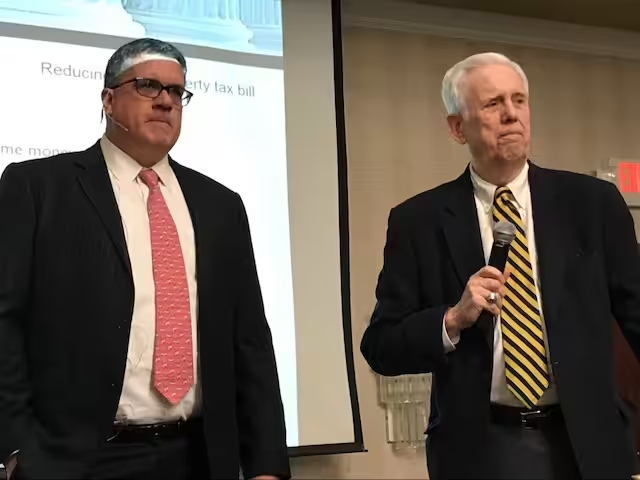
Hamilton County Auditor Dusty Rhodes and Finney Law Firm attorneys Chris Finney will present on Property Tax Reduction at the Greater Cincinnati Real Estate Investors Association (REIA) meeting on February 6, 2020, at the Holiday Inn North, 5800 Mulhauser Road, West Chester, Ohio 45069. Directions here.
The meeting begins with dinner at 5:30. Our presentation begins at 6 PM.
The meeting is open for free to all REIA members. First-time attendees can obtain a free guess past here.
Auditor Rhodes has presented on this topic with Finney Law Firm numerous times to great appreciation from home owners and investors alike. We appreciate the opportunity to “pull back the curtain” and help property owners understand the process involved in bringing a successful challenge to your property’s valuation.
Remember if you plan on filing a challenge to the value of your property in Ohio, the deadline is March 31.
Yesterday the views of attorney Curt C. Hartman, of counsel to Finney Law Firm, were featured in the pages of the Washington Post on the impeachment proceedings underway in the United States Senate.
Curt Hartman helps lead the Finney Law Firm public interest practice, which includes Constitutional Law. Three times his briefing brought us to 9-0 wins before the US Supreme Court and numerous victories in federal and state Courts of appeals as well as the Ohio Supreme Court.
Finney Law Firm prevails in “Mansion House case” through Ohio Supreme Court
Attorney Casey A. Taylor
Recently, our firm had a probate decision make its way all the way up to the Ohio Supreme Court as part of joint effort by Attorneys Isaac T. Heintz of our transactional team and Casey A. Taylor of our litigation team.
While the precise legal issues in that case were somewhat idiosyncratic (and certainly underutilized), the underlying situation in that case was not all that unique. That is, our firm has been approached on more than one occasion by an individual whose spouse has passed away and, to their surprise (or perhaps not), had disinherited them before their passing.
Many times, the surviving spouses are left believing they have no recourse and will be left with pennies on the dollar relative to the decedent’s estate. However, that is not always the case.
A Surviving Spouse’s Right to Purchase Assets from Decedent’s Estate
Under Ohio law, a surviving spouse has the right to purchase certain assets from an estate at the appraised value, including “the mansion house.” See R.C. 2106.16 (providing the right to purchase “the mansion house, including the decedent’s title in the parcel of land on which the mansion house is situated and lots or farm land adjacent to the mansion house and used in conjunction with it as the home of the decedent” at its appraised value, provided that it is not specifically devised/bequeathed to someone else).
The “mansion house” is often not an actual mansion, as the name would suggest but, generally speaking, can be thought of as the decedent’s primary residence. See id. (“. . . as the home of the decedent.”) (emphasis added). Additionally, if there is a farm associated with the mansion house, which is used in connection with the home (and not a commercial farming operation), the farm should also be subject to the surviving spouse’s right to purchase.
The statute, however, is not limited to the “mansion house” but also may apply to household goods and other personal property under certain circumstances. Although it is typically not the focal point of a surviving spouse’s rights, R.C. 2106.16 can provide an opportunity for a surviving spouse to promote a more expeditious resolution of an estate and, if the facts and circumstances are right, benefit monetarily.
As a threshold issue, R.C. 2106.16 only applies to assets that are, “not specifically devised or bequeathed.” A specific devise or bequeath occurs when a Will specifically references a designated asset transferring to a particular party (e.g., I give to John Doe the real estate located on 123 General Street, Anytown, Ohio).
A residual devise/bequest, by contrast, almost never qualifies as a specific devise/bequest (e.g., I give to John Doe the rest, residue and remainder of my estate). As long as the asset in question is not subject to a specific bequest, R.C. 2106.16 may be an option as to the asset in question.
R.C. 2106.16 – the “Mansion House Statute” – Applied in Real Life
Not only can the exercise of this right allow the surviving spouse to purchase and, at his or her election, remain in the home that served as the decedent’s residence (and, perhaps, as the surviving spouse’s residence too, though this is not required – keep reading. . . ), but it can also serve to maximize an otherwise disinherited spouse’s share under the decedent’s estate. For instance (and especially where the mansion house appraises for less than the surviving spouse believes it is worth), a practical, yet largely overlooked strategy available to surviving spouses is to purchase the mansion house (or another undervalued asset contemplated under the statute) and immediately sell it to a third-party purchaser for a higher price. R.C. 2106.16 imposes no requirement that the surviving spouse maintain ownership of the mansion house/asset for any set period of time.
Thus, if the subsequent sale generates excess proceeds, those proceeds would belong to the spouse. In this scenario, even a disinherited surviving spouse who would otherwise take very little under the decedent’s estate may be able to pocket a significant amount by capitalizing on the difference between the appraised value and market value/purchase price of a sale to a subsequent buyer, consistent with his or her rights under R.C. 2106.16.
Further, there may be instances where the purchase of one or more assets by the surviving spouse (or the threat of him/her purchasing) could help facilitate a resolution or settlement of the decedent’s estate. For example, if the asset is desired by the executory/adverse party, he or she may seek a prompt resolution if that asset is in jeopardy, or the surviving spouse could otherwise use his or her right to purchase as a bargaining chip of sorts.
These are just a couple of ways that R.C. 2106.16 could be used to the benefit of a surviving spouse in an otherwise less-than-ideal situation in a practical sense. This is an area where our firm excels – we have a well-rounded team, with experience in diverse areas of the law and real estate, who come together to develop innovative solutions for our clients.
Our Case
In our “Mansion House” case, our client was a surviving spouse asserting her right to purchase the home and farm owned by her husband, which served as his primary residence. The executor of the decedent’s estate challenged our client’s right to purchase the home/farm, arguing primarily that she (the surviving spouse) did not live at the home/farm full time at the time of her husband’s (the decedent) death. In essence, the executor wished to impose a residency requirement on the surviving spouse where the statute only contemplates the residency of the decedent. Though more secondary arguments, the executor also asserted that:
the property was somehow specifically devised by virtue of the residuary clause in the decedent’s will and, thus, excluded from the purview of R.C. 2106.16 (conveniently, the executor was the beneficiary of the residual and desired the home/farm), and that
if the decedent’s home was the “mansion house,” and if our client had a right to purchase it, that right did not extend to the farmlands adjacent to the home because they were a separate parcel.
The trial court rejected all three of the executor’s arguments and found for our client (i.e., that the home/farm at issue was a “mansion house” under that statute and that our client was entitled to purchase it at its appraised value). Specifically, the trial court found that the plain language of the statute does not impose a residency requirementon the surviving spouse – the “mansion house” is the home of the decedent.
Additionally, the residuary clause contained no specific devise of the property at issue. And lastly, the statute (R.C. 2106.16) explicitly contemplates “lots or farm land adjacent to the mansion house” and used in conjunction therewith. On appeal by the executor, the Twelfth District Court of Appeals unanimously upheld the finding in our client’s favor. You can read the full appellate decision HERE (link to 12th Dist. Decision).
In a final effort to thwart our client’s purchase of the property, the executor sought discretionary review from the Ohio Supreme Court, arguing that the question was a great issue of public importance. The High Court, however, declined to exercise its jurisdiction to hear the case, leaving the lower court decisions for our client undisturbed.
Conclusion
This was a very favorable outcome for our client and our firm, and we take pride in our ability to deliver creative solutions to our clients’ unique, and often difficult, legal questions. If you would like to speak someone regarding estate planning or any other legal questions you may have, please don’t hesitate to reach out to us. You may reach Isaac Heintz at 513.943.6654 and Casey Taylor at 513.943.5673.
Most employment is at-will, meaning the employer generally has the right to discharge an employee at any time for any reason or for no reason at all. However, a termination or other job action cannot violate protections against unlawful discrimination or retaliation.
Federal laws prohibit employment actions based on an individual’s sex, religion, age, race, national origin, disability, pregnancy status or veteran status. If an employee claims that you fired them because they are part of one of these protected classes, you could face an employment discrimination investigation by the U.S. Equal Employment Opportunity Commission (EEOC) along with a wrongful termination lawsuit requesting monetary damages and other relief.
Before you decide to sever ties with an employee, it is smart to prepare yourself for the possibility that you could face these legal ramifications. Here are some proactive steps that can be taken:
Establish a process for discipline and termination —Following the same disciplinary and termination procedures for all employees can demonstrate that no employee was treated differently because of the protected class to which they belong.
Compile evidence — Though at-will employment allows you to terminate an employee for no reason at all, collecting and documenting evidence in support of your decision can be crucial to rebutting claims that the firing was in violation of law. Having these records on hand is much more effective than trying to offer justification for the firing after an investigation or lawsuit has been commenced.
Do not retaliate — It is illegal to retaliate against an employee who refuses to participate in unlawful behavior, complains about sexual harassment, files an EEOC complaint, complies with an EEOC investigation or takes other actions protected by law. Government workers and employees of government contractors are also shielded from retaliation under the federal Whistleblower Protection Act.
Consider a severance agreement — The best way to accomplish a trouble-free termination is to offer the employee financial compensation and other benefits and favorable terms in return for their agreement to release the company from legal liability. The employee should be given a reasonable period of time to have an attorney review the agreement before they sign.
Wrongful discharge claims are often proved by circumstantial evidence, so taking these steps can help you overcome the inference that the reason given for firing the employee was a pretext for unlawful discrimination or retaliation.
About Finney Law Firm, LLC
Founded in 2014, FLF has grown to 15 attorneys located in offices in Eastgate and downtown Cincinnati with five major practice areas: Corporate Law, Real Estate Law, Employment Law, Commercial Litigation and Public Interest and Constitutional Litigation. FLF has the unique claim to three 9-0 victories at the United States Supreme Court for its public interest practice along with breakthrough class action work.
FLF also has an affiliated title insurance company, Ivy Pointe Title, LLC, that closes and insures nearly a thousand commercial and residential real estate transactions annually.
For more information about Finney Law Firm, visit finneylawfirm.com.
Media Contact: Mickey McClanahan; mickey@finneylawfirm.isoc.net; 513.797.2850.
The Fair Labor Standards Act (“FLSA”) is the federal law requiring employers to pay time and a half to most employees who work more than 40 hours in a work week. On September 23, 2019, the Department of Labor issued some new rules that significantly changed the overtime requirements of the FLSA. These new rules took effect on January 1, 2020.
By far the most important of these changes has to do with which employees are considered “exempt“ from the overtime laws. To be considered exempt, an employee must meet two conditions: (1) they must be performing a category of work recognized as exempt, and (2) they must be receiving a regular salary that normally does not vary based on the amount of hours they spend working. Furthermore, in order for the exemption to apply, the salary the employee receives has to be above a certain threshold. That threshold is where the new rules come into play.
Under the old rule, an otherwise exempt employee who was paid a salary of as little as $23,660 a year ($455 a week) was not eligible to be paid overtime when they worked more than 40 hours. On January 1, however, that amount was increased to $35,568 a year, or $684 per week.
As a result of this change, it is estimated that approximately 1.3 million salaried workers who were previously exempt, and were not entitled to overtime pay, will now be eligible to get time and a half their regular rate of pay whenever they work more than 40 hours in a work week.
For employers who employ workers like these, this does not just mean having to pay overtime when they did not have to pay it before. It also means they now have to keep close track of the hours such employees work. There is no obligation to keep track of the hours of “exempt“ employees, but now a great number of previously exempt employees will be considered non-exempt, and their hours will have to be tracked.
If you are an employer or employee who may be impacted by these important new rules, and need guidance on your rights and responsibilities, be sure to seek competent legal counsel as promptly as possible. Mistakes in this area can be very costly.
If you have questions about the FLSA, consider speaking to one of the labor and employment attorneys at the Finney Law Firm: Stephen E. Imm (513-943-5678) or Matt Okiishi (513-943-6659).
Tipping employees in various service professions (barbering, food service, etc.) is as American as apple pie. Unfortunately, the retention of employee tips by employers is a less common, but nonetheless pervasive, practice. Both employers and employees would do well to note that an employer’s retention of any employee tips (except as part of a valid “tip pool”) is illegal, as the 2018 amendments to the Fair Labor Standards Act (“FLSA”) make clear.
It was not always this way. For example, prior to the 2018 amendments, federal appellate courts were split on the issue of whether an employer could keep employee tips if the employer paid the employee above the minimum wage.
But the law has changed, and both employers and employees should know that employees have a right to demand and receive the tips paid by customers. The gains that employers can expect from skimming tips are simply not worth the risk of being caught in a lawsuit. In addition to requiring employers to pay the full amount of improperly withheld tips, the FLSA further entitles employees to additional liquidated damages, which is an amount equal to the improperly withheld tips, plus attorneys’ fees and expenses. (This means a court award of double the actual damages of the wrongfully withheld tips plus the attorneys fees and expenses of the litigation.)
Because the FLSA is a federal law, it applies to nearly all employers and employees in the United States, including those in the Cincinnati tri-state area (Ohio, Kentucky, and Indiana).
If you are an employee who has been shorted on their tips or an employer who needs to update its policies to accommodate the requirements of the FLSA, consider speaking to one of the labor and employment attorneys at the Finney Law Firm: Stephen E. Imm (513-943-5678) or Matt Okiishi (513-943-6659).
The Dayton shooting earlier this year was horrific and sad for the victims and their families. One friend of the shooter has found himself in legal jeopardy not for any involvement with the shooting, but for his willingness to assist the law enforcement investigation efforts.
In order to purchase a firearm from a federally licensed firearms dealer, one must complete ATF Form 4473, which asks, among other things, if you are addicted to, or a user of illegal drugs. Since at least October 2016, the form includes a warning that marijuana is still illegal under federal law regardless of whether states have legalized or decriminalized marijuana.
In helping law enforcement, Ethan Kollie allowed federal agents into his home and admitted to habitual use of marijuana and psychedelic mushrooms. Review of Kollie’s Form 4473s revealed that Kollie had marked “No” in response to the illegal drug question. Thus, upon finding firearms and illegal drugs in Kollie’s home, the federal government had an open and shut case for (1) lying on ATF Form 4473 (18 USC § 924; and (2) being a user of unlawful drugs in possession of a firearm (18 USC § 922(g) & (n).
Kollie admitted that he lied about his drug use on the form because he knew he would not be able to purchase firearms had he answered truthfully.
Lying on Form 4473 is a felony punishable by up to ten year’s imprisonment. For being a user of unlawful drugs in possession of a firearm, the punishment is up to five years in prison.
Keep in mind that Mr. Kollie’s crimes have nothing to do with the shooting. He simply agreed to talk to law enforcement and allowed them into his home, and those discussions and the permitted search of his home resulted in these charges.
Mr. Kollie has plead guilty and is expected to be sentenced in early 2020.
Two major lessons from Mr. Kollie’s conviction: (1) don’t lie on federal forms; and (2) consult an attorney before you allow law enforcement access to your home. Mr. Kollie is learning these lessons the hard way.
As discussed in a previous post, courts will only enforce contracts for the sale of real estate if the contract is in writing (and signed by the person against whom you seek enforcement). Click here to read that post.
The legal principle that requires certain contracts to be in writing is the Statute of Frauds. In Ohio, the Statute of Frauds is codified in Chapter 1335 of the Ohio Revised Code; and the Statute of Frauds covers more than just real estate contracts (both sales and leases). For example, R.C. 1335.02 requires loan agreements with financial institutions be in a signed writing to be enforced. However, “the use of a credit card results in the person using the card being bound by the card member agreement.” Citibank, N.A. v. Ebbing, 2013 -Ohio- 4761, ¶ 13, 2013 WL 5783722, at *3 (Ohio App. 12 Dist.,2013)
R.C. 1335.05extends the Statute of Frauds to a promise to pay the debts of another person; an executor’s promise to pay the debts of the estate from her own funds; an agreement made in consideration of marriage; and for contracts that are not to be performed within one year.
R.C. 1335.11 further extends the requirements of the Statute of Frauds to sales commissions.
These same subjects are covered by Kentucky’s the Statute of Frauds at K.R.S. 371.010.
Despite the formal language of the statute, we see these in everyday life: a parent cosigning on a child’s student loans for instance. An agreement made in consideration of marriage includes prenuptial agreements (but not the agreement to marry itself).
When faced with oral agreements that are not to be performed within one year, courts will often engage in detailed analysis to determine if it is possible that the contract could have been performed within one year. For instance, in Jones v. Pouch, 41 Ohio St. 146, 1884 WL 84 (Ohio 1884), the Ohio Supreme Court ruled that an oral contract to construct a section of road in 1 year and 20 days was enforceable, because it was possible to have completed the work within one year, the additional twenty days were merely a precaution against contingencies. This case is still good law and was cited in the 2015 edition of Williston on Contracts despite being 131 years old.
Additionally with respect to agreements that are not to be performed within one year, Ohio’s courts have determined that the statute of frauds will not bar recovery where one party has fully performed their obligations under the contract but has not been fully paid. In another 19th century case, Towsley v. Moore, 30 Ohio St. 184, 1876 WL 176 (Ohio 1876) the mother of Olive Towsley, an 11 year old girl arranged for her to work in the home of Mr. Moore until she turned 18, in exchange for room and board, and, when she turned 18, Moore was to pay Olive the value of her services. The Court rejected Moore’s argument that the statute of frauds prevented Olive from recovering the value of her services. Ultimately, Moore was ordered to pay Olive $300.00 for her nearly 7 years of service.
Even where a contract fails to satisfy the requirements of the Statute of Frauds and a breach of contract claim cannot be brought, a claim for unjust enrichment or other equitable claims may allow you to obtain a just result.
Whether you are the borrower or the lender, employer or employee, you can avoid these questions by getting your contract in writing and signed by all parties.
If you have a business or residential property in Hamilton County that experiences flooding that includes sewer effluent, you may have a claim for repairs to damage, and retrofitting your property to prevent future flooding.
Master settlement with US EPA
In 2002, the US EPA, the State of Ohio, and others brought suit against Hamilton County and City of Cincinnati alleging that overflows of MSD’s sanitary sewer system violated the Clean Water Act and related Ohio laws and regulations. They challenged the capacity and pollution problems with MSD’s sewer system, including sewage overflows from MSD’s sanitary sewers, overflows from combined storm water and sanitary sewer lines, deficiencies at wastewater treatment plants, and backups of sewage into homeowners’ basements.
On December 3, 2003, a final settlement was reached with the Board of Commissioners of Hamilton County and City of Cincinnati. The case was pending in the U.S. District Court in the Southern District of Ohio. Under the settlement, Metropolitan Sewer District of Greater Cincinnati (MSD) agreed to bring its aging sewer system into compliance with the Clean Water Act.
Consent Decree creates Sewer Backup Program
In June 2004, the Court approved two consent decrees aimed at eliminating all sanitary sewer overflows. The Consent Decree established a comprehensive framework for the County and City to develop and implement a long-term plan for infrastructure improvements to address the capacity and pollution problems with MSD’s sewer system. The Consent Decree also required the County and City to implement programs to prevent basement backups, clean up backups when they occur, and reimburse residents for property damages for sewer backup events. This probram is referred to as the Sewer Back Up Program (“SBU”), formerly known as the Water in Basement Program, whereby aggrieved homeowners who have experienced backups to their Property emanating from MSD sewers can recover their damages.
Claims process
There are multiple steps in the MSD claims process.
First, a homeowner who has experienced a backup to their Property must report the same within 24 hours, either at (513) 352-4900 (24 hours/7 days a week) or online here.
Second, that homeowner should fully document with photos and videos the backup, as well as all entry points, including sewer drains at the Property.
Next, within 2 years of the date of the backup, a homeowner must complete and submit the Sewer Backup Claim Form available here.
MSD will conduct a technical evaluation and upon determination that MSD is responsible, assign the claim to a claims adjuster. Once the claims adjuster has completed its review, the proposed settlement is sent to MSD for legal review and once approved by MSD legal, a letter containing the settlement offer and release is sent to the Property owner, the Claimant. If the Claimant is in agreement with the settlement offer, he/she signs the release and returns it to MSD. If the claimant is not in agreement with the settlement offer, he or she may further discuss the amount with MSD or pursue the Review Process set forth by the Court, as set forth herein.
Review of decision by Federal Magistrate Judge
Claimants who are dissatisfied with MSD’s disposition of a claim under the SBU program may request review of the decision by the Magistrate Judge in Federal Court, whose decision is binding and not subject to any further judicial review. In accordance with the Consent Decree, Federal District Court case #C-1-02-107, the Claimant may file a Request for Review with the Federal Court in Cincinnati, Ohio. The Claimant should file that Request within 90 days with the Clerk’s Office of the Federal Court located in the Potter Stewart U.S. Courthouse, Room 103, 100 East 5th Street, Cincinnati, Ohio 45202. The Claimant may also call the court-appointed Ombudsman, the Legal Aid Society, at (513) 362-2801 for further information.
In determining the cause of an SBU, MSD must exercise its good faith reasonable engineering judgment and consider the following non-exclusive factors: amount of precipitation, property SBU history, condition of the sewer system in the neighborhood, results of a visual inspection of the neighborhood to look for signs of overland flooding, neighborhood SBU history, capacity of nearby public sewer lines, and topography. United States v. Bd. of Hamilton County Comm’rs, 2014 U.S. Dist. LEXIS 157434, *17-18 (S.D. Ohio Nov. 6, 2014).
Damages that can be recovered
Damages arising from basement backups for which MSD is responsible are limited to documented real and personal property. Under the Consent Decree, “[d]amages will be paid for losses to real and personal property that can be documented” and “[c]laimants will be asked to submit copies of any documents that they may have that substantiate the existence and/or extent of their damages.” (Doc. 131, Exh. 8 at 2-3). United States v. Bd. of Hamilton County Comm’rs,2014 U.S. Dist. LEXIS 37601, *27 (S.D. Ohio Mar. 20, 2014).
The Claims Process will only reimburse for damages arising from basement backups caused by inadequate capacity in MSD’s Sewer System or that are the result of MSD’s negligent maintenance, destruction, operation or upkeep of the Sewer System. United States v. Bd. of Hamilton County Comm’rs, 2014 U.S. Dist. LEXIS 37601, *22-23 (S.D. Ohio Mar. 20, 2014). Claimants seeking a review of the denial of an SBU claim bear the burden of proof of showing that the backup of water into their property was due to inadequate capacity in MSD’s sewer system (a sewer discharge) and not overland flooding.
Inadequate capacity versus overland flooding
However, Courts have found that there is nothing in the language of the Consent Decree that limits recovery where the evidence shows damages were concurrently caused by a combination of overland flooding emanating from MSD’s Sewer System and overland flooding not emanating from MSD’s Sewer System. The language of the Consent Decree does not require that SBU be the sole or greater cause of the damages sustained, or that damages should be apportioned where damages are caused by both SBU and overland flooding not emanating from MSD’s Sewer System. Under the terms of the Consent Decree, homeowners “who incur damages as a result of the backup of wastewater into buildings due to inadequate capacity in MSD’s Sewer System (both the combined and the sanitary portions) can recover those damages. . . .” United States v. Bd. of Hamilton Cnty. Comm’rs, 2016 U.S. Dist. LEXIS 46858, *10-11 (S.D. Ohio Mar. 29, 2016).
The Court has found that language of Consent Decree excluding overland flooding “not emanating from MSD’s Sewer System” necessarily contemplates circumstances where overland flooding in fact “emanates” from MSD’s Sewer System. Thus, where the public sewer discharges from the cover of the manhole and flows over ground and into a building, the terms of the Consent Decree cover any subsequent claim for damages. Accordingly, the Consent Decreedoes not bar claims for overland flooding which emanates from MSD’s Sewer System. United States v. Bd. of Hamilton County Comm’rs, 2014 U.S. Dist. LEXIS 37601, *23-24 (S.D. Ohio Mar. 20, 2014) The fact that overland flooding may occur and ultimately contribute to the lack of sewer capacity — resulting in a sewer surcharge does not exclude sewer backup as one cause of the damages sustained. The language of the Consent Decree does not require that SBU be the sole or greater cause of the damages sustained, or that damages should be apportioned where they are caused by both SBU and overland flooding not emanating from MSD’s sewer system. United States v. Bd. of Hamilton Cty. Comm’rs, 2017 U.S. Dist. LEXIS 79177, *19-20 (S.D. Ohio May 23, 2017).
Conclusion
If you have experienced a Sewer Back Up and would like assistance with the claims process or review of your claim in federal court, please contact Julie Gugino at 513-943-5669.
St. Clair Township in Butler County, Ohio has filed suit against the City of Hamilton, the Butler County Commissioners, Butler County Treasurer, and Butler County Auditor to recover lost tax revenue owed to it for properties that were annexed and excluded from the Township into the City of Hamilton.
Ohio Revised Code Section 709.19 provides that when property is annexed and excluded from a township, that township is entitled to be made whole via payments of a portion of the property taxes it would have collected over the next twelve years.
In 2016, the City of Hamilton and County Commissioners acted to exclude from St. Clair Township thousands of parcels that had previously been annexed from the township. This action triggered the obligation to make St. Clair Township whole. The City of Hamilton has thus far refused to comply with its obligations under Ohio law.
The complaint details the missteps along the way in excluding the property as well as the failure to make St. Clair Township whole.
The case has been assigned to Judge Craig Stephens of the Butler County Court of Common Pleas.
St. Clair Township is represented by Chris Finney of Finney Law Firm and Curt Hartman of the Law Firm of Curt C. Hartman. Mr. Hartman is lead counsel in the case.
The Journal News has coverage of the lawsuit here.