Our firm was recently retained to represent Stacy and Jason Hinners in a suit against the city of Huron Ohio and its council members for violating Ohio’s Open Meetings Act.

In 2017 and 2018 the city council voted during an executive session to award a Bonus and salary increase to the city manager. Ohio’s Open Meetings  Act is clear, while the council can deliberate on these issues in executive session, they can never take formal action or vote in executive session. But by authorizing a pay increase and bonus payments, that’s exactly what the Council did.

In this case in Erie County, Ohio, Hinners v City of Huron, Case No. 2019 CV 0275 the Hinners actually alerted the city to the violations and asked the city to undo the illegal payments. Instead the city informed the Hinners that the council would simply “ratify” the illegal payments.

The Hinners filed suit; and true to their word, the council voted the next day to ratify the illegal payments. But not before first arresting Mrs. Hinners on the pretext of “disrupting a public meeting” in violation of her civil rights.

Mrs. Hinners is represented by Subodh Chandra in the criminal case. You can read more about the criminal case at the Chandra Law Firm’s website.

A visiting judge has been appointed to hear the Open Meetings case, retired judge Michael Jackson formerly of the Cuyahoga County Common Pleas court. Judge Jackson has set a short schedule for the case. Trial is scheduled for February 2020.

Given that the city’s first response was to arrest our client, we expect that the city will mount an aggressive defense and we are prepared to mount an equally aggressive offense. We have already issued our first round of written discovery and anticipate deposing the council members in the next few months.

Read the Complaint below or here. And read the City’s Answer here.

[scribd id=419874630 key=key-AeIUceCLZP9RZIKCPjpA mode=scroll]

Attorney Christopher Finney

In our relentless drive to provide value to clients in commercial litigation, one immeasurably painful exercise is convincing opposing counsel and adverse parties to comply with the civil rules in producing discovery responses in a timely fashion.

In one case our firm has underway at present, we have granted two 30-day extensions of time to respond to written discovery beyond the 30-days the civil rules provide, and beyond that opposing counsel is still 10 more days late.  Opposing counsel — despite repeated promises — has refused to provide a single responsive document or answer.  We thus filed a motion to compel.

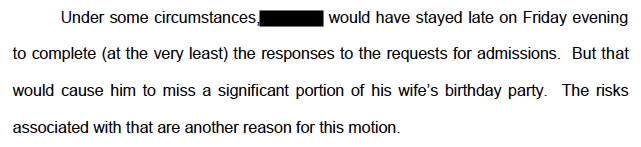
His response, in part, contained the following:Yes, he actually told the Court that he feared “the risks associated with”… “miss[ing] a significant portion of his wife’s birthday party,” after already having had more than 100 days to respond to written discovery.

It’s such a joy to argue these motions.  It’s sublimely absurd.

Attorney Casey A. Taylor

We’ve all heard of bankruptcy being used as a shield to protect against creditors’ attempts at debt collection. However, in the practice of law especially, the automatic stay is no longer an issue reserved for those who file bankruptcy, nor does it exist solely within the confines of the bankruptcy courts. Sure, the bankruptcy court generally governs matters involving the “stay” but, particularly in our increasingly adversarial society, these issues tend to bleed over into other legal proceedings as well, such that every litigator (and perhaps every litigant) should be apprised of the ways in which the automatic stay could impact them and their claims.

The bankruptcy petition triggers the automatic stay – imaginary armor that then cloaks the debtor (the person who files bankruptcy), halting all collection efforts by creditors (those seeking to collect money from the debtor).  Uponfiling bankruptcy, a debtor is immediately protected by the automatic stay which prohibits, among other things, “any act to collect, assess, or recover a claim against the debtor that arose before the commencement of the case. . . .” 11 U.S.C. § 362(a)(6). The automatic stay imposes on creditors an affirmative dutyof compliance. Sternberg v. Johnston, 595 F.3d 937, 943 (9th Cir. 2010).

In other words, once you file bankruptcy, your creditors (whether that be the telephone company merely seeking to collect a past-due bill, or someone intending to sue you on a $1 million tort claim) are no longer allowed to take any steps toward recovering that which they think you owe them, in court or otherwise. They cannot call you, they cannot send you a letter threatening action against you if you refuse to pay, they cannot file a lawsuit against you, and they cannot continue to pursue claims that are already pending against you without explicit relief from the bankruptcy court in which your petition is filed. Violating the automatic stay is a very serious offense that often results in an award of damages and attorney’s fees against the violating party.  11 U.S.C. 362(k).

Perhaps you represent a defendant in a contract case, your client filed for bankruptcy (invoking the stay), and the plaintiff’s attorney then serves you with discovery request asking your client to admit that he owes the money sought in the lawsuit. The automatic stay protects your client. Or, maybe you are a passenger who was injured in a car accident, and you are preparing to sue the at-fault driver (a debtor in bankruptcy) for reimbursement of medical expenses. The automatic stay likely prevents you from doing so.

In a practical sense, the affirmative duty of compliance placed on creditors even goes beyond just monitoring their own conduct to ensure that they are not violating the stay – it imposes a duty to police against others, namely courts, violating the stay, as well. This may seem a harsh result, but the Sixth Circuit has explicitly held that creditors cannot sit idly by and allow stay violations occur. See generally Wohleber v. Skurko, 2019 Bankr. LEXIS 653 (6th Cir. March 4, 2019).

In the Wohleber case, the husband-debtor was subjected to a post-petition sentencing hearing arising out of a pre-petition contempt proceeding (i.e., he failed to pay a property settlement previously ordered by a domestic relations court and the hearing was to determine his consequences). At the hearing, the debtor was put in jail until he paid the amount ordered by the domestic relations court (also pre-petition). The husband-debtor later argued that the wife-creditor and her attorney violated the automatic stay by allowing the sentencing to proceed. The bankruptcy court, initially, rejected this argument on the grounds that neither the wife-creditor, nor her attorney took any affirmative action to collect the debt post-petition. However, the Sixth Circuit reversed, holding that the wife-creditor and her attorney had an affirmative duty to “prevent the use of the sentencing hearing and [subsequent confinement] of the [debtor-husband] to coerce payment of the dischargeable property settlement.” Id., at *44.

In sum, the automatic stay is not a concept reserved for bankruptcy courts and the attorneys who practice primarily within it. Instead, it intersects with nearly every area of the law and, frequently, in litigation.  Because the stakes are so high for stay violations and missteps can be costly, it is important that creditors (or potential creditors, or their counsel) are in-tune with what the stay means and the type of conduct it prohibits. It is likewise important for debtors to know their rights so that they can recognize improper conduct if and when it occurs to their detriment.

______________________

For assistance with all of your commercial litigation needs, contact Casey A. Taylor at 513.943.5673 or Bradley M. Gibson at 513.943-6661.

Unless you live under a mossy rock, last week you read or saw that the Finney Law Firm won a swift and important victory for our clients in an important civil rights case.

At 10 PM Monday night, our firm filed a lawsuit exposing the unlawful handcuffing, arrest and search of a black Realtor and his homebuyer by nine police officers responding to a caller falsely claiming a breaking and entering at a home for sale in Price Hill.

At the same time as the filing, Channel 19 broke the story with a detailed newscast using body cam videos from the officers showing guns drawn, handcuffing for a protracted 4-5 minutes, and an illegal search of the innocent pair.  The house was for sale and had a “for sale” sign in the yard and a lockbox providing keyed access to the home.  The Realtor properly had made an appointment for the showing and legally made entry into the home via the key provided.

Our clients, Realtor Jerry Isham and his home buyer Tony Edwards, entrusted the important case to our firm.

In addition to the constitutional violations by the responding police officers, the City had illegally destroyed seven of the body camera videos months after our firm formally requested them, in itself actionable in a law suit.

At 2:30 PM the following day, fewer than 16 hours and 30 minutes after the filing of the suit, the City settled the case for 100% of the demand of the clients, including police and Realtor training seminars on police interaction on home sales.

In this instance, the Finney Law Firm provided swift and full justice for the Plaintiffs, but also sent a message into the community about respect for the constitutional rights of African American citizens engaged in entirely lawful behavior.

You may see the Channel 19 story here and read about the settlement in the Enquirer here.

In addition to our appreciation to our clients for entrusting our firm with this case, we also thank the City Solicitor’s office and Mayor Cranley for their leadership in quickly recognizing the legitimacy of the claims and settling them.

Tonight, Channel 19 has a well-researched story by Jennifer Edwards Baker of our clients, Jerry Isham — Realtor — and his buyer Tony Edwards, innocently looking at a house in West Price Hill for possible sale, when they were rousted by eight Cincinnati Police Officers with guns drawn.  The police then illegally detained and handcuffed the pair, and illegally searched Mr. Isham’s pockets.

They had done absolutely nothing illegal; they had done absolutely nothing wrong.

It’s truly as if CPD officers have received no training on the constitutional limit on the exercise of their their policy powers.

Incidentally, CPD illegally destroyed seven of the body cam and dash cam videos of the incident after they were subject to a formal public records request from the City.

Read the Ch. 19 story here:   Lawsuit: Realtor, prospective home buyer illegally detained by CPD after retired cop calls 911.

The Fox 19 video story is here.

For more information, call Chris Finney at 513-720-2996.


In May, Finney Law Firm notched its fourth in a series of wins in class actions against point-of-sale inspection ordinances in Ohio and Kentucky.  Previous judgments or settlements have been achieved against Covington, Kentucky, Oakwood, Ohio and Portsmouth, Ohio.  Each Ohio case was co-counseled with attorney Maurice Thompson and the non-profit law firm the 1851 Center for Constitutional Law.

It seems to have become a trend for municipalities to enact ordinances that mandate municipal inspections of rental properties (interior and exterior) either before a new tenant moves in or annually and pre-sale.  Very simply, all of these ordinances are unconstitutional searches of property under the Fourth Amendment to the United States Constitution.

Maurice Thompson of the 1851 Center has proficiently developed and pursued this line of cases and the legal theory underlying each case.

Our suits have succeeded in each instance in obtaining injunctive relief against the impermissible enactment, and the class action recovers the illegally-obtained inspection fees for the property owners affected.

For more information on our public interest litigation practice, contact Christopher P. Finney at 513-943-6655.


As we discuss here and here, title insurance provides a lifetime of coverage to the insured owner, and covenants in a general warranty deed also last forever.  This is true, however, only as to losses sustained by the insured under a title insurance policy and the grantee under a general warranty deed, and essentially as to no other party.  Let me explain.

Title insurance

An owner’s policy of title insurance is a one-time premium in exchange for permanent coverage of losses sustained by the insured.  And what this means is that coverage is in place as to both (a) losses sustained by the insured while he is the owner of the property and (b) claims against the insured after he  conveys the property by general warranty deed (only as to claims that existed before the policy was issued).

Warranty covenants

Similarly, when a grantee acquires title to real property from a grantor by a limited warranty deed or a general warranty deed, he benefits from those covenants forever (read about different warranty covenants here).  This extends beyond his ownership of the property to claimants who acquire the property through a chain of warranty covenants.  Each owner can sue “up the chain” to the grantor who conveyed property to him or her up to the party who first created the title problem.  This “chain” is created and maintained by successive general warranty deeds.

Breaking the chain

But the benefits of both of these forms of indemnity are destroyed when a grantor deeds property to another by limited warranty deed or quit claim deed.  This is because the insured, or grantee under a warranty deed, no longer has a risk or “an insurable interest” in title to the property when  he conveys the property away by quit claim deed.  And since a limited warranty deed only applies to title problems arising after the grantor acquired title, there is nothing to blame on anyone else “up the chain”.  Because that grantee can’t claim “up the chain,” the insured no longer has liability.  And further, since the insurance or warranty covenant covers only the grantee’s or insureds “risk,” and he no longer has any exposure, there is nothing to insure or against which to indemnify.

Insured’s estate planning or asset planning

Many times, an owner of real property will convey property into his own limited liability company or estate planning trust for liability protection or tax benefits.  And in doing so, whether on their own or through their attorney, the owner transfers the property by quit claim deed.  That’s effective to transfer real estate, but all of the benefit of the title insurance (that someone paid good money for) or the warranty deed is completely, unconditionally and forever destroyed.

A better option: General Warranty Deed

Thus, when conveying property between an owner, and his trust or his own LLC, it is advisable to do so by means of a general warranty deed, thus preserving all benefits acquired by an owner’s policy of title insurance or general warranty covenants.


Updated with links to recent filings below

More than three months after the open meetings lawsuit against Cincinnati’s self-proclaimed “Gang of Five” – Councilmembers Tamaya Dennard, Greg Landsman, Wendell Young, Chris Seelbach and PG Sittenfeld – there is a new development with the filing of a lawsuit against the City of Cincinnati, Binary Intelligence, and a Finney Law Firm, essentially seeking to undo Ohio’s public records laws.

Bizarrely, the case is brought by two “John Does” in an effort to conceal their identities, but whom allege their communications with members of the Gang of Five have been produced in response to public records requests coming since the resolution of the Finney Law Firm suit, and a public records suit won by Angenette Levy and Channel 12. The Levy lawsuit provided a judicial declaration that there is no practical difference between text messages and emails in the context of public records law, and that the fact that a communication is made from or stored on a personal device does not mean that the communication is not a record under Ohio law. Read the text messages released in response to Angenette Levy’s suit here.

The John Does seek to enjoin the City from maintaining its file of communications to and from the Gang of Five and to force Finney Law Firm to destroy the public records he has obtained from the City in response to requests he has made on behalf of clients.

A hearing on the Plaintiffs’ motion for a temporary restraining order is scheduled for Tuesday, July 2 at 3 pm before Judge Michael Barrett.

Media Roundup:

Channel 12’s story is here.

Cincinnati Enquirer coverage is here.

Channel 9’s coverage is here.

Channel 19’s coverage is here.

The City’s memo in opp to the motion for a temporary restraining order is here, Exhibits A-E are here, here, here, here, and here.


[scribd id=415030882 key=key-aBcXlVnsaTxHkdQBzGFx mode=scroll]


As I meet with clients to explain the expensive and drawn-out odyssey that litigation can become, it can be a challenge to explain the mind-bending mental gymnastics that attorneys can force parties to endure.  Things that are painfully logical and simple to ordinary folks (laymen, non-attorneys) can be expensive and difficult to establish in court as litigants want to argue over absolutely everything.

The best example I can give of this is an exchange I had in a trial held before Federal District Court Magistrate Litkovich in January of this year.

This trial was an MSD claim relating to the MSD’s administrative claims process for basements subject to sanitary sewer backups.  This case was an extreme instance in which our client experienced more than 9′ of effluent that came into his basement on a regular basis, and MSD simply refused to stand behind its obligations under a consent decree arising from prior litigation with the US EPA.

To win, we had to prove these things: (a) sanitary sewer “surcharge” flooded his basement, (b) on multiple occasions, (c) that MSD was unable to develop an “engineering solution” that would stop the flooding, and (d) that he had made a claim to the MSD hotline within 24 hours after an incident.

The flooding was so severe and repeated that these elements were easily proved.  Yet for two years, MSD had refused to negotiate a settlement in good faith.  They insisted upon a trial, even though there was no factual issue in dispute; from our perspective, there was simply nothing to try.

So, MSD’s attorneys adopted the defense at the hearing that our client, the Plaintiff, could not prove that it would actually rain again:

Tim Sullivan of Taft, Stettinius & Hollister represented MSD at the hearing and here he was questioning my client’s expert witness:

Q. And if we had no rain, if climate change really turns out to be as dire as some people tell us, you would agree this property would have no problem in the future?

A. If there was no rain?

Q. Right, or not enough rain to cause any surcharge from any part of the Sewer District system.

A. Yeah, I would think the property would be — certainly you could take another look at living there and going there if you have no risk of backups, any kind of backup.

I must admit it was a creative question: “What if it never rains again?”  Brilliant! And we already had our lineup of witnesses named.  Who could testify with requisite expertise that, in fact, Cincinnati would experience a rain event in the future?

We ultimately settled the case.  But after 30 years of doing this I once again learned the hard lesson that lawyers can argue over absolutely anything.

And for the record, since this hearing, Cincinnati has experienced 15″ in rainfall more than is average for this point in the year. Yes, Virginia, it is going to rain again.

_____________________

For help with your litigation challenges, call Bradley M. Gibson at 513-943-6661 and for help with MSD claims call attorney Julie M. Gugino at 513-943-5669.

_____________________

A copy of the transcript excerpt in this exchange is attached here.  The quoted language is at page 19, starting at line 13.


The hot topic today in Ohio real estate law is the problem for sellers and Realtors of buyers backing out of residential purchase contracts and thus, after tying up a property for 15 to 30 days, putting the property back on the market for sale. This creates the problem of a “stale” listing and the further problem of other Realtors and buyers asking “what was wrong with that property that Buyer #1 backed out?”

How can your seller avoid this problem?

Defining the problem

First, let’s define the problem.  In today’s hot real estate market, residential properties come on the market and days or even hours later they are under contract and unavailable.  Buyers, fearful of missing out on a deal, have met this challenge by quickly placing a property under contract, figuring they could make their “real decision” during the inspection or financing contingency periods.

Thus, after 10 to 20 days, they perform their home inspection and decide — perhaps for no valid reason — to terminate the contract, leaving the seller holding the bag after having wasted that two to four weeks of prime marketing season.

So, I have had prominent Realtors ask me: What can sellers do to prevent this?  Here’s some perspectives:

Contracts mean something

As a starting proposition, even though the CABR Contract has some holes (read here) and contingencies (inspection, financing, etc.) can provide an “out,” contracts actually mean something. In other words, contracts are written to be enforced (i.e., use as a basis for a law suit), not to be put on a shelf.

If a buyer has not threaded the needle in terms of properly terminating a contract pursuant to a contingency, then the buyer is obligated to perform.  If he fails to, he can be sued for either specific performance (i.e., make him buy) or money damages for their breach.

Earnest money does not define or limit damages available

Here are two blog entries I have written on earnest money under Ohio real estate law:

The pertinent language I want to highlight is:

  • “a common misunderstanding of parties to a purchase contract is that the escrow money is some sort of measure of or limitation on damages for the buyer’s breach, or, conversely, that the return of the earnest money “cures” the seller’s breach and is the limitation on his damages as well. However, unless the real estate purchase contract specifically calls out either of those limitations, neither of those propositions is true.”
  • “This article seeks to bust a common myth about an escrow deposit: That a seller must return the earnest money of a buyer he claims is in breach before selling the home to a second buyer.”

Thus, forfeiture of the buyer’s earnest money in the event of a clear default is not the default remedy — although many times the parties settle for that.  The Buyer has open-ended exposure for the seller’s damages arising from a breach.

Residential property litigation is rarely cost-effective

For a host of reasons (see this blog entry), litigation is typically not cost-effective, meaning that frequently the cost of litigation will exceed the recovery.  This is so because (a) litigation is so incredibly expensive, (b) the damages recovery available to a seller are both difficult to determine and many times lower than a seller might anticipate, and (c) the outcome of litigation is incredibly unpredictable.  I tell clients that many times they would be better taking their money to the casino and betting it than investing in litigation.

However, using the cudgel of threatened or actual litigation can  either help (a) force a buyer to close or (b) leverage a favorable settlement for the seller in the event of breach.

Practical solutions

In a typical arm’s length purchase contract in the greater Cincinnati marketplace, the buyer has an inspection and a financing contingency, and places a low ($1,000 or less) in escrow with the buyer’s broker at the time of contract signing that is refundable if the contingencies are not fulfilled.

But in today’s “Seller’s market,” there’s nothing to say that a seller cannot demand a better position in the purchase contract to address the “backing out” problem.

  • Get more earnest money.
  • Limit the contingency period so the time “off market” is reduced.  (When I am a seller, this is paramount to me.  Don’t waste my time if you are not serious.)
  • More due diligence on the buyers to “know” they are serious (are they prequalified?, are the planning to buy and flip?, do they have a house they themselves need to sell first before buying?, what is their background?).
  • Did the buyer actually look at the property before making an offer?  This is a sure sign of a buyer who intends to “make his decision” at a later date.
  • Deal only with serious agents and serious brokerages on the other side.  In my experience, buyers are going to find a broker who meets their profile.  Flaky agent, flaky company = flaky buyer.
  • Make earnest money non-refundable and even payable directly to the seller, not in escrow.
  • Have the home pre-inspected, and have the buyer use that inspection report, thus no contingency needed.
  • Sue to obtain actual damages or to intimidate a buyer into closing.

Conclusion

We have a problem of balancing the legitimate interests between (a) the seller not wanting unserious buyers tying up their property on the one hand, and (b) buyers legitimately needing to “kick the tires” before closing on the other hand.  This balance in a traditional purchase contract is heavily tilted to buyers to give them an open-ended opportunity to walk away during the contingency periods.  It doesn’t have to be that way.  Sellers can “tighten things up” in a purchase contract to tilt that equation more in their own direction.