
Nearly every aspect of the modern world is regulated, in one manner or another, by the use of contractual agreements. As a result of their ubiquity, it is unrealistic to expect the average person to read every word of every contract they sign. To be clear, under no circumstance do we advise signing a contract without reading it, but one must discard reality to believe that such advice will be received, much less heeded. That said, the purpose of this article is to provide guidance for the average person to use when faced with a contract, particularly in light of the general propensity to sign contracts without reviewing them.

Ordinary contracts and adhesion contracts

Insofar as this article is concerned, the most prominent aspect of contract law is the distinction between ordinary contracts and adhesion contracts. Consider ordinary contracts to be agreements between two or more parties that are reached by negotiation. For example: (i) a real estate purchase contract where one party must sell his or her property in exchange for a negotiated purchase price or (ii) an employment contract where one party must perform work in exchange for negotiated income and benefits. As these contracts are bargained for, the parties need to be absolutely sure that the terms agreed upon are, in fact, the terms contained in the written agreement. This concern is exacerbated by the endless spectrum of legal clauses that can be drafted into a contract. As a result, the only way to achieve certainty is to read the contract, and consult with legal counsel regarding any provisions that: (i) you do not understand, (ii) you are not comfortable with agreeing to, and/or (iii) are contrary to your understanding of the agreement of the parties.

On the other hand, adhesion contracts are best defined as agreements between two or more parties wherein the terms are set by one party without negotiation. Examples of adhesion contracts include: insurance contracts, cell phone provider agreements, loan agreements, etc.

Less risk in Adhesion Contracts

Again, this is not advice to sign contracts without reading, but, for those persons who are going to do so anyway, it is worth noting that between the two types of contracts, adhesion contracts pose less concern for a variety of reasons including, but not limited to, the following:

1. If you want the product being offered, then you have to agree to the terms being offered. Why? Because you have no bargaining power to negotiate them. For example, if you walk into Verizon and ask them to change a provision in their cell phone provider agreement, then you will, in all likelihood, leave the store without a cell phone plan.

2. Countless people before you have signed an agreement with identical or nearly identical terms. This does not in and of itself mean that a contract is risk free; however, continuing with Verizon as an example, it is reasonable to equate the number of long term Verizon customers with the acceptability of Verizon’s contractual terms.

3. Other than notice provisions (i.e., requirements to notify other parties upon the occurrence of a triggering event) and negative covenants (i.e., promises to refrain from doing something), consumer obligations under adhesion contracts typically revolve around money to be paid in exchange for a service or product. In other words, the consumer side of an adhesion contract is less likely to have obligations beyond the payment of money.

4. Analyzing a dozen or more pages of legalese can be a burden for the most brilliant of legal minds, so the idea that the average person can read through the same while standing at a check-out counter is nothing short of absurd. While every contractual provision is important, the average consumer is mainly concerned about the cost of the product or service. Thus, the decision to execute a contract is more often based on the consumers’ desire to obtain the service or product rather than their agreeability to convoluted contractual provisions.

5. Unconscionable contract provisions are not enforceable. A provision is unconscionable if it is substantively unfair or oppressive to one party, or otherwise represents a degree of unreasonableness. If there are unconscionable terms in a contract, then a court will either strike the provision from the contract or declare the contract void in its entirety.

Ohio Consumer Sales Practices Act

In addition to those reasons stated above, Ohio consumers are protected under the Consumer Sales Practices Act (the “CSPA”), which states among other things that suppliers cannot commit unconscionable acts or practices in connection with a consumer transaction. A supplier is defined as “a seller, lessor, assignor, franchisor, or other person engaged in the business of effecting or soliciting consumer transactions, whether or not the person deals directly with the consumer.” To determine if a transaction or contract is unconscionable, CSPA asks if the supplier: (i) knowingly took advantage of a consumer because of the consumer’s physical or mental infirmities; (ii) charged a price that substantially exceeded the price of similar property or services that are readily obtainable; (iii) knew the consumer could not receive a benefit from the property or services; (iv) knew the consumer was unable to pay; (v) required consumer to enter a transaction where supplier knew the terms were substantially one sided; (vi) knowingly made a misleading statement that the consumer was likely to rely on, or (vii) refused to make a refund for a return unless there is a sign posted at the establishment stating such refund policy.

The CSPA also regulates suppliers by proscribing unfair and/or deceptive acts in connection with consumer transactions. Moreover, CSPA lists a series of acts and practices that are per se deceptive. That list includes, but is not limited to, a supplier’s false representation to a consumer of any of the following: (i) a product or service contains benefits that it does not have; (ii) a product or service is of a particular grade or quality, when it is not; (iii) a product is new or unused, when it is not; (iv) the product or service is available for a reason that does not exist; (v) a replacement or repair is needed, when it is not; and (vi) that a price advantage exists, when it does not. If a supplier runs afoul of this statute—or any CSPA provision—the consumer may bring a cause of action for the actual damages he or she incurred plus an amount not to exceed five thousand dollars ($5,000.00).

Conclusion

Ultimately, you should read every contract that you sign, regardless of any representations or verbal agreements. It does not matter what you agreed to verbally if you signed a document that states otherwise. This article is not intended and shall not be construed as providing advice to sign documents without reading them. Rather, this article merely offers a pragmatic view of the all-too-common practice of signing contracts without reading them.
Today, attorneys for the City of Cincinnati filed the self-proclaimed “Gang of Five’s” answer to the April 9, 2018 Open Meetings Complaint (read the complaint here, read additional blog posts about the case here and here).

Surprisingly, the Gang of Five deny that they conducted meetings via telephone, email, and text message.  We say surprisingly, because the emails and text messages attached to the complaint make clear that the Gang of Five did conduct such meetings.

The councilmembers’  responses to interrogatories and requests for documents are due later this month, and depositions are set to begin shortly.

[scribd id=380988345 key=key-xzHGFm3H8LOpoQ42PC7i mode=slideshow]

A general durable Power of Attorney granted by a person (“Principal”) to a designated attorney-in-fact (“Agent”) provides full power, authority and discretion to do all things required or permitted to be done in carrying out the purposes for which the Power of Attorney is granted as fully as the Principal could do if personally present (unless it is a Limited Power of Attorney granting specific limited powers to the Agent).

It is very important for the Principal to appoint an Agent that is trustworthy and who the Principal believes will fulfill his or her fiduciary obligations to the Principal.  No matter how selective a Principal may be in appointing the Agent, there is always the possibility of the Agent abusing his or her fiduciary obligations.

  1. Theft and Improper Asset Transfers.

There is no question that an Agent acting under a durable Power of Attorney has a fiduciary obligation to the Principal, which includes both the duty to act in the Principal’s best interest, and the duty not to use the relationship improperly for the Agent’s advantage.  If an Agent transfers the Principal’s funds in a way that the Principal would not have wanted, the transfer seems abusive.  Such a transaction may even rise to the level of theft.  Many times there are cases where Agents use durable Powers of Attorney to extract money or assets from their Principals.  If the Agent is not a family member or a close friend, it seems clear that transfers of assets to the Agent are abusive.

Most people name family members as their Agents.  Determining whether a transfer is abusive becomes much more difficult in a family context.  A family member Agent who transfers funds or other assets to himself or herself may believe that the Principal would have wanted the Agent to make the transfer.

Therefore, it is important for the Principal to discuss his or her wishes with the Agent regarding transfers, and to make sure that the Power of Attorney authorizes the Agent to make any desired transfers.  If the Principal wishes the Agent to have the power to make only gifts that would qualify for the Federal gift tax annual exclusion, this limitation should be included as a provision in the Power of Attorney and also discuss it with the Agent.

Further, if a Principal does not want to grant the Agent authority to transfer assets, it is imperative that a provision be included in the general durable Power of Attorney restricting the Agent from making such transfers.

  1. Interference With Principal’s Estate Plan.

An Agent may be faced with dealing with property that has been specifically disposed of in the Principal’s estate plan.  This type of interference ranges from an act by an Agent performed with the specific intent to deprive a specific beneficiary named in the Principal’s estate plan to receive a gift, to a transfer made without thought of the Principal’s estate plan.

  1. Remedies for Abuse.

Attorneys are often asked what remedies are available for abusive acts by Agents appointed in a durable Power of Attorney.  In most cases, courts seem to agree that an Agent under a durable Power of Attorney is governed by some fiduciary standard.

It is possible that an improper transfer could be prosecuted as theft, and a court could order restitution to the Principal.  Also, improperly transferred funds could be recovered through a civil lawsuit for breach of fiduciary duty.  The funds may not be recoverable because the abuse cannot be proven, or because the Agent has dissipated the funds.


As has been discussed in numerous posts on our firm’s blog, see here, here, and here, the changes to Ohio’s property valuation law enacted in 2012 are slowly coming into effect as the Ohio Supreme Court has been consistently ruling that the changes made by the legislator mean exactly what they say.

Notably, R.C. 5713.03 was amended specifically to require that real property be valued for taxation purposes, “as if unencumbered.” But auditors and school boards have resisted calls to apply the plain meaning of “as if unencumbered” to include leases, arguing that “as if unencumbered” refers only to liens or easements.

Yesterday (May 22, 2018) the Ohio Supreme Court weighed in again on the question in Lowe’s Home Centers, Inc. et al. v. Washington County Board of Revision, et al., Slip Opinion No. 2018-Ohio-1974, that “it is plain that a lease is an encumbrance and that R.C. 5713.03’s directive to value the realty ‘as if unencumbered’ means to value the realty as if it were free of encumbrances such as leases.” Id. at ¶19.

In Lowe’s, the County’s appraiser compared leased fee properties to the subject property to ascertain the value, and made adjustments to account for the leases. The Board of Tax Appeals adopted the value proposed by the County’s appraiser, but appeared to rely on a case decided prior to the amendments to R.C. 5713.03, thus leaving some question whether the Board of Tax Appeals analyzed the lease adjustments.

Unquestionably, the changes, aimed mostly at commercial property valuation, bring with them new challenges for Ohio’s auditors and school boards (the major recipient of property tax dollars). And there are certain to be calls for new amendments to undo some or all of the recent changes.

The deadline for filing Board of Revision Challenges has passed for this year. To learn about the Board of Revision process in preparation for next year, watch Chris Finney’s presentation here. Contact us here if you have questions about your commercial property valuation.

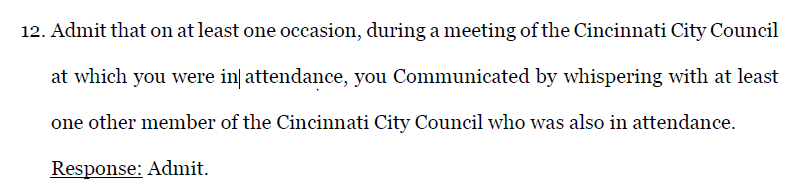
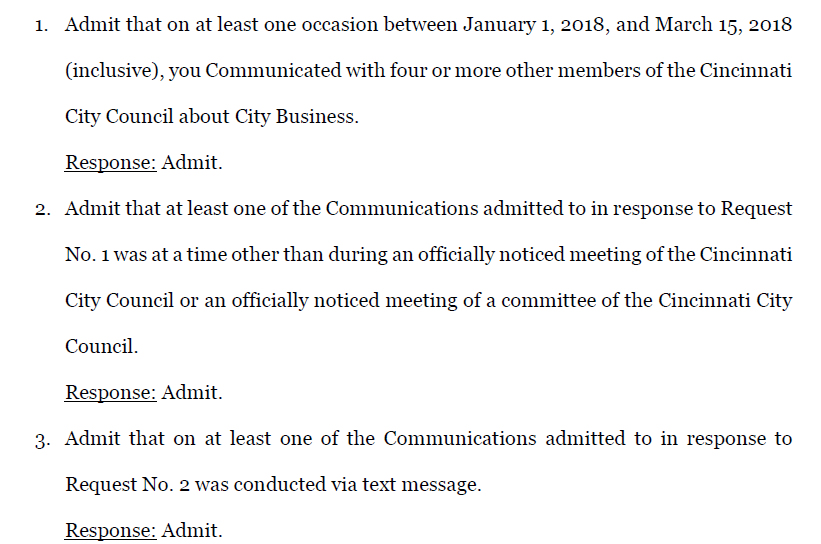
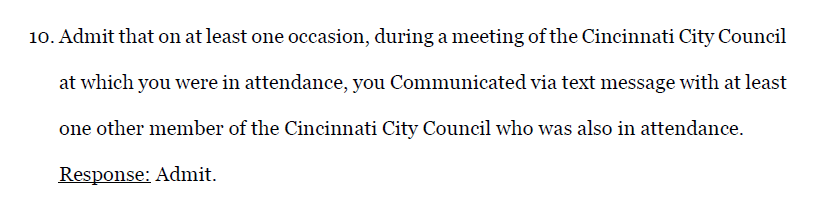
As part of their responses to the first round of discovery in our Open Meetings lawsuit, Cincinnati City Council Members PG Sittenfeld, Chris Seelbach, Wendell Young, Tamaya Dennard, and Greg Landsman – the Self-Proclaimed “Gang of Five” – have now admitted to additional Sunshine Law violations: other meetings conducted via text message, and whispering and texting to each other during City Council meetings.

Thus far, the Gang of five have only responded to our requests for admission, still outstanding are responses to our interrogatories and requests for documents. The City asked for, and we granted, an extension of time to respond to the interrogatories and document requests. Those responses will shed even more light on the topics of discussion during the illegal meetings and result in the production of additional text message correspondence between the Gang of Five.

What is unquestionable now is that the question of firing the City Manager was not the first time the Gang of Five discussed public business outside the public eye, in clear violation of Ohio’s Sunshine Laws and the Cincinnati City Charter.

Next steps are to obtain the additional written discovery responses and then depose the Gang of Five under oath.

As part of his political “house cleaning” when he first took office, Aftab Pureval paid severance packages to outgoing employees and required that they sign non-disclosure agreements. Local government watchdog Mark Miller asked for copies of these records, only to be ignored by Aftab Pureval.

Now, six weeks after Pureval received the request, and with no response whatsoever from Pureval, Finney Law Firm filed suit to force the release of the requested records.

It is expected that the records will show that Pureval used attorneys other than his official statutory counsel in drafting these agreements, and that the agreements are legally unenforceable; that they were simply a means of coercing former employees into silence as he prepared his run for higher office.

Read the complaint below or click here to view it on Scribd.

[scribd id=377796673 key=key-tff3AszQ6iZyPzYNIFo4 mode=scroll]

Social media sites such as Facebook and LinkedIn are commonly used by employees to provide updates about their professional careers and business activities. When posting about such things, most people probably don’t think about whether they might be breaching a contract they made with a previous employer. They should.

There have recently been several cases filed by former employers against ex-employees, alleging that the employees have violated a non-competition agreement or non-solicitation agreement through their social media posts. In one such case, filed in Minnesota, an employee who had left her employer to work for a competitor filed a post on LinkedIn about her new job, inviting people in her social network to contact her for a “quote,” telling them that her new company was the “best,” and inviting them to “connect” with her. The court held that this “post” was really a sales pitch on the employee’s part, and that it violated the terms of a non-solicitation agreement she had with her previous employer.

In another case, an employee was sued by his former employer for sending a LinkedIn invite to his former co-workers to join his network. Anyone who accepted the invite would see a job posting for the employee’s new employer. His former employer considered this to be a “solicitation” by the former employee of its current employees, in violation of a clause in  the employee’s non-solicitation agreement. Here, the court found that the employee had not violated his agreement, ruling that the post was simply a “status update” rather than a “solicitation,” despite the link to the job posting.

These cases illustrate that merely accepting or sending a friend request on Facebook, or updating a LinkedIn profile, will not violate a non-compete or non-solicitation agreement. However. social media posts aimed at a specific population, or focused on former colleagues or customers, may be actionable. Former employees bound by non-compete or non-solicitation agreements should be very careful when using social media platforms, especially if they intend to engage in promotional activity. Anything more than a mere status update or generic invitation to join a social media group may get the employee in serious legal trouble.

Therefore, employees who have signed non-compete or non-solicitation agreements should understand the scope and reach of those agreements before engaging their social media network. And employers seeking to enforce their contractual rights should be mindful of activity their ex-employees may be engaged in on social media.

Today, Finney Law Firm filed suit against the self-proclaimed “gang of five” – PG Sittenfeld, Chris Seelbach, Wendell Young, Tamaya Dennard, and Greg Landsman – seeking production of public records they are withholding in violation of Ohio’s Public Records Law.

On April 9, 2018, Finney Law Firm submitted a public records request on behalf of Mark Miller, to each member of the “gang of five” seeking production of all communications between each of them and any other member of council from March 1, 2018 to March 19, 2018 regarding Harry Black or John Cranley.

This morning, attorneys for the City produced 10 pages of group text messages between all five members, but made clear that they refuse to produce text messages or emails other than the group-messages. As Cincinnati Enquirer attorney, Jack Greiner, told the Cincinnati Business Courier, this is contrary to the requirements of the Public Records Law, R.C. 149.43:

Jack Greiner, an attorney at Graydon Head & Ritchey who represents other Cincinnati media organizations in public records and open meetings matters, said state law requires that public records be kept, that communications between officials are a public record and text messages qualify as communications.

“The format shouldn’t matter,” Greiner said. “The city has a records retention schedule that would cover those. The city has to figure out how they’re going to retain that information and archive it.”

You can read the complaint below or on Scribd here.


[scribd id=376746523 key=key-KDMKBBP0yJvZtvUqNh9n mode=scroll]

This morning the City of Cincinnati released a collection of text messages exchanged between five Cincinnati Councilmembers that made up a series of illegal meetings regarding the question of whether and how to terminate the City Manager.

While the City has yet to produce all of the responsive records, this production demonstrates the need for our lawsuit and injunction to force compliance with the Open Meetings Act. Unfortunately, because the City continues to withhold additional records, our client will be forced to bring another suit against the City and the rogue members to force compliance with the Public Records Act.

You can read the text messages on Scribd or below:
[scribd id=376698656 key=key-45W4n9CmI6tNLgrqLLaZ mode=scroll]