In our Spring 2017 newsletter, we introduce you to the paralegal team we have carefully assembled as well as provides updates in commercial leasing, labor and employment law, and medical malpractice litigation,
Read it here.



In our Spring 2017 newsletter, we introduce you to the paralegal team we have carefully assembled as well as provides updates in commercial leasing, labor and employment law, and medical malpractice litigation,
Read it here.
 In the last 20 years or so, it has become more and more common for employers to require employees to enter into arbitration agreements. These are documents or policies that are designed to protect employers from having to defend lawsuits in court. They provide that if any legal disputes arise between the employer and the employee, before or after the employment relationship ends, they will be submitted to an arbitrator for decision, instead of to a judge or jury.
Employers have tended to favor these agreements for several reasons. First, the idea is that arbitration takes less time and is more streamlined than a court case, and therefore costs much less in attorney fees. Secondly, it is generally believed that arbitrators are likely to me more “employer friendly” than juries. Thirdly, there is believed to be less chance of a really “eye popping” damage award from an arbitrator than from a jury.
There is some validity to each of these considerations. And employee advocates have resisted arbitration agreements where they can, primarily because they prefer that their employee clients receive jury trials, and they view juries as more sympathetic to employee rights. There is some truth to this.
Employers should be aware that, In order for an arbitration agreement to be enforceable, it has to meet certain requirements:
1. It has to really be an “agreement.” In other words, it should be a written document signed by the employee. Merely having an arbitration “policy” that the employee does not formally agree to may be unenforceable.
2. It must allow the employee to recover the same remedies available at law. An agreement that limits the employee’s recovery, such as by prohibiting certain types of damages, may not be enforced.
3. It can’t make it too expensive for the employee to pursue arbitration. If the costs of arbitrating are far more expensive to the employee than the filing fees charged by a court, a court is less likely to enforce the agreement.
This last point has caused some employers to re-think the wisdom of requiring employees to sign arbitration agreements. The cost of paying an arbitrator for his or her service can be a five-figure expense. If the employer has to bear that expense alone – as it may have to do in order for its arbitration agreement to be enforceable – suddenly arbitration may not seem like a much less expensive alternative to a court proceeding.
Additionally, many sets of arbitration rules that apply in employment cases – such as those of the American Arbitration Association – have expanded the “discovery” (depositions, interrogations, etc.) permitted before an arbitration hearing. This is designed to make sure the employee has a fair opportunity to develop evidence to support his or her case, but it also makes the process longer and more expensive – again, more like a court proceeding.
Whether you are an employer or an employee, if you have questions about whether arbitration agreements are a good idea, or about whether a particular agreement is enforceable, please give us a call.
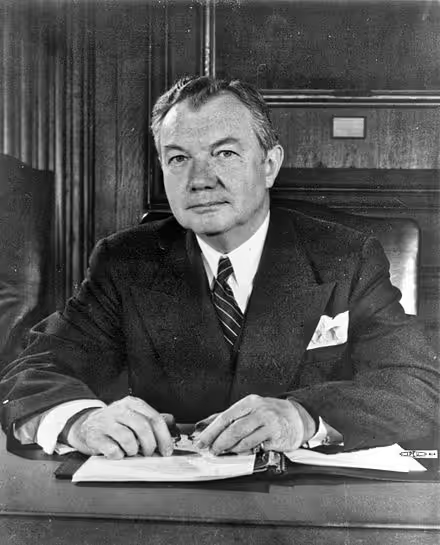
The Solicitor General of the United States is the attorney for the government who presents briefs and oral arguments before the U.S. Supreme Court. The person who holds this position, thus, makes more frequent — and more important — appellate arguments than just about anyone.
Often, the U.S. Solicitor General is later appointed to the United States Supreme Court, the earlier job being both a proving ground for that important position, and a place from which the holder can become known to the President of the United States, who makes such appointments.
Thus, I got a chuckle out of this quote from former Solicitor General Robert H. Jackson, who himself was appointed to the U.S. Supreme Court by President President Theodore Roosevelt. (As a side historical note, Jackson is the only man to have held all three jobs as U.S. Attorney General, U.S. Solicitor General and Supreme Court Justice.)
“I used to say that, as Solicitor General, I made three arguments of every case. First came the one that I planned–as I thought, logical, coherent, complete. Second was the one actually presented–interrupted, incoherent, disjointed, disappointing. The third was the utterly devastating argument that I thought of after going to bed that night.”
This is, of course, precisely what appellate advocacy is like.
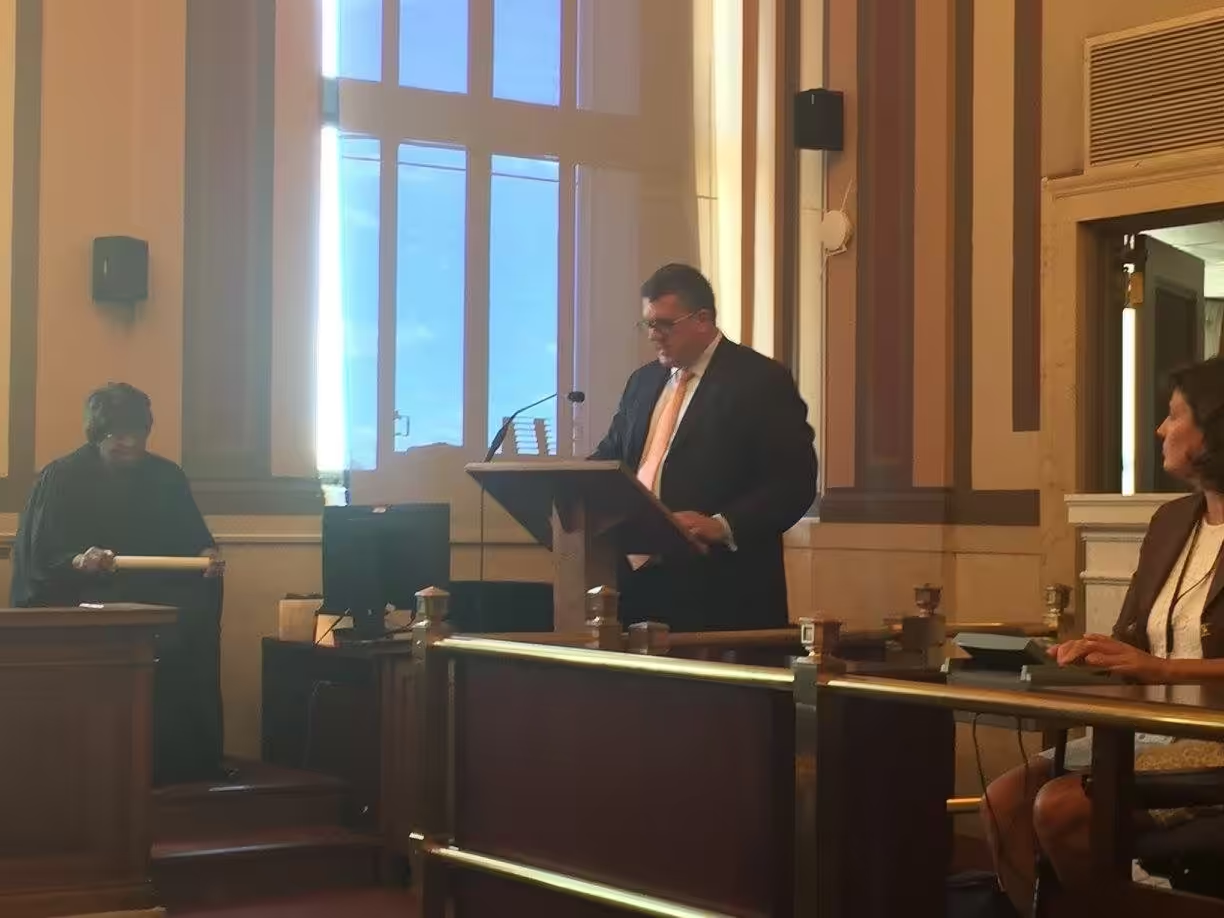
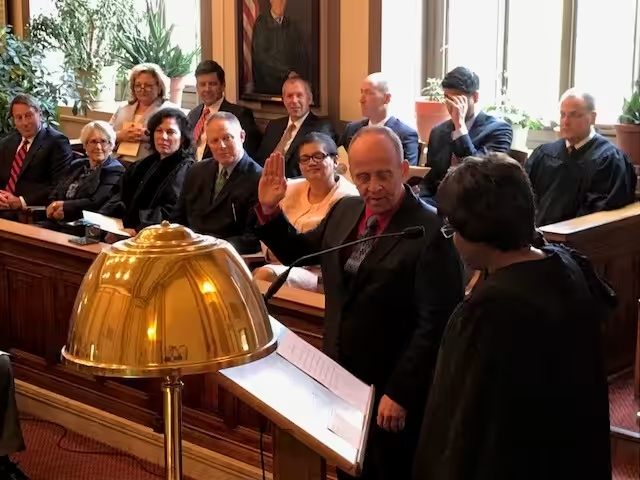
Today, former Finney Law Firm attorney (of counsel) Curt Hartman took the oath of office as a Judge on the Hamilton County Common Pleas bench. The oath was administered by Judge Melba Marsh. Judge Hartman was appointed by Governor John Kasich to the bench to fill the unexpired term of Judge Beth Myers, who last fall won a seat on the Court of Appeals.
Immediately afterwards, Judge Hartman’s parents — Carl and Barbara Hartman — formally “robed” the Judge.
Our own Chris Finney served as Master of Ceremonies.
It was a joyous occasion. Congratulations, the Honorable Curt C. Hartman!
For both landlords and tenants, there is curious and confusing phraseology in many if not most commercial leases relative to the payment of rent:
Rent will be paid without any set-off, counterclaim, deduction or recoupment whatsoever.
That sounds like (and is) a lot of legalese, but what does that mean?
It is, in fact, an important provision of commercial leases. What it means is simply that rent is due from the tenant without delay or reduction based upon claimed breaches of the lease by landlord. Thus, if the tenant thinks he has defenses to the payment of rent, or claims against the landlord, he must bring them in a separate court action and not use the tactic of offsetting rent — and delaying an eviction — based upon meritorious or frivolous claims of landlord breach.
The provision is not unnecessarily unfair to one side or the other. Rather, it is a business term for negotiation between the parties.
From a landlord’s perspective, he is surrendering possession of the Premises to tenant and tenant should, month in and month out, pay him for that possession. If the tenant is “starving” the landlord of rent, while the landlord has to pay his mortgage, taxes, maintenance and insurance, it is a painful and stacked deck against the landlord. Further, while each month the tenant is getting the benefit of the bargain by occupying the premises, the tenant may prove uncollectible after months or years of litigation. Further, landlord does not want to find himself in the position of pursuing rent — all the way through a trial — if the defenses of the tenant are entirely fictitious and manufactured just to buy time against an eviction for a rent default.
From the tenant’s perspective, if the landlord has made his building unoccupiable by severely burdensome practices — noise, dust, odors, lack of access or parking, non-operational elevators, bugs, vagrants, etc. — then why should he tender payment every month only to have to litigate in a separate forum to get some or all of that money back? Further, a landlord can similarly bleed a tenant dry by extracting rent during the tenancy while failing to maintain his building. And a landlord may prove judgment-proof as well at the end of litigation.
As a result of the weighing of the interests of the landlord and the tenant, there could be compromise language to sometimes standard form lease “no offset” language — for extreme circumstances that “put a tenant out of business.” But prying that door open even slightly to give the tenant an “argument” against eviction could lead to months or years of costly litigation against a tenant who otherwise would be paying rent monthly.
# # #
Our firm practices extensively in the area of commercial lease drafting and litigation to enforce the same in Ohio and Kentucky. We invite you to use our professionals to assist you with your investment properties. Isaac Heintz leads our practice as it relates to commercial lease drafting and Brad Gibson heads our litigation group for its enforcement or defense.
Yesterday, the family of O’Bryan Spikes announced that they had retained attorneys Chris Finney and Brad Gibson to represent them and the Estate of O’Bryan Spikes in their claims against those responsible for the Club Cameo tragedy.
Read about that here:
Cincinnati Enquirer >> Family of Cameo shooting victim prepares to sue
WCPO >> Cameo Night Club shooting victim’s family to pursue civil claims for his death
Local 12 >> Family of Cameo shooting victim seeks accountability
WLWT >> Cameo Nightclub shooting victim’s family to pursue civil suit in man’s death
WXIX >> Cameo Night Club shooting victim’s family prepares to sue, seeks public’s help
WVXU >> Family Of Cameo Shooting Victim Preparing Lawsuit
This blog will keep you updated on developments in this case as they occur.
 The Supreme Court of Ohio is scheduled on April 7, 2017 to hear arguments in the case of Dennis Stewart, Individually, and as the Administrator of the Estate of Michelle Stewart, Deceased v. Rodney E. Vivian, M.D., et al., 2016-1013. The issue before the court is whether Ohio Revised Code 2317.43, known as The Apology Statute, makes statements of fault or liability made by medical providers while apologizing or commiserating with patients and their families also inadmissible at trial.
The Ohio Apology Statute, O.R.C. 2317.43, was enacted in 2004 with the intention to improve relationships between providers and patients in the case of errors by allowing medical providers to commiserate with patients and their families with the protection that their words would not later be used in a legal action against them. O.R.C. 2317.43(A) reads:
In any civil action brought by an alleged victim of an unanticipated outcome of medical care or in any arbitration proceeding related to such a civil action, any and all statements, affirmations, gestures, or conduct expressing apology, sympathy, commiseration, condolence, compassion, or a general sense of benevolence that are made by a health care provider or an employee of a health care provider to the alleged victim, a relative of the alleged victim, or a representative of the alleged victim, and that relate to the discomfort, pain, suffering, injury, or death of the alleged victim as the result of the unanticipated outcome of medical care are inadmissible as evidence of an admission of liability or as evidence of an admission against interest.
The question before The Supreme Court in Stewart is whether or not statements made by a provider expressing fault or liability while also expressing “…apology, sympathy, commiseration, condolence, compassion, or a general sense of benevolence…” are also to be excluded as evidence.
At issue in the underlying case, is whether statements made by the defendant doctor to the plaintiff’s family in the ICU are admissible. The plaintiff alleged that the doctor’s statements were admissions of fault, while the doctor argued it was his intention to apologize about what happened. The doctor filed a motion in limine to exclude testimony concerning this conversation from the trial. The trial court determined that the doctor’s statements were an attempt at commiseration with the family, however ineffective, and that a statement of fault can be included in an apology.
On appeal, the Twelfth District reviewed a 2011 decision of the Ninth District Court of Appeals in the case of Davis v. Wooster Orthopaedics & Sports Medicine, Inc., et al. In that matter, Leroy Davis, husband of Barbara Davis, deceased, sued Dr. Michael S. Knapic and Wooster Orthopaedics & Sports Medicine, Inc. after Dr. Knapic completely severed Mrs. Davis’s left common iliac artery and lacerated her iliac vein during a lumbar microdiscectomy. Mr. Davis and his daughter both testified at trial that Dr. Knapic told them he had nicked an artery during the surgery and that he took responsibility for it. After the jury awarded Mr. Davis $3 million in damages, Dr. Knapic appealed on the grounds that the trial court admitted apology evidence in violation of R.C. 2317.43. Mr. Davis argued that the court did not admit apology evidence, as R.C. 2317.43 does not prohibit the use of statements of fault, responsibility, or liability. Dr. Knapic argued, however, that a distinction could not be drawn between an expression of sympathy and an acknowledgement of fault because doing so would violate the intent of the statute; the word “apology”, he argued, includes an expression of fault. Mr. Davis argued that the words of the statute did not intend to exclude a direct admission of fault and responsibility.
In the Davis decision, the Ninth District Court of Appeals recognized that the word “apology” could include “an implication of guilt or fault”, but also noted that upon hearing that someone has died, it is common to say, “I’m sorry” without the assumption of being at fault in the person’s death. The court, therefore, determined that the word created ambiguity. In the end, the court opined that when reading the word “apology” in the context of the other words of the statute, “…sympathy, commiseration, condolence, compassion, or a general sense of benevolence…”, that do not express a sense of fault, they believed the statute “…was intended to protect apologies devoid of any acknowledgement of fault.” The appellate court, therefore, ruled that the trial court had correctly admitted the testimony of Mr. Davis and his daughter.
The Twelfth District agreed with the Davis decision in that the word “apology” creates ambiguity in the statute. They disagreed with the Davis court, however, on the intention of the statute. The Twelfth District determined that the statute was enacted to provide medical providers the ability to apologize to and to console patients and families without the fear of legal action. The Stewart court opined that the intent of the statute was to exclude all statements of apology, including those of fault, because a common usage of “apology” is to admit a wrong while expressing regret. The court further noted that since the statute provides that “any and all” statements expressing apology are to be inadmissible, it can be resolved that the intention was to exclude statements of fault as well.
The Ohio Supreme Court’s decision should help clarify the ambiguity in the statute and resolve the conflict that exists amongst the district courts. It will be interesting to see how the Court interprets the statute in light of evidentiary rules that allow admissions of fault to be to be introduced at trial.

Our client, former Enquirer reporter Rachel Richardson, tired of its repeated violations of Ohio’s Open Meetings Law sued the City of Milford.
The City decided to defend the case with vigor, claiming that Richardson could not prove her case that impermissible topics were addressed behind closed doors, inasmuch as what occurred in those illegal closed meetings was subject to attorney-client privilege. In other words, because what they said was secret, we could not prove it violated Ohio law.
Once Judge McBride ruled that the City could not keep their illegal deliberations secret, the case quickly settled.
Read Rachel Richardson’s guest editorial about our “win” in today’s Enquirer.
The attorneys of Finney Law Firm have a long history of fighting for transparency in government. From presenting at workshops on open government to litigating cases seeking redress for violations of Ohio’s Sunshine Laws, we are proud of the work we have done to ensure that Ohioans have every opportunity to know what is being done in their names.
Our recent settlement of a case with the City of Milford is just the latest example of our work to protect the public interest. Our client, Rachel Richardson became aware of several serial violations of Ohio’s Open Meetings Act, and sought our help in opening Milford’s government up to the people.
Ms. Richardson has an op-ed in the Enquirer about the case here. We are proud to have represented Ms. Richardson and we hope you will take a moment to read her story.
If you or your organization would like to learn more about Ohio’s Sunshine Laws and the public’s right to public records, contact attorney Christopher P. Finney at (513) 943-6655 to schedule an appointment or arrange a presentation.
The Individuals with Disabilities Education Act (IDEA) requires public schools to provide students with disabilities a “free appropriate public education” (FAPE). In order to meet this requirement, school administrators are tasked with creating an “individualized education plan” (IEP) for their students who qualify for services under IDEA. Generally, a student’s IEP should be tailored to accommodate to the unique needs of a student to ensure that he or she can receive an appropriate education. Since enacted in 1975, the federal courts have struggled with defining what level of educational benefit is guaranteed by the law.
In 1982, the U.S. Supreme Court considered the issue in Board of Ed. Of Hendrick Hudson Central School Dist., Westchester Cty. v. Rowley. In Rowley, the parents of a first grade student with a hearing impairment argued that under IDEA their daughter was entitled to an “equal educational opportunity” enjoyed by students without a disability. The Supreme Court rejected the lower courts’ standard relative to “equal opportunity” concluding that a “free appropriate public education” was “too complex to be captured by the word ‘equal’” and required “impossible measurements and comparisons” for courts to make. The Court, however, made it clear that the law required a “substantively adequate” program of education satisfied by an IEP outlining a program “reasonably calculated to enable the child to receive educational benefits.”
The decision in Rowley provided little guidance to the lower courts that have continued to struggle with the defining the rights of students under IDEA over the last 35 years. Some federal circuits have determined that students are owed “some” benefit under IDEA, while others have ruled that IDEA requires school districts to provide a “meaningful” benefit to students with disabilities. The conflict amongst the circuit courts prompted the Supreme Court to revisit the educational requirements of IDEA last month in the case of Endrew F. v. Douglas County School District. In Endrew, the parents of a student with autism removed him from his public school when they determined that his progress had stalled. The parents enrolled their child in a private school specializing in educating students with autism. After he made vast improvements, the parents returned him to public school where he was given a new IEP. But the parents rejected the new IEP and ultimately filed suit against the school district claiming that it failed to provide their son with a FAPE because the proposed IEP was not “reasonably calculated to enable [their son] to receive educational benefits.”
The case progressed to the Tenth Circuit Court of Appeals which found that the student must be provided “some educational benefit” that must be “more than de minimis” to be adequate. The Tenth Circuit determined that the student’s IEP was acceptable in this case because it was “reasonably calculated to enable [him] to make some progress.”
On appeal, the Supreme Court unanimously rejected the Tenth Circuit’s standard in an opinion authored by Chief Justice John G. Roberts Jr. The Court held that the student’s “educational program must be appropriately ambitious in light of his circumstances.” In refuting the Tenth Circuit’s standard, Chief Justice Roberts explained that, “When all is said and done, a student offered an educational program providing ‘merely more than de minimis’ progress from year to year can hardly be said to have been offered an education at all.”
There is no one standard or clear test that can be applied in these cases as the education of students with disabilities requires a careful consideration of each student’s unique circumstances. The Supreme Court’s decision requires school districts to make these careful considerations in order to provide ambitious educational opportunities for students under IDEA.
Many special education advocates see the Court’s decision as a significant victory for special needs students that raises the bar across the country. But many commentators are hesitant to call the decision a “game changer” for special education, arguing that by and large school administrators are already meeting the Court’s standards. What is clear, however, is that the decision affords special needs students with additional ammunition to advocate for more ambitious and personally tailored IEPs.