

In August 2024, the Ohio Supreme Court issued an opinion in Ackman et al. v. Mercy Health West Hospital, LLC, et al. reaffirming the principle that a party’s active participation in litigation does not waive the affirmative defense of insufficient service of process, provided the defense is properly raised. This decision, which builds upon and reinforces the earlier case of Gliozzo v. Univ. Urologists of Cleveland, Inc., could have significant implications on litigation strategy and assertion of affirmative defenses

The Case Background

Ackman arose out of a medical malpractice and wrongful death lawsuit filed against a doctor, his employer, a hospital, and Medicare. The doctor and employer responded with an answer asserting the affirmative defenses of insufficiency of process and insufficiency of service of process. Over two years later, they sought summary judgment, arguing that the case was not timely initiated because the doctor had not been served with the complaint. The plaintiff opposed, asserting that the doctor had waived the defense by actively participating in the litigation.

The Ohio Supreme Court, referencing its opinions in Gliozzo v. Univ. Urologists of Cleveland, Inc. and First Bank of Marietta v. Cline, clarified that a party does not waive the defense of insufficient service of process simply by participating in the litigation, as long as the defense is preserved in the pleadings.

The Court emphasized that it is the plaintiff’s responsibility to ensure proper service, and failure to do so according to the Civil Rules, especially in relation to statutes of limitations, can result in the case being dismissed, regardless of the defendant’s engagement in the litigation.

Potential Implications for Litigation Strategy

  1. Strategic Use of Service of Process Defenses and Litigation Tactics: Defendants can now assert with greater confidence a defense based on insufficient service, even after prolonged litigation. The ruling unequivocally establishes that active participation in the case does not automatically waive this defense, provided it is properly raised within the appropriate timeline. As part of their broader litigation strategy, defendants may strategically delay raising this defense knowing that failure to properly serve a complaint can later serve as a dispositive ground for dismissal.
  2. Increased Importance of Service of Process: This ruling underscores the critical importance of properly effectuating service and adhering to procedural rules and deadlines. Litigators must ensure that all potential affirmative defenses, notably insufficiency of service of process, are raised in the initial responsive pleadings. Plaintiffs must also be diligent in completing service within the prescribed timeframe to avoid dismissal on such grounds.
  3. Risk of Dismissal for Plaintiffs. For plaintiffs, this ruling serves as a reminder that the window for correcting service issues is narrow and high stakes, as failure to perfect service could result in the loss of an entire case. In this case, Ackman, service was not effectuated within the required time frame, and refiling would have been outside the statute of limitations, leading to the dismissal of the claim on summary judgment grounds with no opportunity to refile or correct the service. Litigators must be vigilant in ensuring proper service at the outset, particularly in complex or multi-party actions, to avoid the risk of dismissal and the permanent loss of the claim.

The Ackman’s Decision in the Evolving Landscape of Service of Process Law

This Ohio Supreme Court decision in Ackman significantly contributes to the ongoing discourse surrounding the service of process in Ohio. This ruling builds upon and extends prior case law, particularly in light of procedural challenges posed by the COVID-19 pandemic. A 2021 case, CUC Properties v. SmartLink Ventures, Inc., raised concerns regarding the validity of service when USPS return receipts included notations such as “Covid 19” or “C19.” In that case, the First District Court of Appeals determined that such notations failed to meet the requirements of Civ. R. 4.1 for valid service of process, stressing the need to adhere to procedural rules even amidst pandemic-related disruptions.

The CUC Properties decision highlights that while innovative solutions were necessary during the pandemic, courts cannot compromise due process protections. The recent Ackman ruling reinforces this principle, highlighting the consequences for failing to effectuate proper service, even when a party has otherwise participated in the litigation.  As the Ohio Supreme Court emphasized, certainty in litigation is paramount, and defendants are under no obligation to assist plaintiffs in fulfilling their duty to perfect service. This decision marks a critical point for litigators, urging them to ensure procedural rigor to avoid jeopardizing their cases due to service-related missteps.

For further discussion on the impact of COVID-19 on service of process, see a related article here: Hamilton County Court of Appeals rules that certified mail practice during pandemic is not effective service of process – Finney Law Firm.

Additionally, the full court opinion can be found here: Ackman v. Mercy Health West Hosp., L.L.C..


A buy-sell agreement is an essential document for any business with multiple owners. It outlines the procedures for the transfer of ownership interests in the event of specified triggering events, such as the death, disability, retirement or exit of an owner, whether voluntary or not. Keeping a buy-sell agreement up to date ensures that it reflects the current circumstances of the business, the owners’ intentions and applicable legal requirements. Neglecting to review and revise a buy-sell agreement periodically can have adverse consequences.

The components of a buy-sell agreement include:

  • The specification of triggering events, which can be an owner’s death, divorce, bankruptcy or desire to sell their shares. 
  • A valuation method stipulating how the business will be appraised, commonly by a fixed price, a formula-based approach or an independent valuation by a third party. 
  • Mechanisms for funding a buyout, which often involve life insurance policies, installment payments or financing arrangements. 
  • The process for transferring ownership interests, including timelines, required documentation and approval processes.

As a business grows and evolves, an outdated agreement might not accurately reflect the current value of the business, leading to disputes over compensation during a buyout. Additionally, changes in tax laws, business regulations and personal circumstances of the owners can render existing provisions inadequate or even legally non-compliant. This can result in costly litigation, strained relationships among stakeholders, and potential financial instability for the business.

A company should engage experienced business counsel who can tailor to buy-sell agreement to the business’s unique needs. Legal counsel can identify outdated provisions, suggest necessary modifications, and ensure that the agreement complies with current laws and best practices. The updating process should involve a comprehensive review of the existing agreement, a thorough assessment of the current business environment and consultations with all relevant stakeholders. An attorney can help address complex issues such as valuation disputes, funding challenges, and succession planning, providing strategic advice to safeguard the company’s future.

About Finney Law Firm, LLC

Founded in 2014, FLF has grown to 15 attorneys located in offices in Eastgate and downtown Cincinnati with five major practice areas: Corporate Law, Real Estate Law, Employment Law, Commercial Litigation and Public Interest and Constitutional Litigation.  FLF has the unique claim to three 9-0 victories at the United States Supreme Court for its public interest practice along with breakthrough class action work.

FLF also has an affiliated title insurance company, Ivy Pointe Title, LLC, that closes and insures nearly a thousand commercial and residential real estate transactions annually.

For more information about Finney Law Firm, visit finneylawfirm.com.

Media Contact: Mickey McClanahan; mickey@finneylawfirm.isoc.net; 513.797.2850.


In a business divorce, where owners of an enterprise part ways, structuring negotiations effectively can help prevent prolonged disputes, preserve relationships and ensure a fair division of assets and responsibilities. 

Here are some do’s and don’ts of conducting business divorce negotiations, along with insights on when mediation may be beneficial.

Do’s:

  • Prioritize respectful communication — Discuss reasons for the split between owners in a dispassionate, professional manner. Respectful communication fosters trust and can prevent misunderstandings that might escalate the conflict.
  • Establish Shared Goals — Identifying the parties’ intentions can serve as a foundation for the negotiation. Whether it’s the continued success of the business or fair compensation to a departing owner, keep the focus on constructive outcomes rather than on personal grievances.
  • Prepare a comprehensive agenda — Your agenda should cover and prioritize all relevant issues, including treatment of financial assets, intellectual property, customer lists, ongoing projects, liabilities and personnel. This helps guide the discussions and allows parties to gauge progress.
  • Involve legal and financial experts — Professionals can clarify complex issues, help prevent costly mistakes and provide unbiased perspectives that aid in reaching fair settlements.
  • Be open to compromise — Flexibility in negotiations can bring about a less acrimonious outcome, which is important if the parties must maintain any future business relationships.

Don’ts: 

  • Don’t let emotions speak for you — Remain calm and focused on the business aspects. Outbursts or even passive aggressiveness can throw the negotiations off course.
  • Don’t rush the process — While efficiency is important, rushing through negotiations often leads to missed details or unresolved issues. Take the necessary time to address every point thoroughly to avoid future conflicts or financial repercussions.
  • Steer clear of public disputes — Dragging the split into the public sphere can only hurt the business’s image and reputation. Try to project a message that all is well with the company.
  • Avoid taking intractable positions — Approaching negotiations with a combative mindset can derail progress. Refrain from issuing ultimatums or threats, which tend to create hostility and resistance.

If business divorce negotiations become contentious or reach an impasse, mediation provides a cooperative environment to work out solutions. The mediator, a neutral third party, can guide discussions, defuse emotions and divide the dispute into smaller elements, which can help move past gridlocks. Mediation is especially beneficial when there’s a power imbalance or if one party is less experienced in business negotiations. A mediator can level the playing field and ensure that both parties feel heard and respected. 

About Finney Law Firm, LLC

Founded in 2014, FLF has grown to 15 attorneys located in offices in Eastgate and downtown Cincinnati with five major practice areas: Corporate Law, Real Estate Law, Employment Law, Commercial Litigation and Public Interest and Constitutional Litigation.  FLF has the unique claim to three 9-0 victories at the United States Supreme Court for its public interest practice along with breakthrough class action work.

FLF also has an affiliated title insurance company, Ivy Pointe Title, LLC, that closes and insures nearly a thousand commercial and residential real estate transactions annually.

For more information about Finney Law Firm, visit finneylawfirm.com.

Media Contact: Mickey McClanahan; mickey@finneylawfirm.isoc.net; 513.797.2850.


Defamation is a false statement presented as fact that injures the reputation of the person or entity about whom it is made. In a lawsuit alleging defamation of a business, the damages that need to be proved must be related to the business’s economic losses. These can consist of harmed relationships with customers, suppliers, and investors, ultimately affecting sales, profits, and overall market position. Unlike in personal defamation actions, business defamation damages are usually not presumed.

The following are types of damages that a business can prove in a defamation lawsuit:

  • Actual damages — A business can demonstrate that the defamatory statements have caused direct financial harm, such as loss of sales, customers or contracts; reduced profits; or expenses incurred in counteracting the defamatory statements. Actual damages are often the primary form of relief sought, as they represent the concrete impact on the business’s bottom line.
  • Reputational harm — In proving reputational harm, the business must show that the defamatory statement resulted in a loss of goodwill, that is, the trust and loyalty among customers that the company has built over time. This may be difficult to quantify precisely but can be inferred from other evidence, such as customer testimonials, expert testimony, or financial performance indicators.
  • Loss of business relationships — Defamation can cause a company to lose valuable relationships with suppliers, distributors or other business partners. If the defamatory statement falsely suggests that the business is unreliable or unethical, it could result in a diminution of trust and credit, which could harm the company’s operations and bottom line.
  • Punitive damages — These damages might be awarded if the business can prove that the defamation was committed with actual malice, that is, with knowledge of the falsity of the statement or with reckless disregard for the truth. Punitive damages are awarded not to compensate for harm but to punish the wrongdoer and deter similar conduct in the future.

The primary difference between defamation of a business and defamation of an individual lies in the relative availability of presumed damages. For certain types of defamation of an individual, damages for reputational harm need not be proved, such as when the defamatory statements are classified as libel per se or slander per se. Examples are false statements alleging someone committed a crime, has an infectious or contagious disease, has been engaged in sexual promiscuity or is unfitness to perform their profession. The reason for presumed damages is that an individual’s personal reputation is usually of unique importance and that defamation has a direct, immediate social impact. 

For a business, however, presumed damages are generally not awarded unless the plaintiff can show actual malice or demonstrate that the defamation was of a nature that inherently caused harm to the business’s commercial reputation. An example is where the false statements impugned the plaintiff’s trademark or brand to the point that it is irreparably weakened. Although the harm is speculative, it may warrant damages if it is reasonably quantifiable and traceable to the alleged defamation. 

About Finney Law Firm, LLC

Founded in 2014, FLF has grown to 15 attorneys located in offices in Eastgate and downtown Cincinnati with five major practice areas: Corporate Law, Real Estate Law, Employment Law, Commercial Litigation and Public Interest and Constitutional Litigation.  FLF has the unique claim to three 9-0 victories at the United States Supreme Court for its public interest practice along with breakthrough class action work.

FLF also has an affiliated title insurance company, Ivy Pointe Title, LLC, that closes and insures nearly a thousand commercial and residential real estate transactions annually.

For more information about Finney Law Firm, visit finneylawfirm.com.

Media Contact: Mickey McClanahan; mickey@finneylawfirm.isoc.net; 513.797.2850.


We have gotten calls from property owners inquiring about how their municipal property tax abatement should work.

The inquiries usually commence with a misunderstanding that an exemption (typically a 100% exemption on improvements for some period of time) means that the owner will never pay taxes on an assessed value for more than that in place at the time the abatement commenced.  This is not so.

The Ohio statute that empowers municipalities to provide property tax abatements is Revised Code Section 3735.67.

Section (A) of that statute allows an abatement “of a percentage of the assessed valuation of a new structure, or of the increased assessed valuation of an existing structure after remodeling began.”  So, two things there: (a) the assessment is not on the land value and (b) the abatement is not for a specific amount of the cost of the improvements at the time they are built, but “a percentage of the assessed valuation of ” those improvements.  Therefore, at the commencement of the abatement, the County Auditor needs to assess the value the improvements added to the property as a percentage of the value of the improvements. And as the abatement period rolls forward, to apply that percentage on the improvement value.

In ensuing triennial reassessments by the County Auditor, he should then calculate separately the value of the land and the value of the improvements for every parcel in the County. As to the abated parcel, that initial percentage attributable to the value of the abatements (as a percentage of the improvement number) should be abated (either at 100% or whatever percentage of the abatement as was initially agreed or granted)  The land value along with the new value of the unabated percentage of the improvements would be subject to taxation.

The reason taxpayers are inquiring (or one of the reasons) is that our upwardly-dynamic housing market (and in some cases commercial market) since the COVID pandemic means that over the three-years of the triennial, some neighborhoods are seeing cumulative valuation hikes overall of 50% or more.  Even if the abatement is properly included in the tax bill calculations, when compared to the initial pre-abatement valuation, some taxpayers assume “there must have been some mistake” in calculating that abatement.  Sometimes there is a mistake, many times there is not — or not enough of a mistake to wade into the adjustment process to make it worthwhile.

It’s fairly easy to calculate the abatement that is due with entirely new construction: If that abatement is 100% of increased improvement valuation for a period of time, during that interval, only the land would be taxes, and even that land value will (may) go up in valuation over time.

But calculating the abatement due to renovations are more complicated.

In the case of a renovation the calculation of what is abated: “it’s complicated.”  Imagine a property with an initial $100,000 in land value and $400,000 in building value before the renovation.  And to that existing structure, the owner adds a building addition along with a kitchen and two-bathroom do-over.  The total improvements to the property cost $200,000.

Three years later, the Auditor makes a new triennial valuation of the property, assessing the land at $250,000, and the building (before abatement) at $750,000, for a total valuation before considering abatement of $1,000,000.  What amount of the valuation should be abated?

The proper calculation would consider that the improvements are 33.3% abated ($200,000 of improvements are 33.3% of the $600,000 value of the improvements at the time they were made [$400,000 in initial value + $200,000 of improvements] [these numbers assume these were the correct “value of these respective improvements at that time.])  Thus, the land value is now $250,000 and two-thirds of the improvement value would be $500,000, for a total post-assessment taxable valuation of $750,000.

Now, one client who recently called said “wait a minute, the percentage of increase in the land valuation exceeded the percentage of increase in the building valuation.”  From a purely mathematical perspective, that is correct in the foregoing example: 250% increase in land valuation versus a 25% increase in the improvement valuation.  I get it.  But as we walked thru the land valuation issues given the dynamic marketplace, the land valuation was not wrong.

The County Auditor is charged with independently determining these components of value — it’s one of the prerogatives of the elective office.  The taxpayer can challenge these valuations before the County Board of Revision, but the challenge cannot be based upon the relative valuation differences of land versus building.  The percentage increases do not need to track one another.

In short, there are three take-aways on Ohio tax abatement valuation questions:

  1. Do not enter into a tax-abated transaction with the assumption that the taxable valuation will never increase over the term of the abatement period.  This is foundationally incorrect.
  2. Land value for all abated transactions can adjust each triennial for both new construction and renovations.
  3. Throughout the abatement period, the amount of the unabated improvement portion of a renovation should track the percentage of valuation of the unabated improvements versus the abated work at the time the work was concluded, and that percentage should remain consistent throughout the abatement period.

If you have tax abatement questions, Finney Law Firm team members Eli Krafte-Jacobs (513.797.2853), J. Andrew Gray (513.943.6658) or Casey Jones (513.943.5673) who are each familiar with tax abatement issues.

A person or company alleging legal malpractice bears a unique burden often referred to as proving “the case within the case.” Essentially, the plaintiff must show two layers of causation: first, that the defendant attorney’s conduct fell below the standard of care, and second, that if the attorney had handled the underlying case competently, the outcome would have been more favorable. The malpractice trial must simulate or recreate the original case so that the factfinder — usually a jury — can determine the probable result if the attorney had acted appropriately.

To meet the burden of proof in a legal malpractice case, the plaintiff must present evidence that not only establishes what the attorney did wrong but also enables a jury to assess what the result would likely have been if the lawyer had handled it correctly. In a negligence case, this would involve presenting testimony and other evidence that would have been on record in the underlying trial. If it was a criminal case in which the plaintiff was convicted and/or received a heavy sentence, it would have to be shown that the outcome would have likely been an acquittal or a lesser sentence if the attorney had been more diligent.

In structuring the case within the case, a judge must apply the same procedural and evidentiary rules and jury instructions as in the original trial. The judge must make sure that the jury’s focus is on the evidence rather than on conjecture. This sometimes involves the judge giving specific instructions to clarify that the jury is not reconsidering the underlying case itself but instead determining what the outcome should have been.

The case within the case becomes more complex when the underlying case ended in a settlement rather than a trial. The plaintiff still must prove that a more favorable outcome could have been achieved. However, settlements involve numerous factors, including the strengths and weaknesses of the case, the risks of litigation and the plaintiff’s own preference for certainty over potential future gains. In these instances, the jury does not evaluate what a judge or jury would have decided in the original case but instead assesses whether the plaintiff could have obtained a better settlement if the attorney had handled the matter more competently.

If the matter was settled, the court may rely more on expert testimony to help the jury understand how settlements are evaluated, particularly if they involve specialized fields like corporate law, intellectual property or personal injury. Experts can provide insight into typical settlement values and how specific errors by the attorney — such as failing to pursue certain claims or neglecting evidence that would have strengthened the plaintiff’s position — may have impacted the settlement. Additionally, the judge may instruct the jury to consider how the attorney’s actions influenced the plaintiff’s decision to settle, such as if the attorney failed to fully advise the client of the risks or potential outcomes of going to trial.

A person bringing such a lawsuit should entrust the matter to a professional malpractice attorney who understands the underlying case and can vividly show how the defendant’s conduct fell short of the applicable standards of care.

About Finney Law Firm, LLC

Founded in 2014, FLF has grown to 15 attorneys located in offices in Eastgate and downtown Cincinnati with five major practice areas: Corporate Law, Real Estate Law, Employment Law, Commercial Litigation and Public Interest and Constitutional Litigation.  FLF has the unique claim to three 9-0 victories at the United States Supreme Court for its public interest practice along with breakthrough class action work.

FLF also has an affiliated title insurance company, Ivy Pointe Title, LLC, that closes and insures nearly a thousand commercial and residential real estate transactions annually.

For more information about Finney Law Firm, visit finneylawfirm.com.

Media Contact: Mickey McClanahan; mickey@finneylawfirm.isoc.net; 513.797.2850.

Finney Law Firm is pleased to announce the addition of Ashley Duckworth as our newest associate attorney.  Ashley joins the firm’s litigation group, primarily handling real estate and commercial law disputes.

Ashley graduated in the spring from Salmon P. Chase College of Law and just recently passed the Ohio Bar Examination.  The firm and many of its clients have gotten to know Ashley through her clerkship for the past 15 months.

Ashley graduated from Western Kentucky University in 2021 with a Bachelor’s Degree in Communication.

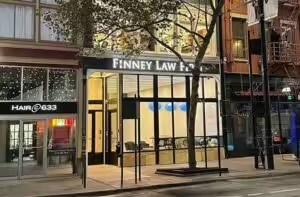
Exterior photo on the downtown Cincinnati location

Finney Law Firm and Ivy Pointe Title have opened their office in downtown Cincinnati at 635 Main.  For us, this has been a much-anticipated and long-awaited development.  This office replaces our Mt. Adams office on Celestial Street in the historic Rookwood Pottery Building.  We hope you enjoy this new office as much as we have enjoyed crafting it.

Why downtown?  First, this office joins a post-COVID resurgence for downtown, which is seeing a return of office workers, a huge growth in residential development and a host of new hotels and restaurants, bars and other entertainment venues.  Second, many of our major corporate clients are downtown-based and some are downtown-focused.  Third, the office is located strategically just one block north of the Potter Stewart U.S. Courthouse (which houses the Federal District Court for the Southern District of Ohio and the 6th Circuit Court of Appeals) and three blocks immediately south of the Hamilton County Courthouse.  Ample parking surrounds the new facility.

We are jazzed about our ability to revive an historic 150-year-old building into a sparkling new facility, with energy-efficient HVAC and lighting, and cutting-edge smart technology throughout.  In this revival, we have retained many of the original historic features of the building.  We hope you come by for a closing, a deposition, a mediation or a meeting with our attorneys and staff.

The project took the best of our creativity (I know, I know, we are attorneys) and resources, partnering with a host of talented consultants, architects, designers, and contractors.  (I learned so much by doing this project and am glad to share my experiences as well as our list of consultants, contractors and materials that have made it a rousing success).  We combined a smart initial purchase of the property with federal and state historic tax credits and City of Cincinnati residential and commercial tax abatements.  My transactional team handled the tax details and legally divided the building into three condominiums, our office and two residential condos.

Many have asked me: How was City Hall to deal with on this project?  I can say without exception that each City department with which we dealt has been exceptionally prompt and professional: Historic Conservation, the Building Department, the Economic Development Department, and even the Mayor and City Council.

_____________________

Thanks to our loyal clients while we completed this master work, to my attorneys and staff who were endlessly patient while I got it finished, and to our whole design and construction team who endured my endless questions, prompts and concerns, while each providing exceptional products and services.  You simply would not believe the hard work, long hours and creativity needed to bring this project to fruition by our design and construction team members.

Even the most well-run companies can become involved in disputes that end up in court. These disputes can arise in a variety of situations and can impact a business’s operations, finances, and reputation. Examples of common commercial disputes include breaches of contract, intellectual property disputes, employment issues and regulatory compliance matters. 

Whether your company finds itself as a plaintiff or defendant, careful and thorough preparation is crucial to the outcome. To prepare for impending commercial litigation, the following are among the essential steps to follow:

  • Assess the situation — Understanding the nature of the dispute is vital. Determine the facts and legal issues involved, identify the parties and assess the potential risks and impacts on the business. This initial assessment will help in formulating a response and determining whether to pursue litigation, seek a settlement or explore alternative dispute resolution methods.
  • Gather and preserve evidence — Companies should assemble and organize all relevant documents, emails, contracts and other records related to the dispute. It is equally important to preserve this evidence to prevent loss or destruction, which could lead to adverse inferences in court. Implementing a legal hold on relevant data can be an effective way to ensure preservation.
  • Review insurance policies and notify carriers — Review any relevant insurance policies to determine if they provide coverage for the dispute. This could include comprehensive general liability (CGL) insurance, directors and officers (D&O) insurance, or errors and omissions (E&O) insurance. Understanding coverage options can help in planning for legal costs and potential liabilities. It is also important to notify your insurance carriers that coverage claims may ensue. 
  • Consult with legal counsel — Engaging a skilled business litigation attorney early in the process is essential. An attorney can provide guidance on the legal issues, help develop a strategy and represent the company’s interests. Legal counsel can also assist in navigating complex legal procedures and negotiating with the opposing party.
  • Develop a litigation strategy — Based on the initial assessment and consultation with legal counsel, develop a comprehensive litigation strategy outlining the desired outcomes, key arguments and mitigation of potential risks. 
  • Identify and interview witnesses — Identify witnesses who can provide testimony or evidence in support of the company’s position. Interview these witnesses to understand their perspectives and gather detailed information. Witness testimony can significantly impact the outcome of the case.
  • Manage public relations — Litigation can attract public attention and affect a company’s reputation. Develop a public relations strategy to manage communication with the media, stakeholders and the public. Clear and consistent messaging can help protect the company’s image and prevent misunderstandings.
  • Evaluate settlement options — Not all disputes need to be resolved in court. Evaluate settlement options throughout the litigation process. Settlement can be a cost-effective and time-saving alternative to a lengthy trial. 

About Finney Law Firm, LLC

Founded in 2014, FLF has grown to 15 attorneys located in offices in Eastgate and downtown Cincinnati with five major practice areas: Corporate Law, Real Estate Law, Employment Law, Commercial Litigation and Public Interest and Constitutional Litigation.  FLF has the unique claim to three 9-0 victories at the United States Supreme Court for its public interest practice along with breakthrough class action work.

FLF also has an affiliated title insurance company, Ivy Pointe Title, LLC, that closes and insures nearly a thousand commercial and residential real estate transactions annually.

For more information about Finney Law Firm, visit finneylawfirm.com.

Media Contact: Mickey McClanahan; mickey@finneylawfirm.isoc.net; 513.797.2850.

The Health Insurance Portability and Accountability Act (HIPAA) imposes strict requirements on
employers, particularly those classified as covered entities or business associates, to protect the privacy
and security of employees’ protected health information (PHI). HIPAA mandates that these entities
implement safeguards to ensure the confidentiality, integrity, and availability of PHI, including physical,
administrative and technical measures.


Common HIPAA violations in the workplace include the following:


  1. Unauthorized access and disclosure — Allowing unauthorized individuals to view or receive PHI,
    such as sharing health information without patient consent or displaying it publicly.
    2. Lack of safeguards — Failing to secure electronic PHI (ePHI) through encryption, proper access
    controls, or secure transmission methods.
    3. Insufficient training — Not providing adequate training for employees on HIPAA compliance,
    leading to mishandling of PHI.
    4. Inadequate data disposal — Improper disposal of records containing PHI, such as not shredding
    documents or securely erasing electronic files.
    5. Social media misuse — Sharing PHI on social media platforms without consent.


Penalties for HIPAA violations depend on the level of negligence and can range from financial fines to
criminal charges. The Department of Health and Human Services’ Office for Civil Rights (OCR) categorizes
violations into four tiers, with penalties escalating based on the level of culpability:


  1. Tier 1 — Violations where the entity was unaware and could not have reasonably avoided the
    violation, with fines ranging from $137 to $68,928 per violation.
    2. Tier 2 — Violations due to reasonable cause, but not willful neglect, with fines from $1,379 to
    $68,928 per violation.
    3. Tier 3 — Willful neglect violations corrected within 30 days, with fines starting at $13,785.
    4. Tier 4 — Willful neglect violations not corrected within 30 days, with penalties up to $2,067,813
    annually.


An employment law attorney experienced with HIPAA compliance can advise companies on how to
avoid significant penalties by taking positive actions, such as the following:


  1. Implement comprehensive training programs — Regular training for all employees on HIPAA
    regulations and the proper handling of PHI.
    2. Establish robust security measures — Use encryption, access controls and secure
    communication channels to protect ePHI.
    3. Develop clear policies and procedures — Establish clear protocols for accessing, using and
    disclosing PHI, and ensure all employees understand these policies.
    4. Regular audits and risk assessments — Conduct regular audits and assessments to identify and
    address potential vulnerabilities in PHI protection.


In the event of a breach, companies must act swiftly by notifying affected individuals and the OCR,
conducting a thorough investigation and implementing corrective actions to prevent future incidents.


About Finney Law Firm, LLC

Founded in 2014, FLF has grown to 15 attorneys located in offices in Eastgate and downtown Cincinnati with five major practice areas: Corporate Law, Real Estate Law, Employment Law, Commercial Litigation and Public Interest and Constitutional Litigation.  FLF has the unique claim to three 9-0 victories at the United States Supreme Court for its public interest practice along with breakthrough class action work.

FLF also has an affiliated title insurance company, Ivy Pointe Title, LLC, that closes and insures nearly a thousand commercial and residential real estate transactions annually.

For more information about Finney Law Firm, visit finneylawfirm.com.

Media Contact: Mickey McClanahan; mickey@finneylawfirm.isoc.net; 513.797.2850.