


Legal disputes are rarely cut-and-dried to the point that the other party is without any legal defense to the action.  It seems there is always something about which to argue (read here, for example).  But it certainly seems to us — by reading the statute and by using it — that a statutory partition action in Ohio (O.R.C. Chapter 5307) is just such a “perfect” solution.

Two or more parties own property; one or more parties wants “out”

In this case, the statute addresses the issue where two or more parties own real property together but cannot agree if or when to sell it.

We are not addressing multiple shareholders in a corporation that owns real property or co-members of an LLC that own real property, but two or more parties named as grantees in a deed who own property together (known in the law as co-tenants).  Those shareholder or member disputes are handled in another manner.

Perfect power of partition

In short, in a partition action, one party can force the judicial sale of the property to the highest bidder with the net proceeds divided among the co-owners (the parties may argue, and this firm has argued about proper adjustments to the distribution of net proceeds).  There is no defense to the action although the process can take time as the Court permits discovery over the course of the partition proceedings.  However, the right to partition of jointly owned property is statutory – if one party brings the action, the property will ultimately be judicially sold.

How to proceed to partition

Thus, if you own property jointly in Ohio and you want to liquidate your interest (for any reason at all or for no real reason at all), but the other party or parties do not wish to sell what are your options?

For this situation, let’s assume two things:

  • The co-owners are not married as that would be handled in Domestic Relations Court.
  • There is no written agreement, what we call a co-tenancy agreement (see here), whereby the parties have established in writing how they will handle disagreements between them as to how the property will be held and disposed.  In that case, the agreement likely will control.

Then, what options do you have to resolve differences over the ownership and disposition of jointly owned real estate? The answer lies in an action in partition.

What is partition?

A real estate partition is a formal legal proceeding through which a joint owner of real estate can ask the court to split the property.   An “action for partition is equitable in nature, but it is controlled by statute.”  McGill v. Roush, 87 Ohio App.3d 66, 79, 621 N.E.2d 865 (2d Dist. 1993). A Partition Action is a lawsuit which existed at the common law for the purpose of passing down family farms.[1] When the heirs could not agree on how to run the farm together, one or more could commence a partition action, asking the court to fairly divide the farm between the heirs. Partition of the property itself is favored over sale and division of proceeds, however a property may be sold if it can be shown that it cannot be divided without manifest injury.[2]

Sale if property cannot reasonably be divided

Thus, a party can ask that the property be sold if it is determined that it cannot be divided. Certainly, this is the usual case for typical residential properties today. In this situation, the Court will appoint a commissioner or commissioners under O.R.C. § 5307.09.  When the commissioner(s) are of the opinion that the estate “cannot be divided without manifest injury to its value” they will provide a “just valuation of the estate” to the Court. One or more of the parties can elect to take the estate at the appraised value and pay to the other parties their proportion of the same. Alternatively, if neither party desires to purchase the property or cannot agree on the proportionate purchase of the same, the property will be sold at auction to the highest bidder.  Often, cases are resolved and settled among the parties prior to this occurring.

Under O.R.C. §5307.07, when partition of more than one tract is demanded, the Court will set off to each interested party its proper proportion in each of the several tracts. Thus, when multiple parcels of land are owned jointly, the separate parcels can be conveyed to separate owners so that each owner will have total control over their now separately owned parcel.

If a property was acquired upon someone’s death, a partition cannot be ordered within one year from the date of the death of the decedent, unless it is proven that either (i) all claims against the estate have been paid, (ii) secured to be paid, or (iii) that the personal property of the deceased is sufficient to pay those claims.

Attorney’s Fees

Under O.R.C. §5307.25, reasonable attorney’s fees can be paid from the proceeds of the sale to Plaintiff’s counsel and may also be paid to “other counsel for services in the case for the common benefit of all the parties” as the Court determines.

Conclusion

Thus, a Partition Action can be used to force the sale of jointly owned property where a recalcitrant party refuses to act.  Partition is a powerful tool to unwind and unstick a longstanding problem with a co-owner that will not budge.


______________________________________

[1] The Appellees assert that the “Commissioner made a good faith effort to partition the Property, but there is no way to physically divide this family farm into four sections based on the lack of frontage, the inconsistent and varying nature and uses of the land, and the physical location of the parcels. Simon v. Underwood, 2017-Ohio-2885, ¶ 65 (Ct. App.).

[2] “Since the partition of property is to be favored over the sale of property, when a party objects to a commissioner’s report, that party should have a right to a hearing to contest the commissioner’s findings before the property is appraised and subsequently sold.” Stiles v. Stiles, 3d Dist. Auglaize No. 2-89-3 (May 10, 1991)]. Court must comply with statutory procedures to appoint a commissioner, make an independent valuation and recommendation regarding whether the property could be divided without a manifest injury to the property’s value and providing a joint owner opportunity to elect the property, and no was provided. Thrasher v. Watts, 2011-Ohio-2844, (Ohio Ct. App., Clark County 2011).

It’s common for a business to have more than one owner, each with a substantial financial stake in the company. But partnerships don’t always last, either because businesses fail, owners disagree or one or more of them retires or moves on to their next venture. This could require splitting up the value of the company or buying out the departing owner.

In a closely held business, there is no market value for shares of stock. Instead, it is necessary to determine the value of the business and its assets as a whole in order to determine the amount payable to each departing broker. There are several methods of valuation from which you may choose.

If the company closes down or doesn’t generate significant income, the adjusted net asset method is a useful option. This involves adding up the value of the business’s assets and subtracting its liabilities as reflected in the balance sheet, then modifying that figure to reflect reality by, for instance, correcting inaccurately reported assets and liabilities.

If the business is making a profit and will continue to operate after an owner is bought out, the capitalization of cash flow method may produce a better valuation. It begins with determining the business’s recurring income and expenses over a given period and dividing the resulting net figure by the cap rate — a percentage based on the rate of return that the owners can expect to generate in the future. This results in an amount substantially larger than the adjusted cash flow.

If the company doesn’t have a steady cash flow, but you have a reasonable way of projecting its future cash flow, the discounted cash flow method might be a better valuation option. It adjusts the projected cash flow to take account of the time value of that money. Time value reflects the fact that you can use money you have now, so money you have not yet received decreases in value the longer it takes to receive it.

Another way of valuing an ongoing business is to hire a qualified business appraiser to determine its fair market value. The appraiser will typically compare the sales prices of similar companies in the same market. You and your partners might not agree on the appropriate valuation method for your company. In all cases, it is helpful to an attorney familiar with the problems of business divorce to negotiate a method that is fair to you. You and your partners can also submit the issue to mediation, a means of settling disputes outside of court with the help of a neutral third party.

About Finney Law Firm, LLC

Founded in 2014, FLF has grown to 15 attorneys located in offices in Eastgate and downtown Cincinnati with five major practice areas: Corporate Law, Real Estate Law, Employment Law, Commercial Litigation and Public Interest and Constitutional Litigation.  FLF has the unique claim to three 9-0 victories at the United States Supreme Court for its public interest practice along with breakthrough class action work.

FLF also has an affiliated title insurance company, Ivy Pointe Title, LLC, that closes and insures nearly a thousand commercial and residential real estate transactions annually.

For more information about Finney Law Firm, visit finneylawfirm.com.

Media Contact: Mickey McClanahan; mickey@finneylawfirm.isoc.net; 513.797.2850.


Ohio Rule of Evidence 408 generally provides that settlement discussions are “not admissible to prove liability for or invalidity of the claim or its amount.”

Public policy behind inadmissibility of settlement discussions.

Why not? Shouldn’t the judge or jury know all of the facts of a situation in determining liability and in assessing damages, for if a Defendant offered to pay he more or less must be liable, correct? Or shouldn’t the amount — the range — of settlement amount discussed, be some indication of the value of the claim?

Well, Courts have decided as a matter of public policy that the answer is “no.”  It would discourage good faith settlement discussions if the fact of such discussions and what was discussed were admissible.  We want parties to settle their disputes and bringing settlement conversations into Court would throw a cold wet towel on those conversations.

But Rule of Evidence 408 is not perfect

But Rule 408 is not all-encompassing.  It excepts party admissions of liability jnd, if agreement is reached, — or claimed to be reached — that oral settlement can be enforceable — sometimes much to the surprise and chagrin of one of the parties.

Further, in our experience, impermissibly and unethically, what happens in the course of settlement discussions is that those conversations seep into court proceedings and discovery.  Further, invariably opposing counsel will share some morsel of the tenor, tone or dialogue with a Judge to gain an advantage in the litigation.  In other words, opposing counsel and parties are not always trustworthy.

“We Can Talk Agreements”

As a result, before engaging in settlement discussions with opposing parties or counsel, Finney Law Firm frequently has the parties sign what we call a “We Can Talk Agreement” that generally provides two things:

  • Nothing said in the course of the settlement discussions will come into play in any manner in the litigation proceedings: Not in discovery, not in “in Chambers” conversations with the Judge, and not in Court.
  • No claimed oral settlement agreement will be binding unless and until it is memorialized in writing and signed by our client.  Period.

I recently had opposing counsel ask me: “Why would you ask me to sign such an agreement?”  It was a case in which we had the upper hand and the defendant was flailing around for some foothold for a defense.  Opposing counsel already had engaged in motion and discovery abuse, needlessly and substantially driving up the cost of litigation, and after 26 months of writing, twisting and turning, he had run out of underhanded tactics, and was approaching facing the music before the Judge.  My answer: “Because I don’t trust you. You, in this case and attorneys at your firm over the years, have engaged in underhanded tactics, and we won’t sit and talk except on our terms.”

Setting the proper tone for settlement conversations

In addition to beefing up the protections of Rule of Evidence 408, the “We Can Talk Agreement” establishes, shall we say, imposed mutual respect between the parties.  We find it a powerful tool to set the proper tone in settlement discussions.

Direct client conversations

Other times, clients want to talk directly — without the filter of attorneys.  Again, it’s not just what our client may say during the course of those conversations that is potentially problematic, but what the other party will claim they said.  (Side note: Assume all conversations these days are being recorded, especially those in situations of conflict.)  Further, sometimes clients want to use an intermediary, such as a priest, pastor or mutual friend to resolve a dispute.

In these instances, we also recommend a “We Can Talk Agreement” to enable and encourage a full and robust conversation.

Conclusion

When you already know you are in the midst of a conflict with another party, caution is the watchword and a “We Can Talk Agreement” can greatly advance the cause of a cautious approach to settlement discussions.

__________________________________________________

The text of Ohio Rule of Evidence 408 is below:

Evidence of (1) furnishing or offering or promising to furnish, or (2) accepting or offering or promising to accept, a valuable consideration in compromising or attempting to compromise a claim which was disputed as to either validity or amount, is not admissible to prove liability for or invalidity of the claim or its amount. Evidence of conduct or statements made in compromise negotiations is likewise not admissible. This rule does not require the exclusion of any evidence otherwise discoverable merely because it is presented in the course of compromise negotiations. This rule also does not require exclusion when the evidence is offered for another purpose, such as proving bias or prejudice of a witness, negating a contention of undue delay, or proving an effort to obstruct a criminal investigation or prosecution.

Some startup companies become successful businesses, but many more fail because they don’t take the steps necessary to put their companies on a workable basis or they take ill-advised actions that cost them dearly. 

Here are some common mistakes that you should avoid if you are starting up a new business: 

  • Failing to make a feasible business plan — If you don’t start out knowing what you hope to achieve and instituting a viable plan for how to achieve it, your business is likely to flounder quickly. In addition to serving as a roadmap to keep the business on track, a good business plan can help boost the confidence of your lenders and investors.
  • Misunderstanding your market — Startups are most successful when they fill a need not adequately served by current businesses. This doesn’t necessarily mean that you can’t offer a product or service to which your customer base doesn’t already have access, as long as it’s of sufficient quality to be competitive. You also need to price your product or service competitively and to encourage feedback from your customers for use in improving your business.
  • Having inadequate capital to succeed — It may take considerable time for your business to become profitable. Until then, you need to line up enough capital to keep it going. Shrewd budgeting can help keep unnecessary costs down, so that you can put your money where it will do the most good.
  • Inadequately protecting your personal assets — Startups are inherently risky, and you don’t want to lose your proverbial shirt because of business debts and possible lawsuits. You should make sure you have adequate insurance and consider organizing your company into a corporation or limited liability company that will protect your personal assets from current and future creditors if financial problems arise.
  • Failing to make suitable contracts — Depending on the type and size of your business, you will likely need to work on a regular basis with some independent contractors, such as suppliers, advertising or marketing firms. You can avoid unnecessary problems with them by making written contracts that are clear, enforceable and adequately protective of your interests, preferably with the assistance of an experienced business contracts attorney.

About Finney Law Firm, LLC

Founded in 2014, FLF has grown to 15 attorneys located in offices in Eastgate and downtown Cincinnati with five major practice areas: Corporate Law, Real Estate Law, Employment Law, Commercial Litigation and Public Interest and Constitutional Litigation.  FLF has the unique claim to three 9-0 victories at the United States Supreme Court for its public interest practice along with breakthrough class action work.

FLF also has an affiliated title insurance company, Ivy Pointe Title, LLC, that closes and insures nearly a thousand commercial and residential real estate transactions annually.

For more information about Finney Law Firm, visit finneylawfirm.com.

Media Contact: Mickey McClanahan; mickey@finneylawfirm.isoc.net; 513.797.2850.


Attorneys are only human and it is possible that your lawyer made a serious mistake or gave you poor advice that caused you to suffer a negative outcome in your case. If you are disappointed with the result of a matter you entrusted to an attorney, you may have a legal malpractice cause of action. An important question is how long you have to sue.

In Kentucky, the statute of limitations requires an injured party to sue within one year from the date of the occurrence of professional malpractice or from the date when the malpractice was discovered or reasonably should have been discovered. But this can be a difficult standard to apply, since legal errors are often not readily apparent to lay people.

Fortunately, a few Kentucky Supreme Court opinions have fleshed out the contours of this standard in a way that is intended to protect the rights of clients while avoiding unnecessary legal malpractice litigation.

First, the court has held that legal malpractice doesn’t occur until the lawyer’s negligence hurts the client in a way that is not speculative and can’t be reversed. Generally, this means that you can’t sue until you are out of normal remedies for correcting the error. For instance, in cases where the lawyer allegedly mishandled litigation, the court has said that the malpractice didn’t occur until the client’s right to appeal was exhausted.

Secondly, the court applies the “continuous representation” rule, which delays the start of the limitations period until after the relationship with the attorney ends. One rationale for this rule is that you can’t be expected to discover the legal malpractice as long as the attorney who committed malpractice is the one advising you. Often times, you are not in a position to know whether the attorney is doing a bad job or is merely faced with a bad case or an obstinate judge.

This rule also gives attorneys the opportunity to correct their mistakes. A legal malpractice lawsuit is a poor substitute for pursuing a still winnable case. This doesn’t mean you are required to stick with an attorney who you believe is not doing their job properly. You are entitled to seek better representation if you can. However, the rule is meant to give the client and the attorney the opportunity to solve the problem before the mistake becomes irreversible.

About Finney Law Firm, LLC

Founded in 2014, FLF has grown to 15 attorneys located in offices in Eastgate and downtown Cincinnati with five major practice areas: Corporate Law, Real Estate Law, Employment Law, Commercial Litigation and Public Interest and Constitutional Litigation.  FLF has the unique claim to three 9-0 victories at the United States Supreme Court for its public interest practice along with breakthrough class action work.

FLF also has an affiliated title insurance company, Ivy Pointe Title, LLC, that closes and insures nearly a thousand commercial and residential real estate transactions annually.

For more information about Finney Law Firm, visit finneylawfirm.com.

Media Contact: Mickey McClanahan; mickey@finneylawfirm.isoc.net; 513.797.2850.


Hamilton County Common Pleas Court Judge Wende Cross has certified two classes in White v. Cincinnati, litigation in which both the 1851 Center for Constitutional Law and Finney Law Firm represented payors of the illegal and unconstitutional Cincinnati tax on security alarm systems.  The two distinct classes certified are (a) residential and (b) non-residential payors of the Cincinnati alarms tax.

The City charged residential alarm-system-owners $50 per year to register their systems and commercial owners $100 to register their systems.  Last fall, the 1st District Court of Appeals unanimously ruled the tax illegal under Ohio law and unconstitutional, overruling a trial Court ruling on the same subject.  In March of this year, the Ohio Supreme Court preserved that victory for Cincinnati property owners when it refused to accept discretionary review of the case.

We now proceed to an an Order that will establish the amount and procedures for the restitution of the illegally-collected sums, a fairness hearing, and then distribution of the refunds to payors.  We aim for the conclusion of those steps this calendar year.  The amount of restitution is expected to be more than $3.6 million.

For questions, contact Chris Finney at 513.943.6655.

You may read the order issued April 22 here.


Truth can be stranger than fiction.  And the last few weeks at the Finney Law Firm that has been the case.

Yesterday, Chris Finney, Jessica Gibson and Julie Gugino racked up a unanimous jury verdict (8-0) to defeat a case of claimed retaliation in response to a tenant’s claimed request for a disability accommodation that was met with a non-renewal of a residential lease.  The case was styled Ohio Civil Rights Commission v. Abundant Life Faith Fellowship in front of Judge Christian Jenkins in Hamilton County Common Pleas Court.  The Civil Rights Commission was also suing the Church’s pastor who had served for 41 years.  In candor, the Civil Rights Commission did a terrible job of vetting its own case with a terrible, dishonest plaintiff and a very sympathetic defendant.  Its attorneys at trial also were not exactly prepared or stellar.

The Civil Rights Commission case was full of demonstrable untruths about a kind-hearted 74-year-old African American minister who had suffered two strokes.  By the testimony of two of her fellow tenants in the building, the complaining tenant had plotted starting fewer than two weeks into her tenancy to drum up a fictitious lawsuit against the landlord as a way to extract money from him — she told this to her fellow tenants.  And for a year, she made his life a living hell, with incessant complaints about inadequate heat and fabrication about needing more light for a vision disability (in fact, her complaints about lighting had been adequately addressed early in her tenancy).  Dozens of complaints were addressed by visits by with servicemen, engineers, and repairmen to cater to her many whims and incessant gripes.  The Cincinnati Health Department came out and confirmed the unit in every room was heated to a comfortable 72°F to 73°F (the tenant lied to the jury — never a good idea — and said the readings were 62°F, 64°F and 66°F).

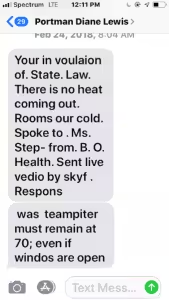
In the funniest part of the trial, the tenant at first denied and then admitted sending a bizarre text message to the landlord in the depth of winter, after he noticed that the windows of every unit in the building were open, including those of the tenant who constantly complained it was too cold!  Here is the text message, grammatical errors and misspellings included:

Yes, her crazy assertion to the landlord was that he must maintain the heat in the unit at 70°F even if the windows of the unit are left open!

Of course Pastor Brown and the Church had to fund the 4-year defense of the Civil Rights Administrative Complaint and the lawsuit, which he did with aplomb, but at great expense.  For the benefit of all landlords subject to outrageous prosecutions from obstinate public agencies, he saw this case through to its appropriate and proper end.  He refused to be bullied by the Ohio Civil Rights Commission, the office of the Ohio Attorney General and Housing Opportunities Made Equal (H.O.M.E.) (which manufactured evidence and knowingly lied to the Civil Rights Commissions in “building their case”).

For more information or to avoid being bullied by these same agencies: (a) DO NOT TALK TO THEM in an investigation EVER and (b) contact Jessica Gibson  (513.943.5677) for assistance with your case.

As we wrote here, in November the Ohio First District Court of Appeals in White v. Cincinnati unanimously ruled in favor of clients of the 1851 Center for Constitutional Law and Finney Law Firm in a challenge to the City of Cincinnati’s alarm tax scheme. The City of Cincinnati asked the Ohio Supreme Court to review that decision, a discretionary call by Court.  Historically, Ohio’s top Court accepts only about 5% of such cases for consideration.

Today, the Ohio Supreme Court declined to accept for review the First District decision.  Since that was the last stop on the railroad for the City, the inevitable next legal steps are injunction against further collection of the tax, class certification and an order of restitution before Common Pleas Court Judge Wende Cross.

Amazingly, even after the First District ruled that the tax was illegal, through today the City of Cincinnati insisted on continued collection of the tax. So, an injunction by the trial court now will be necessary.

If you are a Cincinnati alarm fee payor, you should be expecting a refund once the amount has been calculated and the procedural hurdles cleared, perhaps later this year.  If the City continues to attempt to extract alarm charges from you, respectfully decline and send them this blog entry!

Mediation, a quicker and more cost-effective alternative to litigation, has long been a voluntary option for parties in civil disputes. Now, the Kentucky Supreme Court has adopted rule changes that make court-ordered mediation commonplace in the litigation process. As a result, more lawsuits are likely to be resolved by this method.

The new rules, which took effect on Feb. 1, 2022, give courts the authority to refer all or part of a civil case to mediation and to appoint a mediator — a neutral third party who helps settle some or all of the contested issues. The mediation will remain fully independent of, and outside of, the court proceeding but the court has the discretion to enforce its order to mediate.

In deciding whether to order mediation, the court is required to consider these factors:

  • The stage of the litigation, including whether discovery has been conducted
  • The nature of the issues to be resolved
  • The value to the parties of confidentiality, rapid resolution or maintenance of ongoing relationships
  • The willingness of the parties to mutually resolve their dispute
  • Other attempts at dispute resolution that may have been made
  • The ability of the parties to participate in the mediation process, including virtual mediation
  • The cost to the parties

Mediation will not be ordered in any case where a court determines that one party may pose a risk of harm to others.

Once mediation is ordered, the litigants have 15 days to agree on a mediator and if they don’t, the court can select one. A mediator must be a Kentucky lawyer and comply with a code of conduct that, among other things, requires them to remain competent in mediation skills. Payment of the mediator’s fees is typically shared among the parties. The attorneys for the parties schedule a mediation conference. The mediator confers with the attorneys (and any unrepresented parties) to work out procedures for the conference and may require them to submit confidential statements of the case in advance. The parties’ representatives at the conference must have full authority to negotiate a settlement.

Although mediation is a separate process, the court must be kept advised of its progress. The parties are required to submit a joint statement to the court enumerating the issues that have been resolved and those that remain for trial. The parties may also identify any matters that, if resolved or completed, would facilitate a settlement. The court in its discretion may encourage the parties to continue discussions, with the goal of avoiding or limiting a trial.

About Finney Law Firm, LLC

Founded in 2014, FLF has grown to 15 attorneys located in offices in Eastgate and downtown Cincinnati with five major practice areas: Corporate Law, Real Estate Law, Employment Law, Commercial Litigation and Public Interest and Constitutional Litigation.  FLF has the unique claim to three 9-0 victories at the United States Supreme Court for its public interest practice along with breakthrough class action work.

FLF also has an affiliated title insurance company, Ivy Pointe Title, LLC, that closes and insures nearly a thousand commercial and residential real estate transactions annually.

For more information about Finney Law Firm, visit finneylawfirm.com.

Media Contact: Mickey McClanahan; mickey@finneylawfirm.isoc.net; 513.797.2850.


Do you own land on one of the seven hills of Cincinnati? Has your downhill neighbor started digging on their land? Has such digging threatened to cause or caused your land to slide? If you answered yes to the preceding questions, then you might be entitled to an injunction or damages due to your neighbor removing the “lateral support” to your land.

This blog post will address a (i) background on lateral support; (ii) neighbor’s liability for removing lateral support from a landowner’s land when such land is in its natural or improved state; and (iii) landowner’s recourse when their land is going to start or starts to slide due to their neighbor’s digging.

Background:

The right to lateral support is a landowner’s right to have their land supported laterally by their neighbor’s land. The right varies based on whether the damaged land is natural or improved. Land in its natural state is always entitled to lateral support. However, improved land is not so entitled unless provided by statute or a neighbor negligently removes lateral support. Ohio provides such a statute.

Natural Land:

If a neighbor’s digging causes damage (e.g., sliding) to a landowner’s natural land, then the neighbor is liable for the damages that flow from such digging. There is no need for the landowner to show fault; it is a strict liability standard. To prove strict liability, the landowner must show (i) that their land was injured by the removal of its lateral support, (ii) that the injury resulted from the neighbor’s digging, and (iii) ascertainable damages.

Improved Land:

The Ohio Revised Code, under Sections 723.49 – 723.50, allows a neighbor to excavate down to (i) nine feet below the curb or street grade and (ii) the full depth of the foundation wall of any building on the landowner’s land, without liability. That said, if a neighbor digs to a depth greater than nine feet below the curb of the street, and such digging causes damage to any of a landowner’s buildings, then the neighbor is liable regardless of whether the neighbor is negligent. However, the neighbor’s digging must be the proximate cause of the damage.

Under a negligence standard, a neighbor might also be liable when the neighbor’s digging causes damage to a landowner’s building. The landowner must demonstrate that the neighbor was negligent by showing that the neighbor’s digging (i) removed the lateral support to the landowner’s building, (ii) caused injury thereto, and (iii) caused ascertainable damages.

Note: Concerning negligence, a neighbor has a duty to perform work, even if on their land, in such a manner as not to damage an uphill landowner’s land.

Landowner’s Recourse:

When dealing with the possible removal or the removal of lateral support, a landowner may seek an injunction or sue for damages. A landowner may seek an injunction to ask the court to prevent a neighbor from taking actions that will remove the lateral support to the landowner’s land. Alternatively, a landowner may seek monetary damages after a neighbor damages the landowner’s land. Such damages are based on “the time required to repair and a comparison of the cost to repair to the diminution in the fair market value of the [landowner’s land] before and after the damage.”[1]

Note: If a landowner lives uphill from a neighbor, and the neighbor removes soil downhill from the landowner’s land resulting in damage to the landowner’s land, then the neighbor must make the repairs.

Conclusion:

If (i) you own land on one of the seven hills of Cincinnati; (ii) your downhill neighbor started digging on their land; and (iii) such digging threatened to cause or caused your land to slide, then call the Finney Law Firm today, where an experienced professional can provide insight as to whether you have a claim for an injunction or damages.

[1] 1 Ohio Real Property Law and Practice § 8.07 (2021).