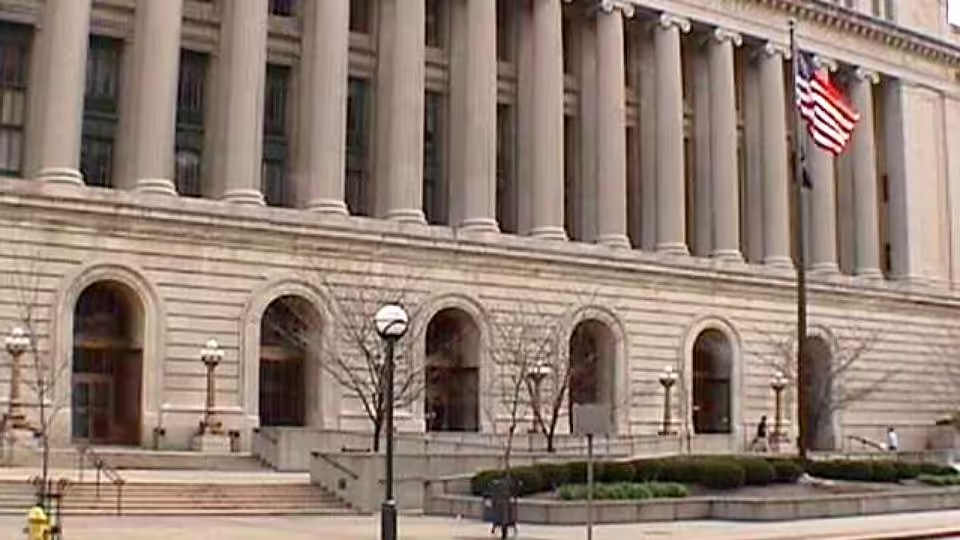
The COVID-19 crisis has created a series of delays in civil and criminal cases. One of those casualties has been residential evictions in Hamilton County.
The problem
No evictions hearings have been held since March 15, and the earliest they are scheduling new hearings at present is July 28. This means not only that landlords can’t clear their properties of tenants who won’t pay rent, but also that tenants who deal drugs, damage property — or even worse criminal behavior — can stay in possession now for more than five months before the landlord can have a hearing to restore possession of the property to him.
Suing the Judges
Finney Law Firm has initiated a relatively unused action — for a Writ of Procedendo — to force the Hamilton County Municipal Court Judges to proceed with forcible entry and detainer actions. The Complaint, captioned State Ex rel. Salvador Properties v. Judge Heather Russell is here.
Other counties
Below is what our research has shown other counties currently are doing (note “per normal” noted below means you can timely get a decision in an eviction case; there may be modified procedures and hours to accommodate the crisis):
Butler County: Holding hearings per normal;
Warren County: Holding hearings per normal;
Clermont County: Holding hearings per normal;
Franklin County (Columbus): Holding hearings per normal;
Montgomery County (Dayton): Holding hearings per normal;
Summit County (Akron and all Municipal Courts): Holding hearings per normal;
Lucas County (Toledo): Holding hearings per normal;
Mahoning County (Youngstown): No hearings being scheduled; and
Cuyahoga County (Cleveland and all Municipal Courts): Cleveland and Cleveland Heights are holding hearings after 6/15/20 and 6/17/20, respectively, and other Municipal Courts (Shaker Heights and Berea) are holding hearings per normal.
So, of surrounding counties and Ohio’s major urban counties, only Mahoning (Youngstown) and two of four Municipal Courts in Cuyahoga County are further delaying eviction hearings for COVID-19 issues. Other than Youngstown with no hearings being scheduled at all, Hamilton County presently is the worst in the State for scheduling eviction hearings.
Conclusion
This suit is one in a series of actions initiated by Finney Law Firm to re-open Ohio business and Courts that have been closed under the COVID-19 crisis. For more information, contact Chris Finney (513.943.6655).
Small business owners are necessarily prepared for various types of challenges, but what do you do when the government orders you to close for an indefinite amount of time? Unfortunately, the COVID-19 pandemic has put millions in this very difficult position. Even worse, it is still unclear in many places when authorities will allow businesses to reopen their doors, and what the U.S. economic landscape will look like when they do.
To address these concerns, the federal government has passed legislation designed in part to support small businesses throughout this crisis. Understandably, reaction has been overwhelming, but the different types of relief can be confusing, and a mistake that leads to a delay could be very costly. If you’re looking for assistance offered in the Coronavirus Aid, Relief, and Economic Security (CARES) Act, here’s what you should know:
Paycheck Protection Program — Much of the media coverage has been focused on the Paycheck Protection Program (PPP), which allows small businesses to apply through their local bank for up to $10 million or 2.5 times their average monthly payroll — whichever amount is smaller. If the funds received from the PPP loan are spent within eight weeks on payroll, mortgage payments or a few other necessary expenses that are outlined in the text of the law, the loan amount is forgiven, making this more of a grant than an actual loan.
Economic Injury Disaster Loans — This measure simplifies and expands upon the Economic Injury Disaster Loan (EIDL) program. Run by the Small Business Administration, the EIDL approval process has been streamlined and businesses can now ask for up to $10,000 as an advance on the loan. These amounts do not have to be repaid and can be granted regardless of whether the underlying loan is ever issued. Moreover, the collateral requirements that were previously in place for larger loans have been eased or eliminated.
Possible future modifications — Even in the first few days, the popularity of the programs caused delays and fears of depletion. Congress is expected to authorize more funds to back these loans, but small businesses might need tenacity, patience and assistance from an experienced adviser to keep up with the changes and secure the funding they need.
If you’re wondering which loan to pick, you can actually apply for both. Just remember that each loan has its own requirements for forgiveness. If you have difficulty applying for, or getting approved for, one of these loans, or if you have questions about whether your lender or the SBA is complying with the text of the law, consult a small business attorney on whether a suitable remedy is available.
About Finney Law Firm, LLC
Founded in 2014, FLF has grown to 15 attorneys located in offices in Eastgate and downtown Cincinnati with five major practice areas: Corporate Law, Real Estate Law, Employment Law, Commercial Litigation and Public Interest and Constitutional Litigation. FLF has the unique claim to three 9-0 victories at the United States Supreme Court for its public interest practice along with breakthrough class action work.
FLF also has an affiliated title insurance company, Ivy Pointe Title, LLC, that closes and insures nearly a thousand commercial and residential real estate transactions annually.
For more information about Finney Law Firm, visit finneylawfirm.com.
Media Contact: Mickey McClanahan; mickey@finneylawfirm.isoc.net; 513.797.2850.
Since March, federal and state governments have engaged in a variety of methods designed to safeguard Americans’ health and financial security in the wake of the coronavirus pandemic. At any time, taxes have a direct impact on our lives, so it’s natural that some of the key provisions of the recently passed Coronavirus Aid, Relief, and Economic Security (CARES) Act relate to taxation. Designed to assist states, medical providers, businesses and individuals, this legislation was signed into law on March 27, in the midst of what is usually income tax filing season.
Critical aspects of the CARES Act that have an effect on taxes include:
Rebate payments — Much has been made of stimulus dollars that will be going directly to taxpayers. Not everyone will collect these payments, however, which begin to phase out for individuals with an annual income of at least $75,000 and jointly filing married couples whose combined income is $150,000 or more. The individual maximum payment is $1,200 and as much as $2,400 can be sent to a couple when the spouses file jointly. On top of that, an additional $500 can go to a household for each child 17 years of age or younger.
Filing and payment extensions — Congress extended by three months the traditional April 15 deadline for the filing of federal income tax returns and the payment of amounts owed to the government. Originally, only the payment date was shifted, but now both deadlines are slated for July 15. That is also the date by which someone must apply for an extension, to October 15, if they need one.
Payroll tax credits — Employers that do not take a Paycheck Protection Program loan, offered through the CARES Act, are eligible to take a credit on their payroll taxes through the end of 2020. This credit is offered to businesses that have been closed down due to government order or have seen a year-over-year drop of at last 50 percent of gross receipts in a given quarter. Within a quarter, the credit can total as much as $5,000.
Handling tax issues can be a challenge at any time, and especially during these perilous economic times, you don’t want to make a costly mistake. Consulting with an effective tax attorney will help you take advantage of programs that have been created or modified to address the issues you’re facing.
About Finney Law Firm, LLC
Founded in 2014, FLF has grown to 15 attorneys located in offices in Eastgate and downtown Cincinnati with five major practice areas: Corporate Law, Real Estate Law, Employment Law, Commercial Litigation and Public Interest and Constitutional Litigation. FLF has the unique claim to three 9-0 victories at the United States Supreme Court for its public interest practice along with breakthrough class action work.
FLF also has an affiliated title insurance company, Ivy Pointe Title, LLC, that closes and insures nearly a thousand commercial and residential real estate transactions annually.
For more information about Finney Law Firm, visit finneylawfirm.com.
Media Contact: Mickey McClanahan; mickey@finneylawfirm.isoc.net; 513.797.2850.
Here is the podcast from today on 550 WKRC Radio with Brian Thomas. The broadcast starts at 69:50.
The discussion in this show again addressed the Finney Law Firm suit on behalf of Tanya Hartman and her business, Gilded Social, a bridal dress shop, who desires a due process hearing on the forced closure of her business in the COVID-19 crisis.
Contact Christopher P. Finney (513.943.6655) if you care to discuss your rights as a business owner under a COVID-19 closure order.
Here is the podcast from today, starting from the top of the show.
The discussion in this show addressed the Finney Law Firm suit on behalf of Tanya Hartman and her business, Gilded Social, a bridal dress shop, who desires a due process hearing on the forced closure of her business in the COVID-19 crisis.
We lost yesterday in getting a Temporary Restraining Order to stop Ohio’s practices without due process. The Judge has called for a Preliminary Injunction hearing for May 11.
Contact Christopher P. Finney (513.943.6655) if you care to discuss your rights as a business owner under a COVID-19 closure order.
Unless you’ve been living under a rock somewhere, chances are the current COIVD-19 pandemic has affected at least one, and likely multiple facets of your life. But how do these circumstances impact contractual obligations made pre-COVID-19? Can the pandemic or the economic turmoil it is has created serve as a justification or excuse for getting out of a contract? For instance, if you contracted to purchase real estate in February, before all of the furloughs and Stay at Home Orders, do you still have an obligation to close on that purchase? While the case law surrounding this question is likely to dramatically expand in light of recent events, the answer could likely be “no” under Ohio law, at least as it stands today.
Four Corners Rule
As an initial proposition, contracts are governed by the “four corners rule,” meaning they will be interpreted consistent with what appears on the face of the document. Chan v. Miami Univ., 73 Ohio St. 3d 52, 57 (1995) (“[A]n instrument must be considered and construed as a whole, taking it by the four corners as it were.”). Where unambiguous, no additional terms will be read into the contract, and the terms that are contained within the document will be given their ordinary meaning. Fidelity & Casualty Co. v. Hartzell Bros. Co., 109 Ohio St. 566, 569 (1924) (“This court cannot make a new contract for the parties where they themselves have employed express and unambiguous terms. In the construction of contracts the language employed must be given its usual and ordinary meaning.”).
Parties to a contract are, thus, bound by the contract’s plain and unambiguous terms and are obligated to do that which they have promised in the contract, subject to certain narrow exceptions…
Force Majeure
Contracts often contain “force majeure” clauses. Roughly translated, force majeure is Latin for “superior forces.” Often, you will see this interpreted or referred to as an “Act of God.” What this means in a practical sense is that there is some sort of unforeseeable, intervening circumstance that justifies non-performance under the contract. For example, you have a contract to rent an apartment unit (a lease) but, right before you move in, a bolt of lightening strikes the apartment building and it burns to the ground. Depending on the language of the force majeure clause, this would likely be a qualifying unforeseeable circumstance that could nullify the lease.
Relative to real estate transactions, force majeure clauses are perhaps more often seen in the commercial context than the residential. Many standard realtor’s contracts do not contain such clauses. These clauses may also appear in certain consumer transactions – think contracts for goods or services to be performed.
Consistent with the four corners rule, courts cannot “read in” a force majeure clause where one does not appear on the face of the contract. Therefore, if your contract does not contain a force majeure clause, you likely cannot claim it as a reason for terminating the contract or skirting your obligations thereunder. SeeWells Fargo Bank, N.A. v. Oaks, 2011 Ohio Misc. LEXIS 4812, at *7 (Franklin C.P. June 24, 2011) (rejecting force majeure argument where the contract did not contain a force majeure clause).
Where a contract does contain a force majeure clause, courts are likely to interpret such clauses in a very narrow fashion. Thus, if the clause does not specifically contemplate disease, pandemic, unexpected unemployment, or business closures, it may not provide relief in the specific COVID-19 context.
What about changing financial circumstances or “impossibility” of complying with your obligations, more generally?
Despite the non-existence of an applicable force majeure clause, one might think that his or her general inability to pay that which they promised under the contract or worsening financial conditions might excuse performance under the contract. While this may seem like a logical conclusion at first glance, the law dictates that “[m]istaken assumptions about future events or worsening economic conditions, however, do not qualify as a force majeure.” Stand Energy Corp. v. Cinergy Servs., 144 Ohio App. 3d 410, 416 (1st Dist. 2001); see also Wells Fargo, at *7-8 (“[E]conomic down-turn is a risk that every business person necessarily undertakes when they enter into a contract . . .That this country incidentally suffered an economic downturn during the term of their contract does not discharge them from their contractual obligations.”). “A party cannot be excused from performance merely because performance may prove difficult, burdensome, or economically disadvantageous.” State ex rel. Jewett v. Sayre (1914), 91 Ohio St. 85, 109 N.E. 636, 12 Ohio L. Rep. 291.
This body of case law generally speaks to “objective” versus “subjective” impossibility. While the law might sanction non-performance based on objective impossibility (i.e., no one could reasonably fulfill their obligations under the circumstances), it typically does not excuse performance based on subjective impossibility (i.e., a particular party cannot fulfill their obligations under the circumstances).
Can challenges posed by COVID-19, independent of financial concerns, create a justification for non-performance?
In the real estate context, for instance, what about the health risks posed by out-of-state buyers or sellers traveling for closings? Fortunately, we live in an era that offers a wealth of technological options here. For example, many title companies are offering “remote” closings. If this is a concern for you, consider reaching out to Ivy Pointe Title for your closing needs, as they offer a staff of experienced title professionals, e-notary licensure in both Ohio and Kentucky, and remote closings, which allow parties to close on real estate transactions from the comfort and safety of their own homes where necessary.
We can help…
All this being said, parties to a transaction can often jointly agree to terminate or delay performance if they so choose, though a subsequent writing may be required to effectuate this agreement in a manner that will be enforceable and protect both sides down the road. If you are party to a transaction and the other side has threatened non-performance where there has been no agreement to terminate or delay, these are likely some of the arguments you will see. On the other hand, if you are concerned about your ability to perform under a contract, there may be additional language within the “four corners” of your contract that could provide some relief. Contracts are exceedingly unique from one another, such that there really is no “one size fits all” approach.
Finney Law Firm has a team of legal professionals with experience ranging from real estate to employment to general commercial law, and we would be happy to review your contract and provide feedback as to your options or help with drafting amendments thereto. Please feel free to reach out to me at (513) 943-5673 or casey@dev.finneylawfirm.com to set up a remote consultation.
Additionally, our attorneys have authored a number of blog entries relative to the COVID-19 crisis and hosted webinars as to potential relief for employers, small businesses, and 1099 employees that may also be of interest. And for more on commercial or real estate transactions and “force majeure,” click here.
We hope you are all staying safe and healthy during this unprecedented time.
The coronavirus pandemic has disrupted practically every aspect of American life. Whether closed by government order or by concerns about public safety, millions of businesses around the country have seen their operations come to a halt. Despite the overwhelming effect of COVID-19, it is not a certainty that an “Act of God” clause in a business contract will enable a party to ignore its obligations under the agreement.
Many contracts include force majeure provisions that account for situations where an outside event prevents a signatory from fulfilling contractual duties. If you’re thinking of relying on this type of provision to justify nonperformance or if a party to an agreement is invoking a COVID-19-related Act of God clause against you, here are some factors to consider:
Terms of the agreement — As in any contract interpretation matter, it’s critical to examine the document to see if a pandemic is mentioned specifically or generally as an event that would affect the parties’ rights. For example, the collective bargaining agreement between the National Basketball Association and its players’ union specifically refers to “epidemics” as a force majeure event that allows the league’s owners to withhold salary and potentially revoke the entire agreement.
Impossibility vs. difficulty — Many unexpected things can drastically alter the feasibility of meeting one’s contractual obligations. However, just because something has become more difficult, economically impractical or even dangerous, that does not justify the use of an Act of God exception. Even in a relatively recent case involving a highly contagious disease, Morocco wasn’t able to invoke force majeure to escape liability after it canceled a 2015 soccer tournament while the Ebola virus afflicted West Africa. Though holding the tournament might have been unwise and costly, the Court of Arbitration for Sport ruled that it was not impossible.
Foreseeability — Another consideration when a party seeks to defend its nonperformance by claiming an Act of God is whether the circumstance was foreseeable. Financial downturns (even severe ones), shipping problems, material shortages and other situations affecting contract fulfillment are usually considered foreseeable. In fact, some agreements specifically exclude common problems that might lead a contract partner to invoke a force majeure
The unique nature of the COVID-19 pandemic has thrust all of America into uncertainty. Counting on Act of God language to relieve you from your legal duties might not be a sure bet, even if you believe you have a compelling case. Taking prompt steps to communicate with contract partners might be a better way to reach a solution that acknowledges the harm that was done and modifies certain rights and obligations. By working with a skillful, creative business lawyer, you might be able to avoid a serious conflict over how force majeure is defined in your situation. If consensus cannot be reached, your attorney can advise whether you might succeed in a legal action.
About Finney Law Firm, LLC
Founded in 2014, FLF has grown to 15 attorneys located in offices in Eastgate and downtown Cincinnati with five major practice areas: Corporate Law, Real Estate Law, Employment Law, Commercial Litigation and Public Interest and Constitutional Litigation. FLF has the unique claim to three 9-0 victories at the United States Supreme Court for its public interest practice along with breakthrough class action work.
FLF also has an affiliated title insurance company, Ivy Pointe Title, LLC, that closes and insures nearly a thousand commercial and residential real estate transactions annually.
For more information about Finney Law Firm, visit finneylawfirm.com.
Media Contact: Mickey McClanahan; mickey@finneylawfirm.isoc.net; 513.797.2850.
In cyberspace, a single negative review, tweet or Facebook post can inflict damage on a business that is difficult to undo. Effectively defending your company’s online reputation demands taking a proactive role rather than waiting until your company is attacked to jump into crisis-management mode. Here are some preventative steps you can take immediately:
Control your brand — Registering a website domain in your business name and doing the same on social media platforms helps prevent others from posing as your company online.
Publish your own content — If someone Googles your company, negative information posted by others may appear at the top of the search results. By publishing blogs, articles, videos, social media messages and other content that is in line with your brand, you can increase the likelihood of your posts appearing high in search rankings.
Encourage and respond to posts and reviews — Develop a record of positive repute by asking satisfied customers and other business contacts to post about or review your products or services online. Responding to positive feedback with thanks and encouragement can inspire more people to voice their appreciation. If someone writes a negative post, responding respectfully with your side of the story demonstrates candor and concern for the truth.
Establish social media and communications policies — Guidelines should be put in place so that anyone who communicates on behalf of your company on social media or anywhere else only should have a clear understanding of which topics should be discussed, what should be kept private and how customer service issues should be handled.
Follow online conversations about your company —By keeping aware of the reports and opinions people publish about your company, you can compile positive feedback while also catching negative impressions when they happen. Among the means available are setting up alerts via Google or using social media tracking software.
Know what to do in a crisis — Plan for the worst by devising a crisis management plan. It should designate who at your company will be in charge of speaking for the company in the event that negative information online poses significant harm. It should also address who should be in charge of developing and implementing damage control measures.
About Finney Law Firm, LLC
Founded in 2014, FLF has grown to 15 attorneys located in offices in Eastgate and downtown Cincinnati with five major practice areas: Corporate Law, Real Estate Law, Employment Law, Commercial Litigation and Public Interest and Constitutional Litigation. FLF has the unique claim to three 9-0 victories at the United States Supreme Court for its public interest practice along with breakthrough class action work.
FLF also has an affiliated title insurance company, Ivy Pointe Title, LLC, that closes and insures nearly a thousand commercial and residential real estate transactions annually.
For more information about Finney Law Firm, visit finneylawfirm.com.
Media Contact: Mickey McClanahan; mickey@finneylawfirm.isoc.net; 513.797.2850.
In a news release yesterday, Ohio Attorney General David Yost warned creditors that CARES Act checks are protected by Ohio state law.
“The stimulus checks were intended to be used during an emergency – to put food on the table, keep the lights on, and a roof over our heads,” Yost said. “It wasn’t meant to pay off an old bill.”
The law to which Yost is referring is Ohio Revised Code Section 2329.66 which exempts property from “execution, garnishment, attachment, or sale to satisfy a judgment or order” under certain circumstances including:
A payment in compensation for loss of future earnings of the person or an individual of whom the person is or was a dependent, to the extent reasonably necessary for the support of the debtor and any of the debtor’s dependents.
ORC Section 2329.66(A)(12)(d).
Ohio Attorney General Yost also posted a NOTICE OF APPLICAPBILITY OF STATE LAW EXEMPTION TO PAYMENTS UNDER THE FEDERAL CARES ACT on his website, which can be found here. According to the Notice:
The payments under the CARES Act are in the nature of emergency support, designed to support basic needs of tens of millions of Americans. This is why debts owed to the Federal and State governments are not being withheld from the payments. Although there is no explicit exemption for CARES Act payments under federal law, Ohio law protects them.
In his notice, Yost indicates that the State of Ohio is reserving the right to enforce this state law against creditors who try to collect against these CARES Act checks.
Watch our blog for more updates, and feel free to contact Rebecca L. Simpson (513.797.2856) for more information.
Litigation attorneys perform much of their work outside the courthouse. There is law to research, documents to review, and motions to write – all of which can be completed remotely with the right technology. But sooner or later, litigation makes it way to the courthouse for a motion hearing or a trial. As the COVID-19 pandemic spreads across the country, trials have been postponed, depositions canceled, and discovery deadlines ignored. What are we – and our clients – to do while the nation weather’s the storm inside our homes?
New legislation on litigation deadlines
Fortunately, the legislature and judiciary have reacted quickly to the developing pandemic and provided much needed guidance. On March 27, 2020, Governor DeWine signed H.B. 197 into law, effectively tolling all statutes of limitations and other deadlines under Ohio law until the state of emergency is lifted or July 30, 2020 – whichever comes sooner.
How do the extensions work?
Statutes of limitation prevent a litigant from having her claims heard in court if she files her case beyond the statutory deadline. In Ohio, for example, an individual has one year from the date of discovering a medical malpractice claim to file a lawsuit. If the would-be-plaintiff files after the expiration of the one-year-period, her case will be dismissed no matter how compelling or meritorious it may appear.
So, how do the new tolling provisions impact our hypothetical med-mal plaintiff? Let’s assume she discovered the malpractice on May 9, 2019. She would then have until May 9, 2020 to file her lawsuit. H.B. 197 now tolls the deadline, retroactive to March 9, 2020 when Governor DeWine issued the state of emergency. Let’s assume the state of emergency is lifted on June 1, 2020. In that case, none of the days between March 9, 2020 and June 1, 2020 will count against our plaintiff. She had two months remaining to file her case when the state of emergency was issued, and she continues to have two months to file from the date the order is lifted. In this scenario, our plaintiff has until August 1, 2020 to file her case.
Changes to Civil and Local Rules affect deadlines
But, in addition to statutory deadlines imposed by the state legislature, the practice of litigation is governed by a litany of deadlines imposed by the judiciary. The Rules of Civil Procedure allow defendants 28 days in which to file a response to a complaint. Local county courts have rules that establish how long a litigant has to file a response to a motion. Each judge sets a calendar order for each case, specifying when discovery is to be completed, dispositive motions are to be filed, experts are to be identified, and when trial is to take place. The list goes on.
To address these issues, the Supreme Court of Ohio issued its own order on March 27, 2020 which tolls the time requirements set forth in all rules promulgated by the State’s high court. The Supreme Court’s Order also applies retroactively to March 9, 2020. Thus, if a defendant’s response to a complaint was due on March 16, 2020, that response will now be due one week after the Court’s Order expires.
What’s happening in practice?
Trial court judges and attorneys are also working to address specific issues on a case-by-case basis. For instance, some in-person hearings can be handled on conference calls, allowing the parties to advance the case where practical. But if your case involves a health care provider, or an entity crippled by the pandemic, the case will likely be put on hold for the duration of the fight.
Technology advantage
In my practice alone, I have had two trials, three mediations, and several depositions all postponed indefinitely. Fortunately, the Finney Law Firm has invested significant resources in technology over the last few years which has allowed us to adapt our practice to meet the needs of our clients while working remotely. We are leveraging cloud-based technology to review and edit documents, obtain electronic signatures, and host video conferences with our clients and colleagues. We can conduct depositions remotely, using videoconferencing technology, when opposing counsel and the particular circumstances of the case allow.
Conclusion
If your case can be advanced in this time, we have the means and wherewithal to do so. Hopefully, sooner than later, we will be able to passionately advocate for our clients in the courts. Until then we are committed to helping our clients navigate the pandemic, and their cases, in these trying times.