

Even with proper estate planning, clients can take actions that unintentionally “undo” their estate planning desires.

Joint Accounts

It is not uncommon for an elderly client to set up a joint account with a child or other caretaker to facilitate such party’s handling of the client’s financial affairs.  In such situations, the joint account will transfer to the joint account holder without probate of the account.  Frequently, a client will not consider this aspect of setting up a joint account which may result in an imbalance in the division of a client’s estate.

Life Time Gifts

From time to time, a client will make monetary gifts to a child when the child is in need.  It is often the intention of the client (and the understanding of the family) that these gifts should be considered part of the child’s inheritance; however, without putting into place the appropriate paperwork, these gifts will not “legally” be considered in connection with the division of the client’s estate.

Loans

As with gifts, a client will make loans to a child when the child is in need, and it is the intention of the client (and the understanding of the family) that these loans will be paid back to the client.  Unless such loans are properly documented, it is difficult to determine the amount of the loans, and/or to enforce repayment of the same.  Even if the loans are documented between the client and the borrower, the documentation may be misplaced or destroyed prior to repayment.  Without repayment of the loan, it could result in the loan amount remaining with the borrower and the reduction of the estate of the funds that would have otherwise been received.

Updating Beneficiaries

Life insurance policies and retirement accounts will be distributed to the named beneficiaries.  If there is not a named beneficiary, then such amounts will most likely be payable to the client’s estate.  Clients do not revisit the beneficiary designations on a regular basis.  This can lead to the payment of these amounts to individuals designated years ago who the client no longer would want to receive such funds.  For example, a client may designate a brother or sister as a primary or secondary beneficiary of a life insurance policy with the idea that the brother or sister will see that the funds are used to take care of a client’s minor children.  However, the funds may not be paid until years later and the payee may not remember or appreciate the purpose for the payment.

Advancement Clauses

One way to address these types of issues is the inclusion of an advancement clause within a client’s estate planning documents.  An advancement clause creates the presumption that gifts given to a person’s heir during that person’s life are intended as an advance on what that heir would inherit upon the death of the client.  The concept of an advancement clause could be extended to assets received on the death of the client from a non-probate asset.

Sharing Information

Another way to help address these types of issues is by sharing information with the client’s beneficiaries and legal counsel.  If the client’s beneficiaries are aware of the intention of the client by creating joint accounts and/or making gifts, loans, and/or beneficiary designations, then the client’s wishes will be known to the affected parties, which could lead to the beneficiaries working together to see that the client’s wishes are honored.  A client’s sharing of information with his or her attorney can help the attorney advise the client on how to document and address such items within the client’s estate planning.

__________________

For help with planning the disposition of your estate according to your intentions, please contact Isaac T. Heintz at 513-943-6654.

Empower U not only has assembled a top-notch lineup of free seminars to enrich its participants (see its remaining fall programs here), but it now has placed some of the courses online — with a sophisticated interface that allows the audio, a video of presenters and the PowerPoint presentation simultaneously to be displayed.

Thus, Tuesday night’s program featuring Finney Law Firm estate planning attorney Isaac Heintz and financial Planner Bill Lyon of the Lyon group is now available on line for your viewing pleasure and education.

You may view it here.

Thanks to Empower U, Bill Lyon, Isaac Heintz, the full house of participants and another 17 on-line virtual participants for making the event a resounding success!

If you have questions after viewing the presentation or need help in planning the disposition of your estate, please feel free to call Isaac Heintz at 513-943-6654 or reach him via email here.


Heintz and Lyons

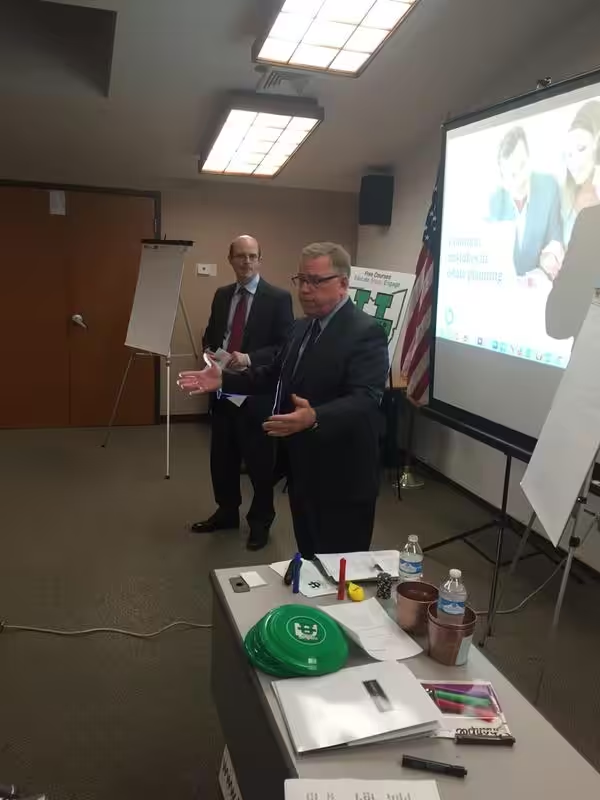
Finney Law Firm attorney Isaac Heintz teamed up with Bill Lyon of the Lyon Group tonight to present to Empower U — a free adult continuing education series — “10 Common Mistakes in Estate Planning.”  The event was well-organized and well attended, a credit to Dan Regenold and Nita Thomas, the organizers of Empower U.  The seminar also was presented “virtually,” which means via live, on-line video, and attracted a good number of participants online.

The video will soon be available online 24-7, and we will share the link when it is available.

Thanks to everyone who made this important event a success.

Cincinnati accounting firm Cooney, Faulkner and Stevens has focused on “exit planning” for business owners — making their companies ripe for sale or implementing a smart succession plan.

Below are just a few of their articles on the topic.  You may also visit their web site.

Over the years, I have worked closely with Crystal Faulkner and Tom Cooney and know them to be good accountants, and people of integrity.  But they also think strategically with and for their clients to bring added value in their accounting services.

Business Owners Who Take Time to Plan Exits Increase Chances of Success >>

Exits Are Inevitable. Failure Is Not >>

Building Value is the Win-Win-Win of Exit Planning >>

Death And Taxes vs. Preserving Wealth: The Final Exit Planning Contest >>

Put Your Objectives in the Driver’s Seat >>

Knowing Business Value is a Very Good Place to Start >>

We recommend giving Cooney, Faulkner a call for your accounting needs, especially exit planning strategies!


1398974656FLF_IHeintz

We are pleased to announce that as a part of the free Empower U adult continuing education series, Finney Law Firm attorney Isaac T. Heintz will co-present “Common Mistakes in Estate Planning” with Bill Lyon, a financial planner with  Cincinnati’s The Lyon Group.

In this session, the presenters will teach the 10 common mistakes in Estate Planning.

The program will be held on Tuesday, October 13 in the Sycamore Township Trustee room, 8540 Kenwood Road, Cincinnati, Ohio 45236 from 7:00 to 8:30 PM.  You can register for the event here.


There are many law firms in greater Cincinnati, some special-purpose and some full-service, and there are many title insurance companies, commercial- and residential-focused.

But as a lender, as a consumer, as an investor, as a Realtor, what are the advantages to having a robust title insurance company coupled with a full-service law firm?  We think there are several.

  • First, from a real estate transactional perspective, we offer significant depth of experience and breadth of services to residential and commercial buyers and sellers, as well as lenders: closing and title services, leases, seller financing documents, and post-occupancy agreements.  We also can handle zoning and regulatory matters relating to your property.
  • Our litigators can vigorously litigate to enforce the contracts that we write and that you sign, or defend against such actions.
  • We can handle sophisticated matters relating to bankruptcy, probate administration, and the business components of a real estate transaction.
  • Finally, our property tax valuation team can assure you are not paying more in taxes than the law requires.

We strive to produce the same high-quality product and responsive customer service across each practice area of the Finney Law Firm and with Ivy Pointe Title.  We invite you to let us show you how we can “make a difference” in your real estate matters.

Under Ohio law, individuals can avoid probate in connection with real estate by executing and recording a Transfer On Death (TOD) Designation Affidavit. A TOD Designation Affidavit is an “effective upon death deed” allowing the owner to transfer the ownership of real estate upon the owner’s death to whomever the owner designates by name. On the death of the owner, the transfer of the real estate to the transfer on death beneficiary is accomplished by filing a certified death certificate and an Affidavit in the applicable County Recorder’s Office.

During the life of the owner, the designated beneficiary has no rights to the real estate, and the recording of a TOD Designation Affidavit does not create a present entitlement to the real estate. The TOD Designation Affidavit can be revoked at any time without the consent of the TOD beneficiary. The TOD beneficiary only becomes entitled to the real estate if the TOD Designation Affidavit remains in effect on the death of the owner.

An individual can designate more than one party as a TOD beneficiary. If multiple TOD beneficiaries are designated, the division of the ownership can be varied among the beneficiaries (e.g. 10% to John Doe and 90% to Jane Roe).

The TOD beneficiary can be the trustee of the owner’s revocable trust. There are advantages and disadvantages to making a trustee a TOD beneficiary as opposed to directly transferring the real estate to the trustee to hold for the trust.

A TOD designation will lapse if the TOD beneficiary predeceases that owner; however, it is possible to designate a contingent TOD beneficiary as a means of addressing this possibility (e.g. to John Doe, if living; otherwise to Jane Roe).

Individuals who own property in “joint and survivorship” can designate a TOD beneficiary of their real estate. Only upon the death of the last surviving survivorship tenant will real estate pass to the TOD beneficiary or beneficiaries designated in the TOD Affidavit.

Please contact us if you would like to determine if a TOD Designation Affidavit is right for your estate plan.

High-income taxpayers need to be aware of the Net Investment Income Tax (NIIT).  The NIIT is a tax passed in 2010 to help pay for the Affordable Care Act, a.k.a. ObamaCare.  Below is a summary of the NIIT, and a few planning opportunities to consider to avoid/minimize NIIT.

The NIIT applies at a rate of 3.8% to certain net investment income of individuals, estates, and trusts that have income above certain thresholds.  The NIIT went into effect for tax years beginning on or after January 1, 2013.

Individuals will owe the tax if they have Net Investment Income and also have modified adjusted gross income over the following thresholds:

Filing Status Threshold Amount
Married filing jointly $250,000
Married filing separately $125,000
Single $200,000
Head of household (with qualifying person) $200,000
Qualifying widow(er) with dependent child $250,000


At this time, the threshold amounts are not indexed for inflation.

In general, estates and trusts are subject to the NIIT if they have undistributed Net Investment Income and also have adjusted gross income over the dollar amount at which the highest tax bracket for an estate or trust begins (for tax year 2014, this threshold amount is $12,150).

In general, investment income includes, but is not limited to: interest, dividends, capital gains, rental and royalty income, non-qualified annuities, income from businesses involved in trading of financial instruments or commodities, and businesses that are passive activities to the taxpayer (meaning the taxpayer does not “materially participate” in the business).  To calculate your Net Investment Income, your investment income is reduced by certain expenses properly allocable to the income. 

To the extent that gains are not otherwise offset by capital losses, the following gains are examples of items taken into account in computing Net Investment Income: (i) gains from the sale of stocks, bonds, and mutual funds; (ii) capital gain distributions from mutual funds; (iii) gain from the sale of investment real estate (including gain from the sale of a second home that is not a primary residence); and (iv) gains from the sale of interests in partnerships and S corporations (to the extent the partner or shareholder was a passive owner). 

The NIIT does not apply to any amount of gain on the sale of a personal residence that is excluded from gross income for regular income tax purposes.

In order to arrive at Net Investment Income, Gross Investment Income (items described in items 7-11 above) is reduced by deductions that are properly allocable to items of Gross Investment Income.  Examples of deductions, a portion of which may be properly allocable to Gross Investment Income, include investment interest expense, investment advisory and brokerage fees, expenses related to rental and royalty income, tax preparation fees, fiduciary expenses (in the case of an estate or trust) and state and local income taxes.

Some planning opportunities to consider to help avoid/minimize the NIIT include: (i) receiving the purchase price from a sale of your closely held business or real estate over more than one year; (ii) generating losses to offset gains; (iii) renting property to your business; (iv) lending money to your business; and (v) take an active role in your closely held business.

Preparing the appropriate estate plan for an individual requires the legal skills of an attorney to put together the right documents in the right combination.  At a minimum, the following estate planning documents are recommended by most attorneys:

Last Will and Testament.  A Last Will and Testament is a legal declaration that directs the distribution of probate assets upon the death of an individual (“testator”).  Probate assets are assets held in an individual’s name at the time of his or her death that do not otherwise transfer by contract (e.g., transfer on death designations, joint and survivorship, etc.).

Probate assets are subject to the oversight of Probate Court and administered in the County in which the decedent resided at the time of death.

The Last Will and Testament includes a provision for the designation of the personal representative (Executor) of the testator’s choosing, to be appointed by Probate Court.

Without a Last Will and Testament, the property passes in accordance with the Ohio Statutes of Descent and Distribution.

Durable Power of Attorney.  A durable Power of Attorney is an instrument by which one person (the principal) appoints another person (the attorney-in-fact) as an agent authorized to perform specific or general acts for the principal.  This financial power of attorney can be a very simple document, but one that gives significant powers to the attorney-in-fact.  This estate planning tool is capable of facilitating the management of an individual’s affairs during incompetence.

 Durable Power of Attorney for Health Care.  Ohio law permits an individual to execute a Durable Power of Attorney for Health Care.  With this document, an individual can designate a person to make health care decisions if the individual is unable to make such decisions on his or her own behalf.

The individual signing the Durable Power of Attorney for Health Care must be of sound mind.  The decision maker may not be the attending physician or the administrator of any health institution involved in the patient’s care.

Generally, the person appointed in the Durable Power of Attorney for Health Care will have the authority to give informed consent, refuse to give informed consent, and to withdraw consent for any medical treatment.  However, the person holding the Power of Attorney will not be able to refuse or withdraw consent to health care needed to maintain life, except in very limited circumstances.

Living Will.  A Living Will is a document that provides a means for an individual to declare his or her intentions regarding the withholding or withdrawal of life-sustaining treatment, including CPR, when he or she is no longer competent to make an informed medical decision and is in a terminal condition or a permanently unconscious state.

Ohio’s Living Will law distinguishes between patients who are terminally ill and those who are permanently unconscious.  Although both conditions must be verified by two (2) doctors, in Ohio there are additional protective measures for the permanently unconscious.  Food and water may not be withheld from a permanently unconscious individual unless the patient has signed a Living Will with a special section in capital letters, which special section must be signed or initialed.

Under no circumstances may an individual be denied comfort care.  Comfort care is defined as the minimum amount of care administered to alleviate pain and suffering, but not to prolong life.