




Frequently, clients desire to lend money, seller-finance the sale of their business or other asset, buy and then lease out a building, or engage in some other business transaction because they are motivated by favorable business terms the transaction provides on its surface: A high rate of interest, a good return under a lease, or a more promising sale price than otherwise the seller would obtain, for example.
This entry asks a prospective private lender to think twice about the risks associated with this activity and to take as many steps to protect himself as possible under the circumstances.
Who is the “lender” and who is the “borrower”
For purposes of this entry, there are many circumstances in which a party is a “lender” and another is the “borrower.”
- Obviously, a simple monetary loan in which there is a lender and borrower is one such transaction.
- Another occurs where an investor either owns a building and desires to rent it, or purchases one for leasing purposes. In addition, as a part of a leasehold transaction, the landlord may be putting into the premises significant sums in “tenant buildout costs.” Here, the renter is “using” the landlord’s money, his credit, and his asset, in exchange for monthly (read: deferred) payments. This is a form of “loan.”
- When a seller is selling his busines, his building or another asset, and does anything other than take back 100% of the purchase price at the time of conveyance, he is a “lender.” (And the worse situation is where the seller is taking a subordinate position to a lender who gets a first mortgage or other lien on the assets acquired. In such situation, the liklihood of the seller getting his “loaned” funds is significantly impaired, and the chance of default significantly higher.)
- Even co-signing a loan or a lease, or guaranteeing the debt of another, is “lending” your credit to the co-borrower.
Four important factors to consider
But consider these factors before “lending” your money, your asset, and your credit to a third party:
First, ask yourself: “Why can’t this buyer get conventional financing?” Banks are in the business of assessing and taking the risks associated with lending. If this “borrower” does not qualify for a bank loan, why should you be in the business of being a lender? Have you really fully assessed the risks of lending to this “borrower.”
Banks know experientially and actuarially the “warning signs” that predict loan defaults. Among these are an inability to come up with an adequate down payment, a poor credit score, a history of litigation, and other warning signs. I spoke with one lender recently, and they said they will never lend to people who fail to pay their taxes — ever.
Second, in my experience, a buyer of an asset is much more likely to raise defenses and counterclaims against a seller than the buyer would be able to as against a third party lender: Fraud in the inducement of the sale, property defects, misrepresentations in the business accounts, and simple contract breach. Buyers will raise any and every excuse and defense against paying money they owe.
Third, the more desperate the “borrower” is, the more likely he is to agree to generous transaction terms: a high rate of interest, a high sale price, or some other above-market remuneration. And — I say this based on experience — borrowers who have no intention and no ability to pay back the “loan” are the most willing to agree to generous lending terms.
Fourth, if you are going to leap (into the position of being a lender), at the very least look first: do the kind of due diligence that a lender would — a credit check, a background check, reference checks, and a simple check of court clerks sites and bankrupcy court history for obvious signs of fiscal distress.
The ABCs of improving your position as a lender
So, you have made the decision to “lend.” What steps can you take to improve your position and increase the liklihood of getting your money paid back, with interest?
A. Certainly ask for a personal guarantee of any “loan” to a corporate entity. Accepting simply a corporate signature, whether of a note maker, a tenant or the buyer of an asset, is asking for trouble, unless that company’s creditworthiness has been thoroughly ascertained
B. Don’t be shy about asking for the personal guarantee of the principal’s (or principals’) wife (or wives). If the borrower is earnest about putting their name, their assets and their creditworthiness behind a promise, and they have asked you to extend credit to them — then shouldn’t their wife also stand behind the obligation? Stating it differently, the most common and most obvious dodge of debtors avoiding their creditors is to place their assets in the name of their wife. Don’t let them avoid their obligations to you so easily.
C. Are there third parties who can guarantee the debt? A business partner? A parent? Who is interested in the success of this borrower’s business such that they would be willing to stand behind its obligations?
D. Look for assets to lien. Does the “borrower” (or his wife) own a house, stocks, jewelry, accounts receiveable, or equipment or inventory in their business? Are those assets presently free from any first lien against them? If so, and if the borrower is earnest about paying back your debt, then he should not have qualms with providing a security interest against those assets to stand behind the loan. (Note: Please consult an attorney about how to properly take a lien in various assets; it can be tricky.)
E. Would some patience or a reduced price yield either a cash buyer or enable the buyer you have to go and get a bank or other third party loan? If so, it may be wise to take one of those options.
Conclusion
Lending is an ultra-hazardous activity that should not be undertaken lightly.
There are exceptions where the seller’s main motivation is not necessarily getting payback of the loan: a parent helping a child; a business or building owner who is getting a great sale price for the asset, and perhaps much of it in cash; or simply a weak market with few buyers. And so long as our clients enter into a transaction understanding the risks of being a “lender,” we are fine with that decision.
But we see many clients seduced by more favorable terms from a borrower or seller-financed buyer who desperately needs their cash versus a stingier cash buyer.
Our suggestion: Think about taking the money and running instead.
The risks inherent in being a lender is why they say: “Cash is king.”


The Finney Law Firm prides itself on our aggressive stance in countering the actions of bureaucratic bullies through claims resulting not just in a victory in the administrative battle being fought, but also in recovering monetary damages, attorneys fees and injunctive relief against those very bureaucrats.
However, because of abstention under Younger v. Harris, 401 U.S. 37 (1971), and its progeny (that has been significantly scaled back by a the recent Supreme Court decision in Sprint Communications, Inc. v. Jacobs, 571 U.S. __, 134 S.Ct. 584 (2013)) and other principles of administrative law and comity, it is a bit of a challenge of how to “turn the tables” on government actors and bring a challenge under 42 USC Section 1983 concurrent with the administrative proceeding.
We had such a case in 2012. There, our client was being disciplined by the Ohio Elections Commission in a proceeding we were certain was unconstitutional violation of her free speech rights.
First, we raised First Amendment defenses before the agency. They were simply deaf to such arguments. Then, when filing our Section 119 administrative appeal in Franklin County Common Pleas Court, we appended a claim for declaratory and injunctive relief under the First and Fourteenth Amendments to the United States Constitution as allowed by 42 USC Section 1983.
And, of course, to level the playing field against an agency who had the full resources of state govermment against her, such claims include the right to have the client’s attorneys fees reimbursed by the State if the Plaintiff prevails.
In Magda v. Ohio Elections Commission, Franklin County Common Pleas Court Case No. 12-CVH 10-13674, the state opposed that Complaint saying that state law did not tolerate a Section 1983 challenge to accompany an administrative appeal. The trial court disagreed, and Judge Mark Serrott wrote this decision allowing the challenge to proceed arm-in-arm with the Chapter 119 appeal.
Judge Serrott later granted the State’s Motion for Summary Judgment, denying both our administrative appeal and the Section 1983 challenge to the statute. That decision was appealed to the 10th Circuit Court of Appeals. Interestingly, the State at that level did not renew their challenge to the Section 1983 claim accompanying the Chapter 119 appeal. Thus, the issue proceeded with both claims before the appeals court.
In the end, the Court of Appeals overturned the trial court decision and granted summary judgment to our client on both the administrative appeal and the constitutuonal claims. Thus, Plaintiff won a permanent injunciton against the enforcement of the statute and reimbursement of the full measure of her attorneys fees dating back to the initiation of the action before the agency under the constitutional claim.
So, yes, a constitutuional challenge (or any claim challenging the authority of the legislature to enact the offending law or the agency to enforce the same in the manner that it has), can be brought along with a Chapter 119 administrative appeal.
This vigorous and creative response to a prosecution by bureaucrats raging out of control in Columbus is a prime example of how the attorneys at the FInney Law Firm succeed in “making a difference” for our clients.
Let us know how we can solve your business and bureaucratic challenges.

On Friday, the Cincinnati Enquirer and USA Today wrote about our case, NorCal Tea Party v. IRS, the only nationally-certified class action challenging the IRS’ and Lois Lerner’s targeting of Tea Party groups for extraordinary review in their non-profit applications.
The new development in that long-running case is that Lois Lerner and her chief lieutenant, Holly Paz, seek to have their deposition testimony sealed, and indeed all pleadings relating to the sealing sealed as well. (You will remember that Lois Lerner pled the 5th before Congress and refused to testify about the scandal, and her role therein.) Indeed, Judge Barrett has ordered a sealed hearing on those motions for this Friday. You may read all about that here.
Well, today, the Gannett GP Media, Inc., the parent company of USA Today and the Cincinnati Enquirer, filed a motion to intervene in the case for the purpose of forcing open the pleadings, the deposition transcripts and the hearing.
Read about that here.
The Enquirer’s Motion is here and their tendered Memorandum in Opposition to the Lerner/Paz motions is here.
In our firm’s relentless pursuit of public interest law, we consider this issue, and this case, to be among the most consequential matters we have addressed.

As attorneys, especially in a smaller city like Cincinnati, we can be tempted to trust one another, especially experienced real estate practitioners as to the timing of recording of instruments. But that trust can be misplaced, as many times between the “closing” and “recording” things go awry.
Roundtable closings
In Ohio, particularly southwest Ohio and for residential properties, round-table closings are common. For clients from other parts of the country, this can seem like a quaint (and legally dangerous) custom.
The buyer, seller, lender, and Realtors all gather in a room with a title agent to sign and exchange documents and funds. This ceremony is a “closing” and there occurs the formal payment of the purchase price, funding of the loan and the delivery of the deed.
Escrowed closings
This can differ from closings more common in other parts of the country where the seller places in escrow the deed, the buyer places in escrow the note and mortgage and the lender and buyer pay the sums to the escrow agent. (Escrowed closings are not unheard of in the Cincinnati marketplace, especially for commercial transaction or corporate executives whose schedule will not allow them to attend a closing in person.)
In this setting, the title agent holds both the escrowed funds from the buyer and the lender, and the deed and mortgage for recording. Then, he records the instruments and checks the title to assure that “all is clear” before disbursing funds.
The “gap”
Thus, with an escrowed closing, there is no “gap” between funding the recording. The funds are not released until after recording and title updating showing no intervening liens or deeds.
However, with a roundtable closing, the funds are released to the seller at the closing table, and the deed and mortgage may not be recorded for hours or days. In the meantime, in theory if not in practice, a deed, easement, mortgage or involuntary lien (such as a tax lien, a judgment lien or a mechanics lien) could be recorded against the real estate.
Since Ohio is a largely race/notice state as to the order of recordation of instruments (whoever records first without actual notice of someone else’s interest in the property “wins” the contest for priority), the later-recorded deed or mortgage would lose priority to an instrument intervening beforehand.
This is a large potential risk in terms of losing value for the buyer or lender. The total value of the real estate can be lost as a result of such a priority issue.
This timeframe between closing (or the last title update) and the recordation of the title instruments is known in the real estate industry as the “gap.”
Insuring the gap
So, the issue for a buyer should be: Who is taking the risk for the gap? It goes without saying that a seller delivering a warranty deed is promising to deliver good title to the buyer. But what if the seller is a crook, bankrupt, deceased or simply un-findable after the closing?
Well, (a) if a buyer purchases an owner’s policy of title insurance, (b) specifically requests that the title company insure the “gap,” and (c) that “gap” coverage is issued at the closing table, then the buyer will be protected from losses from an intervening instrument. If all three circumstance are not present, then the buyer is going to bear this risk and have claims solely against the seller for breach of warranty covenants.
Real-life experience
We recently were approached by a buyer from a round-table closing on a residential property. It took the title agent six days after the closing to record the deed. In the intervening timeframe, the seller gave a deed to a second buyer. (Sure, this was entirely fraudulent conduct by the seller, but nothing should surprise us anymore.) That second buyer’s deed went on before the deed of the first buyer. The first buyer even purchased an owner’s policy of title insurance, meaning at the closing he obtained a “commitment” for a title insurance policy. But that commitment did not contain “gap” coverage language, rather the policy was conditioned upon the instruments being recorded without loss of priority.
Conclusion
That particular matter is still in litigation, but, win or lose, this story highlights the grave risk of closing a transaction by roundtable closing, and failing to ask for and obtain affirmative “gap” coverage. This admonition applies equally in residential and commercial transactions.
Finally, this ties in with our earlier admonitions: (a) buy title insurance (Why title insurance?) and (b) Don’t just buy a title insurance policy; read the policy, on our Ivy Pointe Title blog. While it would be nice to tell clients that protecting their interest is as simple as buying an owner’s policy of title insurance, it is not. The buyer must read and understand the exceptions to coverage and also ask for “gap” coverage. Otherwise, he retains significant risks of partial or total title failure.

In our Spring 2017 newsletter, we introduce you to the paralegal team we have carefully assembled as well as provides updates in commercial leasing, labor and employment law, and medical malpractice litigation,
Read it here.

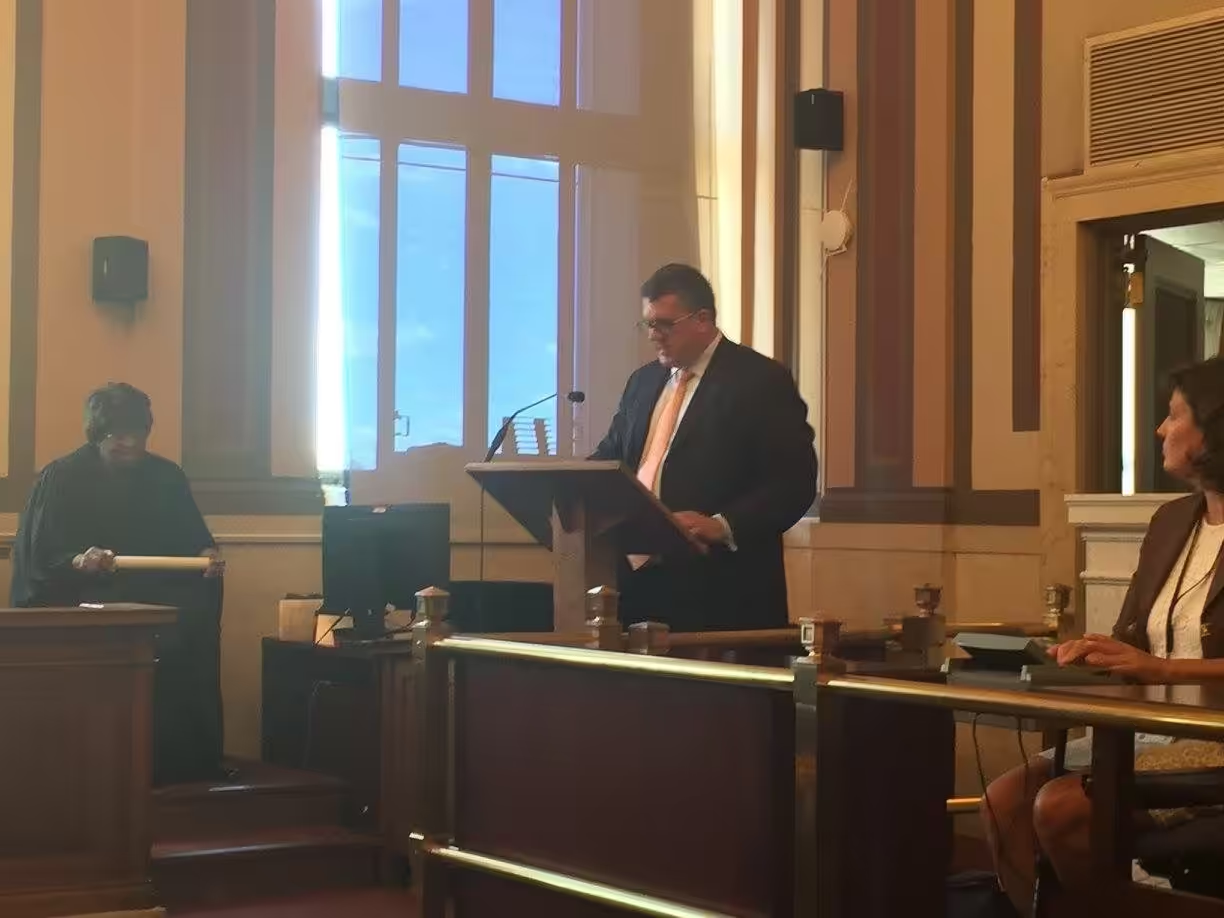
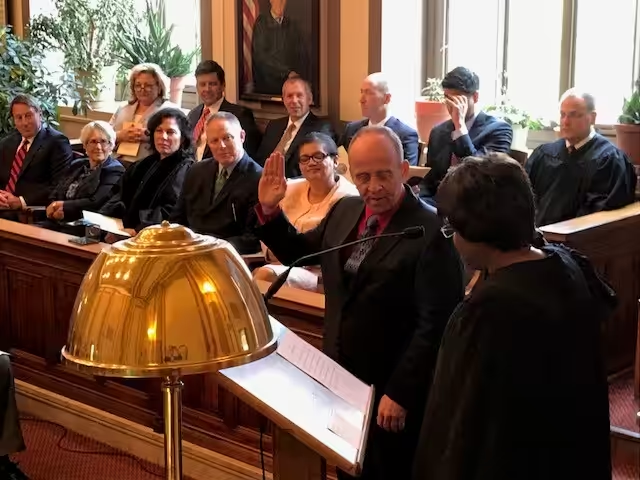
Today, former Finney Law Firm attorney (of counsel) Curt Hartman took the oath of office as a Judge on the Hamilton County Common Pleas bench. The oath was administered by Judge Melba Marsh. Judge Hartman was appointed by Governor John Kasich to the bench to fill the unexpired term of Judge Beth Myers, who last fall won a seat on the Court of Appeals.
Immediately afterwards, Judge Hartman’s parents — Carl and Barbara Hartman — formally “robed” the Judge.
Our own Chris Finney served as Master of Ceremonies.
It was a joyous occasion. Congratulations, the Honorable Curt C. Hartman!

As we have grown, the vision of the Finney Law Firm is sharpening for our clients and the public: A broad array of services offered in one firm, each practice area delivered in a quality fashion.
At our core, we are a real estate firm, with experienced transactional attorneys, a title insurance company that insures residential and commercial titles, and commercial litigators who can address virtually every aspect of disputes relating to real estate: Eviction, foreclosure, title disputes, easement disputes, construction disputes and mechanics lien claims, as well as complex real estate litigation.
Beyond that, we offer quality estate planning and probate administration and our transactional team rounds our its services with corporate formation and development, including acquisitions, dispositions and financing.
Isaac T. Heintz, Kevin J. Hopper, and Eli Krafte-Jacobs, along with paralegals Tammy Wilson and Misty L. Winkler, and Richard P. Turner at the title company, lead our transitional team day in and day out.
Our litigators are well-known for our public interest practice — handing legislative and regulatory matters aggressively, confronting government officials who would illegally interfere with their life, their business and their fortune. Three times we have ascended to the U.S. Supreme Court, and three times we won the relief we sought with 9-0 victories there. We apply this same sophistication and vigor to commercial litigation, personal injury, wrongful death and medical malpractice matters.
Bradley M. Gibson, Stephen E. Imm, Julie M. Gugino, and Casey A. Taylor along with paralegal Brandy E. Fitch are our quality litigation team.
Finally, we are proud to recently have expanded our litigation services to include labor and employment law with experienced litigator Stephen Imm.
When a client asks “do you do that,” I am proud to respond “yes, and we do it well. Let me introduce you to …..”
Let us know how we we can help with your business or personal opportunity or challenge. It is with you in mind that we have assembled this team of quality practitioners.