Curt
Finney Law Firm attorney Curt C. Hartman is a delegate to the Republican National Convention

Today’s Cleveland.Com features an article on safety and security at the Republican National Convention in Cleveland, featuring our own Curt C. Hartman.

We are very proud of Curt for this exercise in leadership — “making a difference” in our community and for our nation!

Read it here.


Adrien-Broner-bearded-fukuda
Cincinnati and champion boxer Adrien “The Problem” Broner


As we reported here, this firm represented the victim of an armed assault by champion boxer Adrien Broner in his civil case.

Today, the criminal case came to trial, and Broner failed to appear.

The Judge locked him up for 30 days just for that.  Read that here.

Broker is know by his nickname given to him by his parents: “The Problem.”

Chris Finney appeared on 550 AM WKRC radio last week to address our new litigation against the University of Cincinnati arising from their practice of segregating male students from female students in physics labs.

We have filed suit on behalf of 19-year-old student Casey Helmicki who was subject to that discrimination, alleging that the same violates the Fourteenth amendment to the US Constitution and Title IX of the US Code, which prohibits discrimination against women in the provision of educational opportunities.

Listen here starting at 1:04 until 1:13.

You may read more about this suit here.

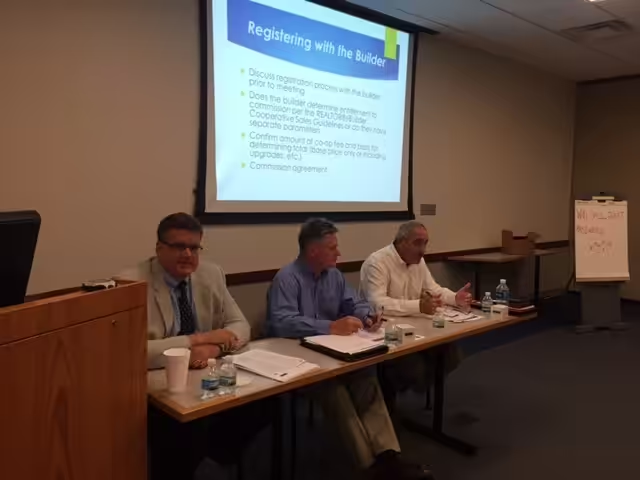
IMG_8153

Our own Chris Finney participated in a panel discussion today on Topics in New Construction at the Cincinnati Area Board of Realtors.  Also on the panel were Mike Hoffmaster of Hoffmaster Properties and former President of the Greater Cincinnati Home Builders Association and Jeff Rosa of Sibcy Cline, Realtors.  The course was designed to train lawyers and Realtors on new construction issues to better assist them in serving buyers and builders.

Thanks to Cindy Henninger and Amanda Wilson at the Board for making this happen!

  • posted: Jun. 21, 2016
  • Hemmer DeFrank Wessels PLLC
  • Uncategorized

Written By: Scott R. Thomas

Figliozzi and Company is the designated contractor performing audits on behalf of the Centers for Medicare & Medicaid Services.  If you sought or obtained an incentive payment for either the Medicare or Medicaid EHR Incentive Program, you are subject to being audited.  A November 2012 report from the Office of Inspector General stung CMS with the conclusion that it was not doing enough to validate attestations.  This spurred CMS to ramp up its program to the point where it’s not really a question of whether you will be audited; it’s only a matter of when.

If the recipient can’t back up the attestations, CMS will recoup the incentive payment.  CMS doesn’t do partial recoupment.  Fail in one respect and they claw back all the money.  CMS may also pursue additional remedies if they smell fraud.  But don’t panic just because your number came up.  While some recipients are targeted for an audit because their numbers seem out of whack, CMS also does random audits.   The key is to acknowledge the fact you will ultimately be audited and start preparing now.

Advance preparation is critical because you typically have only two weeks to respond once you are notified of the audit.  That’s just not enough time if you wait for the mail to arrive.  Asking the auditor for an extension of the deadline implies that you don’t have your stuff in one sack.  And don’t think you can simply rely on your EHR vendor’s certification.  You are the provider and you are responsible for assuring and documenting Meaningful Use within your practice.  The good news is that there’s plenty you can get a head start on.

The first thing to do is to decide who is going to respond.  You may want to set up a team.  This is not something you want to dump on your already over-worked practice manager and forget about it.  The stakes are too high.  The doctors must be involved.  One person should be in charge so the ball doesn’t get dropped in the middle.  The Team Leader should be the sole liaison to the auditor.

The Team Leader should be the only person to have telephone conversations with the auditor.  This will minimize miscommunications.  When the phone call is over, that person should immediately email the auditor and summarize the call, e.g., “Thanks for giving us until Friday, July 15th, to get you the 2015 screen shot you requested and the documentation supporting the SRA corrective actions taken.”  Always add a catch-all such as, “Please let me know if there is anything else you need me to do that I haven’t mentioned.”  That way, you put the burden on them to tell you what they want and avoid any dispute about unfulfilled promises.  Save all the email communications related to the audit.

Put the deadline for getting the documentation into the auditor’s hands on your calendar or tickler system so it doesn’t get missed.

Then gather all your documentation to support attestation data for meaningful use objectives and clinical quality measures.  For most practices, your primary document is the report generated by your certified EHR; that generally provides the data Meaningful Use attestation.  Make sure the report on its face shows that it’s your report by reflecting your provider number, etc.  All this information has to be kept for six years so make sure it’s maintained appropriately and people know where it is.  Mark it conspicuously so no one inadvertently throws it out.   Don’t forget the electronic documentation that supports your attestation.  Store that information together.  Consider saving the data in multiple locations.  Get an external hard drive and keep a copy there as insurance against a system meltdown.

Sit down with your Certified EHR vendor.  Pull out the license agreement.  A contract with the Certified EHR vendor may suffice to prove the use of a Certified EHR.  Some vendors, however, include confidentiality requirements in their contract which may prohibit you from sharing the document with the auditors.  If your agreement has such a term, brainstorm with the vendor about how to give the auditors what they need while still honoring the agreement.

One of the best ways to prepare is to do a self-audit.  Better to iron out all the wrinkles in the tranquility of a dry run before the stress of the real event.  Put yourself in the hot seat and ask the tough questions:

  • Do you have reports from the Certified EHR vendor that validate the clinical quality measures you reported?
  • Are there any red flags at the 50,000-foot level? Do all of the percentage-based measures have the same denominator? Do the numerators and denominators match the figures you put on the CMS attestation form?  Are the figures inappropriately uniform?  For example, do all of the doctors attest with the same percentage figures?  Sniff out discrepancies and get your math right.
  • If your certified EHR doesn’t enable you to do “look backs” and show the values at any past point in time, do you have a paper or electronic screen shot of the report used for attestation purposes? Do you have screen shots from the Certified EHR during the reporting period? Do your screen shots show the level of detail needed (e.g., date, provider, name, etc.)?
  • Do you have proof of performing an adequate Security Risk Analysis per the HIPAA security rule? Did you complete it before the end of the reporting period? Do you have the documentation to memorialize the actions you took to mitigate the risks you identified?
  • If asked (for the purpose of further validating implementation), could you produce evidence of the costs incurred to train staff on the Certified EHR?
  • Is your vendor using the most up-to-date version of a Certified EHR product? Is the product you are using on the list at the Office of the National Coordinator’s website? Is there an upgrade that you haven’t obtained yet?
  • Do you have documentations to support any exclusions you claimed? This may be tricky, as you’re essentially proving a negative.
  • If necessary, would you be able to show the auditor when a particular functionality became operational?
  • The audit is likely to be done remotely but the auditor can request a site visit. The auditor can ask you to give a demonstration of your system. Do you know how you would handle that request?

Whenever you send hard-copy documents to the auditor, send them either by FedEx or by certified mail, return receipt requested.  That way, you will have proof of delivery.  Include a cover letter and make sure the contents are labeled.  Keep a complete copy of every document you provide.

The word is that one out of four recipients fails the CMS audit.  Don’t be one of them.  Sure, you have a right to appeal.  But better to get right from the beginning.  Start getting ready now.

If you would like more information about these issues, please contact Scott Thomas.   He welcomes the opportunity to help you navigate these waters.  Scott’s direct line is 859.578.3862.  You can email him at sthomas@HemmerLaw.com.  If there is a particular topic you would like to see addressed in a blog, please send Scott an email with your ideas.


Friday of last week, the Federal Elections Commission issued a series of decisions on Complaints we prepared and filed for our client David Krikorian five years ago.

Those decisions found that former Congressman Jean Schmidt, and the Turkish Coalition of America violated federal campaign finance laws in accepting payment of her legal fees in legal proceedings against our client, and fined then respectively $2,500 and $25,000 for those violations.

You may read those decisions here, here, here and here.

Making a Difference

These decisions — which sat on the desks of bureaucrats in Washington, D.C. for an inexcusable years and years — capped a tremendous and frequently disappointing journey through the halls of power of Washington and the highest Court in the land.

In the end, we overcame a system of justice that is carefully designed to protect the wealthy, the powerful, and the well-connected, veiled in secrecy, and hidebound by bureaucratic inaction– although not in the manner that the proper administration of justice would provide.

Our firm — through the fine research and writing, and tremendous patience and persistence — saw through to a successful end a complex, tortured and unfair series of legal processes to the advantage of our client.

This journey, perhaps better than any story we can tell, describes the commitment we hold to “making a difference” for our client in each and every assignment.

Ohio Elections Commission action and more

We originally were retained to represent former and future Congressional candidate David Krikorian in the defense of several “false claims” allegations brought by Congressman Jean Schmidt before the Ohio Elections Commission (“OEC”).  She claimed that in the course of the 2010 Congressional campaign, David Krikorian made certain false statements about her, essentially that she was on the payroll of the Turkish lobby in America.

Ironically, through the course of these proceedings and otherwise, she herself proved the basic premise of these allegations.

But tangential to those proceedings, we became curious that Jean Schmidt appears to have unlimited access to “free” legal services from two expensive attorneys from Washington, D.C. and a second in Columbus, Ohio.

Our lead counsel in representing Krikorian was famous Los Angeles attorney Mark Garagos, who was simply fun to work with, and inspired in his legal strategy.

That original OEC action then led to an appeal, a First Amendment challenge to the jurisdiction of the Ohio Elections Commission, and then a defamation case brought by Schmidt.  These were incredibly expensive proceedings that came at us in waves from the Schmidt camp.

The legal actions were unprecedented in that they made no economic sense, and were outside the scope of our experience with clients who have to make practical decisions about proceeding with litigation in the face of daunting obstacles of time, expense, and the difficulty of legal recovery.

Who was paying our Congressman’s legal fees?

As the matter progressed over a period of years — with depositions across the country, two days of trial before the Ohio Elections Commission and endless motions — it dawned on us that something was terribly wrong here, that Jean Schmidt was pursuing this matter because she was accepting an illegal gratuity as a Congressman and as a candidate.

Garagos had the ground-breaking idea to take the deposition of Jean Schmidt’s attorney, Bruce Fein.  In all our years of litigation, it never occurred to us to take the deposition of the opposing attorney.  Schmidt’s attorneys opposed the motion, but the OEC ruled that it would proceed.

In that deposition, we asked Schmidt’s attorney “who was paying all these legal fees?” and he admitted that at the commencement of the relationship he met personally with her and her Chief of Staff and told them both that the Turkish Coalition of America (“TCA”) would foot the whole legal bill for the proceedings.

[This sworn testimony would prove key thereafter, as Schmidt steadfastly denied through multiple proceedings thereafter that she had no idea how her legal bills were being paid, over a period of years, but only that she was never invoiced for the work.]

We estimated — correctly as it turns out — that Schmidt had received more than $500,000 in legal fees from the TCA.

A thicket of confusing rules and multiple whitewashes

Our firm then began to research whether it was legal and appropriate for a sitting member of Congress to accept the payment of her legal fees, to the tune of hundreds of thousands of dollars, from a lobbying group in D.C., dedicated to influencing legislation  before Congress and policy in the administration.

The rules were complex, but the answer was pretty clearly “no” for a host of reasons:

  1.  It violated House Ethics rules to accept the gift.
  2. It was a felony to fail to report the gift on federal financial disclosure forms.
  3. It violated federal elections law to accept the gift.
  4. The gift constituted taxable income to the Congressman, which must be reported to the IRS and on which income taxes must be paid.

Thus, following the key depositions, we waited for the Congressman to file her federal financial disclosure forms for 2011, and then filed Complaints with the Office of Congressional Ethics and the Public Integrity section of the U.S. Attorney’s office.

After waiting more than a year, we learned that the Office of Congressional Ethics had properly examined the gift and referred the matter for further action to the House Ethics Committee.

But in a curious move, the House Ethics Committee ruled that the gift was illegal, and had to be paid back, but found that because Schmidt did not know who was paying her fees (in direct conflict with her own lawyer’s sworn testimony) that she would not be disciplined by the House.  It was, very simply a whitewash.

We then filed a Complaint with the IRS over the unclaimed income.  They also saw nothing untoward.  Another whitewash.

A challenge to the OEC False Claims statute and a trip to the U.S. Supreme Court

As a result of the tortured and unconstitutional proceeding before the Ohio Elections Commission, Finney Law Firm attorneys then decided to challenge the false claims statute in Federal Court.  That commenced in two other actions in 2011 and 2012,

We lost those twin law suits in the U.S. District Court, in the U.S. Court of Appeals for the Sixth Circuit, and en banc before the Sixth Circuit.  Ultimately, not a single trial or appellate Judge saw any merit to our arguments.

But then in January of 2014, the U.S. Supreme Court accepted our case for review, and the tide quickly turned.  We had oral argument in April of 2014  and a decision by June of that year.

In a Clarence Thomas-authored opinion, we won 9-0, sending the cases back to the trial Courts in Cincinnati.  It then took two more yeas of hearing and appeals, but we have prevailed in those actions and the OEC False Claims statute has been struck down as unconstitutional, a tremendous victory for justice against an entrenched bureaucracy in Columbus.

Waiting for the Federal Elections Commission

That left one more decision, a decision that curiously sat for years, and years and years in Washington.  For normal people, what in God’s name takes five years — five years — to decide.  Month after month and year after year, the FEC, shrouded in secrecy, sat and sat and sat on the Complaint that alleged that the $650,000 gift violated federal campaign finance laws.

Last week’s letter to our client from the FEC ended that waiting.  They concluded that Schmidt deserved more than a $2,500 penalty but because her campaign committee had no money and she was no longer a candidate for federal office the pithy sanctions was appropriate.  They fined the TCA more, but not nearly enough.

A Congressman loses her seat

To understand the hubris that would lead to this type of abusive conduct by a member of Congress, one needs to understand two things: (i) members of Congress simply never (almost never) lose their seats, with reelection rates reliably above 95% (read here) and (ii) they know that the House Ethics Committee and federal prosecutors won’t lay a glove on them.

Thus, it was sweet justice in May of 2012 when the voters resoundingly turned Schmidt out of office, in part because of her record of corruption as revealed by the House Ethics Committee and media reports of her mendacity.  Chris Finney even gave a series of speeches to expose the incredible tale.  (see here, here, here and here).

Making a difference

We would have preferred that the path of justice in this matter had taken several different turns — that prosecutors would have recognized the multiple felonies committed by these actors in giving and receiving the illegal gift.  The House Ethics Committee, the U.S. Attorneys’ office, the IRS, and ultimately the FEC failed in discharging their duties to punish these overt and incontrovertible misdeeds.

But the voters had the final say, and the slow, weak and intellectually dishonest bureaucrats, in a strange way, both exposed Jean Schmidt’s corruption, and their own inability to administer justice.

Read more here>> Enquirer: FEC settles Jean Schmidt ethics case

 

Last week, the Ohio Supreme Court issued a landmark decision on Ohio’s Open Meetings law, O.R.C. Section 121.22 in the case of White v. King.

Ohio’s Open Meetings law prohibits closed-door deliberations of public business when a majority of the public body is present, subject to host of exceptions.  But the question was confronted in the King case of whether deliberations via email among that same majority of public officials is also prohibited.

The King case strongly answered that question in the affirmative:

serial e-mail communications by a majority of board members regarding a response to public criticism of the board may constitute a private, prearranged discussion of public business in violation of R.C. 121.22 if they meet the requirements of the statute.

The decision is linked here.

Written By: Scott R. Thomas

You met with the patient.  You explained all the risks of the procedure.  The risks were later spelled out in the consent form and you went over it all again with the patient.  The patient accepted the risks and wanted you to perform the procedure.  You performed the procedure but the results were less than you and the patient hoped for.  Being a stand-up doctor, you explained what happened with the patient.  Genuinely sorry that it didn’t work out as planned, you expressed your sympathy to the patient and the family.  Then you got the summons and Complaint in the mail.  You’ve been sued.  They’ve even quoted—or should I say, misquoted—your apology.  Your colleagues are upset.  Your malpractice carrier is asking questions to see whether your apology affects coverage, given your duty to put them on notice and cooperate.  How can this be happening?

When something bad happens to someone we know, we express compassion.  When a person does something wrong, the natural inclination is to apologize.  You may feel it’s the right thing to do.  You may feel pressure to disclose the facts because of your personal beliefs, the ethical guidance of the American Medical Association, or the requirements of a hospital at which you have privileges.  However natural these feelings are, these statements may have legal repercussions.  Plaintiff lawyers know the power those statements have.  Although these apologies are hearsay, lawyers for patients get them into evidence with the “statement against interest” exception.  They tell the jury, “Why would Dr. Smith apologize if she did nothing wrong?”

In reaction to this, about three out of four states have enacted so-called “Apology Statutes.”  Only a handful of states, however, provide blanket protection for the doctor’s remarks and brand them inadmissible.  Most states try to make a distinction between a statement that is an admission of fault and a statement which is merely an expression of condolence.  Under Ohio Revised Code §2317.43(A), “all statements . . . expressing apology, sympathy, commiseration, condolence, compassion, or a general sense of benevolence . . .  are inadmissible as evidence of an admission of liability or as evidence of an admission against interest.”

Legislatures enact these laws because they believe that a rule protecting a doctor’s expression of sympathy promotes the physician-patient relationship after a negative outcome.  Proponents also argue that patients who sue their doctors often say that they didn’t think the physician was candid or honest about what happened, if it was explained at all.  These are all reasonable theories but no study, anywhere, concludes that patients will refrain from suing if a doctor apologizes.

Apologies of the kind protected by statute don’t deter suits.  As Apology Statutes are written by politicians, it comes as no surprise that protected statements have the ring of apologies you hear politicians make: “If anyone was offended by remarks about my opponent’s race, creed, gender, orientation, or ethnic origin, I sincerely apologize.”  These kinds of “apologies” sound hollow because the speaker doesn’t claim responsibility.

This is precisely why protected apologies are problematic in a health-care setting.  The kind of apology envisioned by the statute doesn’t get you very far.  You meet with the patient and the patient’s family and express your heartfelt sympathy.  Fine.  Now come the questions.  “What went wrong?”  “What caused the bleeding?”  “Why did her blood pressure drop?”  “Why did he lapse into a coma?”  People are grateful for the sympathy but they want the details.  In many cases, the details are not an admission of negligence.  No physician is perfect.  Many things can go wrong in a medical procedure that is performed with care that is state-of-the-art.  An adverse outcome is not synonymous with negligence.  If we didn’t acknowledge the possibility of bad outcomes despite superior care, doctors would be forced to perform only risk-free procedures.  Even so, the line between a bad result with proficient care and a bad result caused by substandard care can be a fine one and may be blurred by circumstances.  Be prepared for the possibility that you and your patient’s lawyer will draw that line differently.

In addition, keep in mind where you are.  Your group may have satellite offices throughout the tri-state area.  You may be in Kenwood one day and Covington the next.  Unlike Ohio and Indiana, Kentucky has not enacted any statute to protect a doctor’s expressions of sympathy.  Anything you say to a patient or the family is up for grabs.

Being a doctor doesn’t yet mean “never having to say you’re sorry.”  When your patient has an outcome other than what you intended, however, it pays to be cautious in your explanation about what happened.

If you would like more information about these issues, please contact Scott Thomas.   He welcomes the opportunity to help you navigate these waters.  Scott’s direct line is 859.578.3862.  You can email him at sthomas@HemmerLaw.com.  If there is a particular topic you would like to see addressed in a blog, please send Scott an email with your ideas.


Written By: Todd V. McMurtry

Today most courts require that litigants attempt to mediate a resolution to their dispute before the court will set the matter for trial. For this reason, it is critical that the parties evaluate a number of key variables before they go to mediation.  Here is starting point for the process.

  • What is the relationship between the two businesses? Is there the potential to preserve the existing business relationship so that the parties can continue to do business with each other after the dispute is resolved? Or, is this a one-time deal after which the parties will likely have no future business relationship? If there is a possibility that the parties might have a future business relationship, this potential opens up new opportunities to find a business solution to the dispute. Perhaps, as a portion of a settlement, one party can offer a discount on future business? If a future business relationship is unlikely, the negotiation will more likely focus on a financial solution.
  • What is the relationship between the principals? Do they get along? Has the situation become emotional in any way? Does the person participating in the mediation have knowledge of the events? Oftentimes, the principals have a long history. Sometimes, they are friends and would prefer to maintain that relationship. The opposite can also be true. No matter, in many situations, the principals will be living in the same industry for years to come.
  • What is the best outcome? Is it just about money? Sometimes a successful mediation requires an affirmative act by one of the parties. For example, if one construction company has multiple ongoing projects with one general contractor, the solution to the current problem may involve modifications to all of the existing business. Does a subcontract need to be revised? Does a particular project manager need to be removed? It is always important to discuss potential outcomes with your client before start of mediation. Both of you need to have established parameters to define what is an acceptable outcome.
  • When is the time right? Too often, mediation comes too early or too late. If it’s too early the parties may still be ready to fight. All lawyers know that litigation is hard on the client. But, if mediation comes too early, the client may not have experienced some of the negative reinforcement (legal fees and aggravation) that would encourage a resolution. Instead, the client may still have visions of a smashing victory in court. On the opposite end, if the client has already invested a significant sum in the litigation process, it may be forced to go to trial to have any hope of breaking even. So, think carefully about when you should suggest mediation.
  • Who is opposing counsel? As we all know, some attorneys just can’t help themselves. A win-win settlement is just not part of their vocabulary. When an attorney like this is on the other side, you should advise your client that mediation may not be productive.

It is always a good idea to reflect carefully on the questions presented in this this blog and those developed from your own experiences before deciding if and when to mediate. Once you make that decision, discuss these issues with your client to improve your chances for successful outcome.

Todd V. McMurtry is a Member at Hemmer DeFrank Wessels, PLLC.  He is a commercial trial attorney and Harvard trained mediator.  Todd has been married to his wife, Maria C. Garriga, for 28 years.  They have three adult children. If you have questions or comments, contact me at tmcmurtry@hemmerlaw.com.


  • posted: Apr. 21, 2016
  • Hemmer DeFrank Wessels PLLC
  • Uncategorized

Written By: Scott R. Thomas

You did everything right.  You negotiated a good deal.  You reduced it to a written agreement so both sides knew their obligations.  You held up your end of the bargain and delivered the goods and services you promised on time.  But now you’re not getting paid.  You call them but get no answer.  Your emails bounce back.  You drive by their office and you find they’ve gone out of business.  Finally, you catch up with one of the principals who cavalierly tells you: “Your contract was with the corporation, not with me.”  You drive home wondering how you’re going to pay for your labor and material costs.  Don’t give up hope yet.

People create corporations for a variety of reasons.  One of those reasons is to permit the owners to limit their liability to the amount of their investment.  A corporation is a separate “person” in the eyes of the law.  Typically, a shareholder of a corporation or member of a limited liability company is not held liable for the debts of the company.  Typically . . . but not always.

A court may permit a creditor to enforce a debt against the shareholders of a corporation in certain circumstances.  Courts call this “piercing the veil” of the corporation.  This is an equitable remedy that invokes the Court’s powers to do justice to the parties.  While each state has its own tests, the principles applied are similar.  The Court will look at the facts to determine whether the owners so dominate the corporation as to deem it their “alter ego.”  In such instances, courts rule that the domination by the shareholders has destroyed the separate character of the corporation, i.e., that the company was a “mere instrumentality” of the shareholders.  In addition, the Court will require evidence that allowing the corporate liability shield to stand would be to promote fraud or injustice.

In considering whether to bring a claim against the owners, you should weigh the evidence you think you can be put before the Court.  Successful veil-piercers can point to various actions that show the line between the owners and the corporation has blurred or disappeared, including:

  • The owners did not “capitalize” the corporation by investing enough money to sustain its operations;
  • The corporation failed to issue stock;
  • The corporation failed to observe “corporate formalities,” e.g., having meetings, taking minutes, etc.;
  • The corporation failed to pay dividends;
  • The corporation is insolvent;
  • The officers or directors of the corporation did not perform the duties associated with their office;
  • The corporation failed to maintain the kinds of records required by law or those that are customarily kept by a company in that industry;
  • The funds of the corporation were “commingled” or kept in the same accounts as the private funds of the owners;
  • The owners diverted assets of the corporation to an owner or third party for less than fair market value, often for little or no consideration;
  • The corporation engaged in transactions at less than arm’s length with shareholders or third parties;
  • Shareholders made personal guarantees of corporate debts;
  • The corporation was created merely to mask the unlawful activities of the owners;
  • The corporation is just a “dummy” corporation for a corporate parent who pays its employees and expenses;
  • The corporation does business predominantly with its corporate parent (or grandparent); and
  • The parent company uses the corporation’s property as its own.

As the debtor company circles the drain, the pressure on the owners may induce them to engage in some of these activities.  The mere fact that the company has collapsed and cannot pay your bill does not mean the Court will pierce the veil.  If you can demonstrate that justice requires the debt be passed to the shareholders, however, you can pursue your claim against them.  The owners, of course, would be allowed to assert any defenses that the company would have been entitled to raise.

About Finney Law Firm, LLC

Founded in 2014, FLF has grown to 15 attorneys located in offices in Eastgate and downtown Cincinnati with five major practice areas: Corporate Law, Real Estate Law, Employment Law, Commercial Litigation and Public Interest and Constitutional Litigation.  FLF has the unique claim to three 9-0 victories at the United States Supreme Court for its public interest practice along with breakthrough class action work.

FLF also has an affiliated title insurance company, Ivy Pointe Title, LLC, that closes and insures nearly a thousand commercial and residential real estate transactions annually.

For more information about Finney Law Firm, visit finneylawfirm.com.

Media Contact: Mickey McClanahan; mickey@finneylawfirm.isoc.net; 513.797.2850.